How to Play Roulette at a Casino

How to Play Roulette at a Casino

Key Takeaways

  • Know the layout and bet categories. Roulette betting is split into inside bets (specific numbers/small groups, higher payouts, higher variance) and outside bets (broad groups like red/black, lower payouts, steadier hits).
  • 0 (and 00) create the house edge. Green pockets aren’t included in red/black, odd/even, dozens, etc., so they make most outside bets lose and are the main reason Roulette is mathematically negative long-term.
  • Follow the casino roulette flow + etiquette. Buy in between spins, place cash on the felt (not in betting areas), use your color-coded roulette chips, don’t reach across others’ bets, and stop touching chips when the dealer calls “no more bets.”
  • Payouts scale with how many numbers you cover. Fewer numbers = bigger payout (e.g., straight up 35:1, split 17:1, street 11:1, corner 8:1, six line 5:1). Outside bets pay 1:1 or 2:1 but hit more often.
  • Game variant matters more than “systems.” French/European roulette generally offers better odds than American because it has fewer green pockets (and French rules like La Partage/En Prison can improve even-money bets). No betting strategy removes the house advantage, best practice is budget + lower-volatility bets while learning.

Roulette is a spinning wheel game where players bet in which numbered pocket the ball will land, offering straightforward gameplay that makes it one of the most popular casino table games worldwide. Whether you’re walking up to a live casino table for the first time, or transitioning from online roulette play, understanding how to play roulette at a casino requires knowing the table layout, bet types, payouts, and basic etiquette.

This beginner’s guide covers everything you’ll need to confidently sit down at a roulette table, place your first bets, and understand what’s happening during each spin.

Remember that roulette is a game of chance where no strategy guarantees profit. The house always has a mathematical edge, but knowing how to play properly maximizes your entertainment value, and helps you avoid costly mistakes.

Understanding the Roulette Table Layout

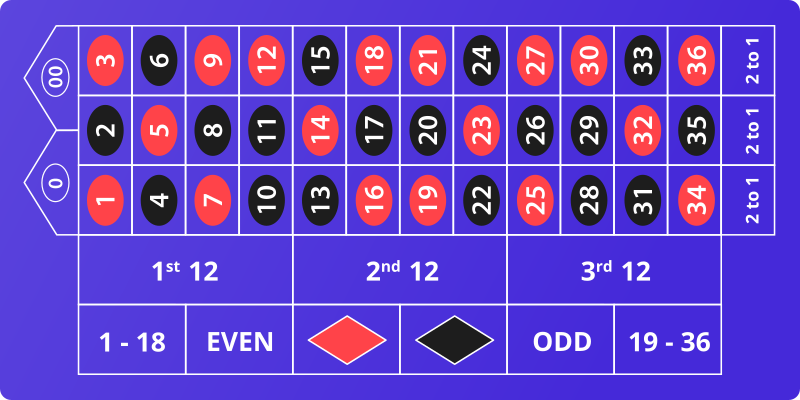
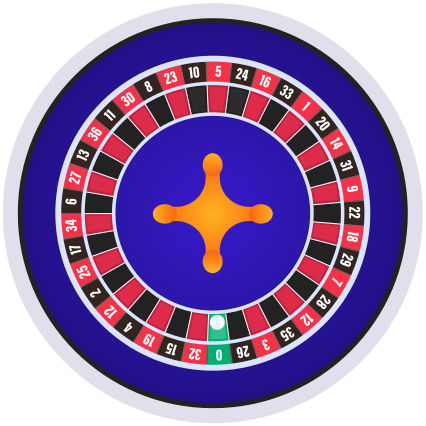
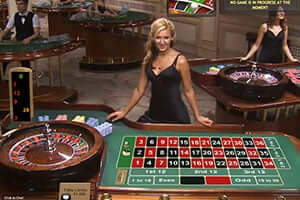
The casino roulette table consists of two main components: The spinning wheel, and the betting layout (the felt where you place chips). The numbers on the betting layout directly correspond to pockets on the wheel, though they are arranged differently for betting convenience.

The Number Grid (Inside Betting Area)

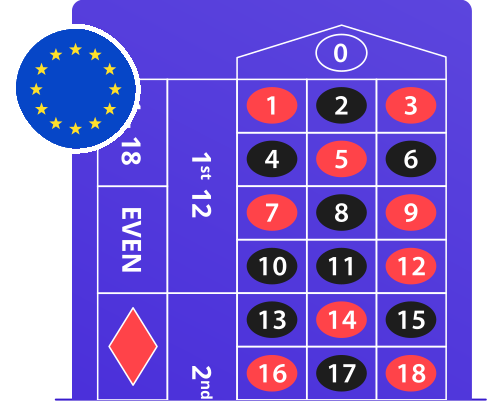
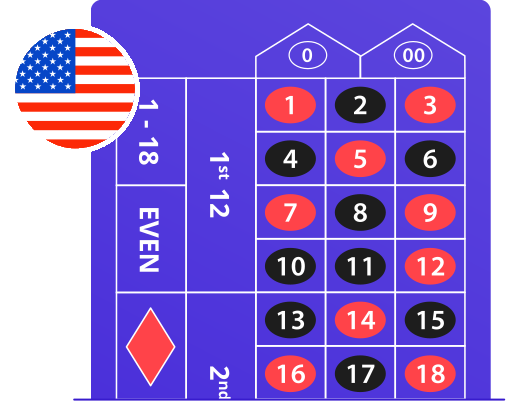
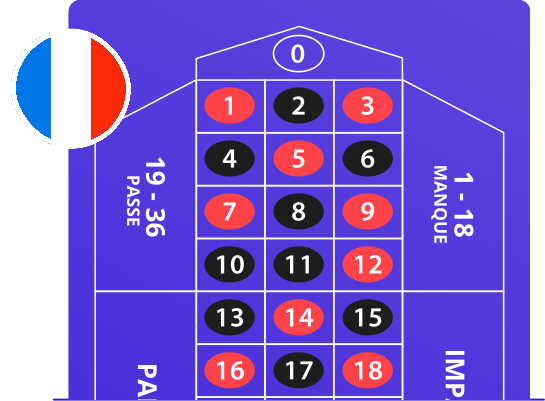
The main section displays numbers 1-36 in three columns of twelve numbers each, plus 0 (and 00 on American wheels) at the top. Numbers alternate between red and black, while 0 and 00 are green. This grid is where you place “inside bets” on specific numbers or small groups.

Outside Betting Zones

Surrounding the number grid are boxes for “outside bets” covering larger groups:

  • Red or Black boxes
  • Odd or Even boxes
  • 1-18 (Low) or 19-36 (High) boxes
  • Dozens boxes (1st 12, 2nd 12, and 3rd 12)
  • Column boxes (2 to 1) at the bottom of each column

Why 0 and 00 Matter

The green 0 (and 00 on American wheels) are how the casino makes its profit. These numbers aren’t red/black, odd/even, or included in dozens. When the ball lands on 0 or 00, most outside bets lose, giving the house its mathematical edge, along with paying wagers off at less than their true odds.

Image Credit: Arthurs perspective/Shutterstock

How to Play Roulette at the Casino

Here’s the complete process from approaching the table, to the next round:

Step 1: Buy Your Chips

Approach the roulette table during a lull between spins. Don’t interrupt mid-spin, or reach across active bets. Check the posted table minimum and maximum limits on the placard (e.g., $5 minimum, $500 maximum, and so on).

Place your cash on the felt (never hand it directly to the dealer), and NOT in any of the betting areas.

Be sure to say something like: “Chips, please,” in order to make certain that the dealers understand you are wanting to change your cash into casino chips, instead of making a “cash bet.” This can often confuse novice players, who can sometimes inadvertently make a “cash plays” wager, when all they wanted was to just change their cash into playing chips.

However, if there is any possible confusion in this process, in most modern casinos today the dealers will usually ask if you are wanting to change the cash into playing chips, or if you are, indeed, trying to make a “cash plays” wager.

Once the intent is made clear, the main dealer (known as the “Croupier”) will exchange your cash for special roulette chips, often color-coded to distinguish each player’s bets. You’ll specify the value per chip when buying in (e.g., $5 chips, $25 chips, and so on).

These color chips are only valid at that specific roulette table. When leaving, exchange them for regular casino chips that can be cashed out anywhere.

Step 2: Place Your Bets

After the dealer clears the previous round and announces “place your bets,” you can put chips on any betting area. Place chips neatly on your chosen spots. Multiple players can bet on the same numbers simultaneously.

You can make multiple bets each round, spreading chips across different numbers, colors, or betting zones. There’s no limit to how many different bets you can place, as long as each individual bet meets the table minimum, or, in some cases, the cumulative amount of your bets qualifies as the table minimum required wager.

Don’t reach across the table, or disturb other players’ chips. If you can’t reach a spot, ask the dealer to place your bet.

Step 3: Watch the Spin

The dealer spins the wheel in one direction and launches the ball in the opposite direction. As the ball begins to slow down, the dealer will announce “no more bets” and wave their hand over the table.

Once “no more bets” is called, you cannot add, remove, or change any bets. Attempting to bet late will be rejected by the dealer. This rule prevents players from betting after they can predict where the ball will land.

Step 4: Payouts and Reset

The ball settles into a numbered pocket and the dealer announces the winning number and color (e.g., “17 black”). The dealer then:

  • Places a marker (dolly) on the winning number;
  • Clears all losing bets from the table;
  • Pays winners in order (typically inside bets first, then outside bets);
  • Removes the marker, signaling the table is ready for new bets;

If you’re unsure whether you won, or what the payout should be, politely ask the dealer to confirm before the next spin begins.

Image Credit: Arthurs perspective/Shutterstock

Placing Bets in Roulette

Roulette offers two main categories of bets, each with different payout structures and win probabilities.

Inside Bets

Placed on specific numbers, or small groups of numbers, within the number grid. These offer higher payouts (up to 35:1) but win less frequently. More volatile, suitable for players chasing bigger wins.

Inside Bet Type What It Covers How to Place the Chip Payout Example
Straight Up Single number (including 0 or 00) Place chip directly on any number 35:1 $5 on 17 wins $175, plus your original $5 back, if 17 hits.
Split Two adjacent numbers Place chip on the line between two numbers 17:1 Place chips on the line between 14 and 17. Wins if either number hits.
Street Three numbers in a row Place chips on the outer edge of the row 11:1 Place chips on the edge of the 4–5–6 row. Covers all three numbers.
Corner (Square) Four numbers meeting at one corner Place chip at the intersection of the four numbers 8:1 Place chips where 10, 11, 13, and 14 meet. Covers all four numbers.
Six Line Six numbers (two adjacent rows) Place chip on the outer corner where the two rows meet 5:1 Place chips at the intersection of the 1–2–3 and 4–5–6 rows. Covers all six numbers.

Outside Bets

Placed on broader categories like red/black or odd/even. These offer lower blackjack payouts (1:1 or 2:1) but win more frequently. Less volatile, ideal for beginners or conservative players.

Outside Bet Type What It Covers Payout Notes
Red or Black All red numbers or all black numbers 1:1 (even money) Loses if 0 or 00 hits.
Odd or Even All odd numbers or all even numbers 1:1 Loses if 0 or 00 hits.
High or Low Low: 1–18  |  High: 19–36 1:1 Loses if 0 or 00 hits.
Dozens 1–12, 13–24, or 25–36 2:1 Choose one dozen.
Columns One of three vertical columns (12 numbers each) 2:1 Choose one column.

Advanced call bets (announced bets covering wheel sections) exist, but are beyond beginner scope. Focus on the above bets initially.

How Roulette Payouts Work

Roulette payouts are based on how many numbers your bet covers. The fewer numbers covered, the higher the payout. However, the presence of 0 (and 00 on American wheels) means true odds differ from payout odds, creating the house edge.

The House Edge

Even-money bets like red/black aren’t truly 50/50 because of the green 0 (and 00). On an American wheel with 38 pockets, betting red covers 18 pockets, but you’re paid as if there were only 36 pockets total. This difference is the house edge: 5.26% on American Roulette, 2.70% on the European wheel.

Types of Roulette Games You’ll See at a Casino

Understanding the differences between roulette variants helps you choose the best table:

American Roulette

Features 38 pockets: Numbers 1-36, plus 0 and 00. The double-zero (00) increases the house edge to 5.26%. This game is the most common in American casinos.

European Roulette

Features 37 pockets: Numbers 1-36, plus single 0. House edge is 2.70%. Better for players than American roulette due to one fewer green pocket.

French Roulette

Single-zero wheel (like European), but with special rules like “La Partage” or “En Prison” that can reduce house edge on even-money bets to 1.35%. Less common in American casinos but offers the best player odds when available.

Electronic vs. Live Dealer

Some casinos offer automated roulette machines where players bet via touchscreen. These play faster and have lower minimums, but lack the social atmosphere of live dealer tables.

Image Credit: Arthurs perspective/Shutterstock

Tips for Playing Roulette for Beginners

Here’s practical advice for your first casino roulette sessions:

  • Start with outside bets (red/black, odd/even) to learn table pace and chip handling
  • Set a budget and session time limit before playing and stick to them
  • Know the table minimum and maximum before buying in
  • Don’t chase losses by increasing bets after losing streaks
  • Keep chips organized and know your total investment
  • Ask the dealer to explain any bet type before placing it
  • Avoid complicated betting systems. They don’t overcome house edge
  • Choose European or French Roulette over American when available
  • Take breaks. Roulette is fast-paced, and continuous play can drain bankrolls quickly
  • Exchange color chips for regular casino chips before leaving the roulette table

What Is the Smartest Bet in Roulette?

“Smartest” in Roulette means lowest house edge combined with reasonable volatility, not guaranteed profit. No bet overcomes the house advantage long-term.

  • Choose European Roulette (2.70% house edge) or French Roulette (1.35% on even-money bets) over American Roulette (5.26% house edge)
  • Focus on outside bets (red/black, odd/even, high/low) for lower volatility and more frequent wins
  • Avoid the five-number bet (0-00-1-2-3) on American wheels, sometimes known as the “Basket Bet,” which has a 7.89% house edge
  • Straight-up bets offer exciting 35:1 payouts but carry high variance. You’ll lose frequently, but win big occasionally
  • Outside bets provide steadier, smaller wins, but the house edge remains constant regardless of bet type (except the five-number bet)

Frequently Asked Questions

Do you tip the Roulette dealer?


Tipping is customary, but not required. Common practice is to place a small bet for the dealer after significant wins, or periodically during your session.

Can you touch your bet after “no more bets”?

No. Once the dealer announces “no more bets” and waves their hand, you cannot add, remove, or change any bets until the next round.

What’s the minimum bet at Roulette?

Table minimums vary by casino and time of day, typically ranging from $5 to $25 for inside bets and sometimes higher for outside bets. Check the posted placard, or online play requirements.

Is European Roulette better than American Roulette?

Yes, for players. European Roulette has a 2.70% house edge versus 5.26% for American due to having only one zero instead of two.

Can you bet on multiple things at once?

Yes. You can place as many different bets as you want each round, spreading chips across numbers, colors, dozens, or any combination.

Get Ready to Spin the Wheel

You now understand how to play casino roulette, Buy your chips, place bets on the layout, watch the spin, and collect winnings. Start with outside bets while learning the table pace, verify table rules before playing, and choose European or French Roulette when available for better odds.

Remember that roulette is entertainment with a built-in house edge. Set your budget, understand the bets, and play responsibly. Whether you’re betting red or black, dozen bets, or lucky numbers, knowing how the game works makes the experience more enjoyable.

And now you know!

Title Image Credit: Arthurs perspective/Shutterstock