 Main menu

Research
Survey: Struggling Americans Turning to Sports Betting as Financial Lifeline
Posted on: September 18, 2026, 09:38h.
Last updated on: September 21, 2026, 04:56h.


Key Points
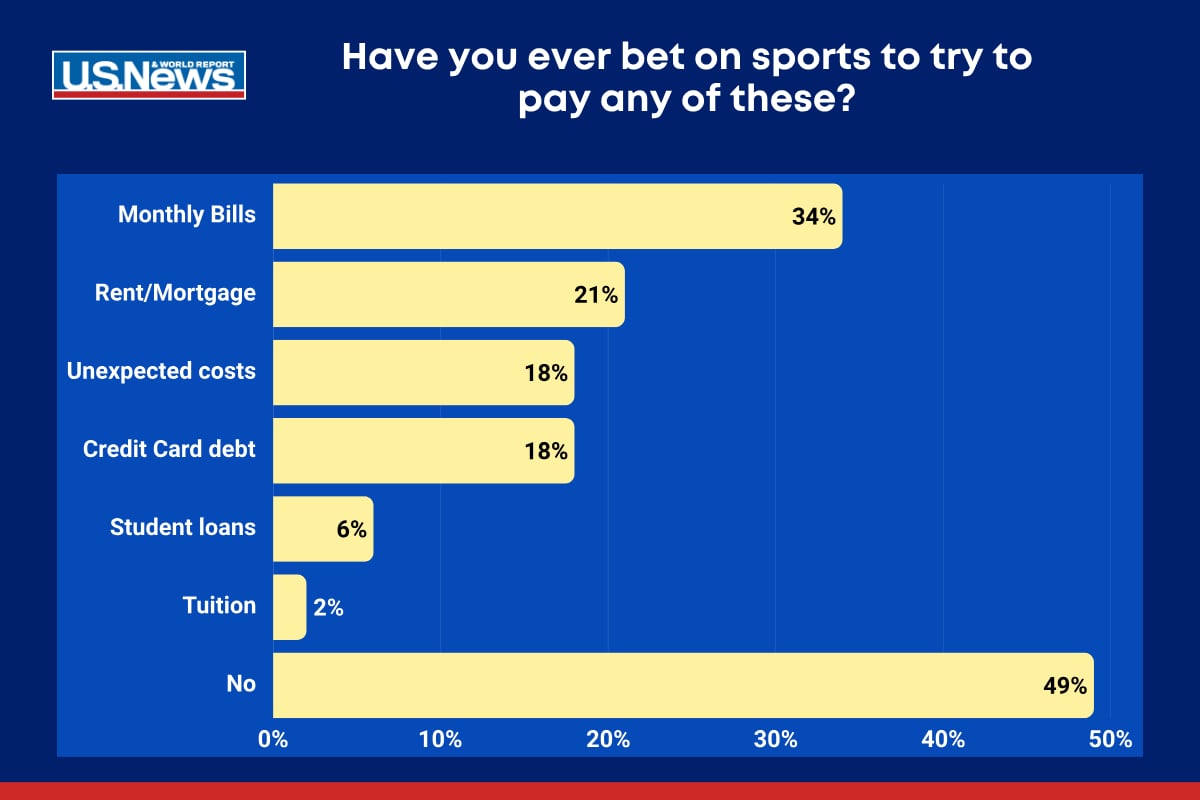
- More than half of sports bettors surveyed by U.S. News said they bet to help pay bills, with 21% wagering to cover rent or mortgages
- Nearly half (45%) said they had borrowed money to place sports bets, while 19% reported outstanding betting debts
- Stanford researchers found that bettors expect to break even despite losing an average of 7.5 cents per dollar wagered


Sports betting is billed by the gaming industry as a form of entertainment, but for a growing proportion of the betting public, covering the spread is key to covering the rent.

A new survey from U.S. News is sounding the alarm over Americans increasingly turning to high-risk endeavors, including sports betting, to help make ends meet and pay their monthly household bills.
U.S. News surveyed 1,200 Americans who placed a sports wager within the last 12 months. The media organization found that more than half of respondents (51%) placed a sports bet to help pay household bills, while 21% wagered specifically to cover their rent or mortgage payment.
Almost six in 10 (57%) of the sports betting demographic said they bet weekly, with 17% betting on a daily basis. Nearly one in five (19%) said they have outstanding sports betting debts.
Frequent bettors are significantly more likely to report that their betting habits are impacting other corners of their financial lives. Of those who bet daily on sports, 40% say they have debts that they attribute to wagers they made,” the report said.
“Nearly half of all respondents (45%) say they’ve borrowed money to place sports bets, with 13% taking out a personal loan to bankroll their betting and 11% securing funds through a high-interest payday loan,” the report continued.
Bettors’ Dismissal of Financial Impact
Many sports bettors are unfazed by the high-stakes financial reality of gambling on sports.
U.S. News reported that only 17% conceded sports betting is negatively affecting their financial health. By contrast, twice as many respondents (34%) claimed gambling on professional and college sports has had a positive impact on their finances. About half (49%) reported that sports betting has not impacted their bank accounts either way.
Some respondents, however, shared severe personal consequences.
I have lost money that was going to be used for my kids’ Christmas presents,” said one respondent. “It led to stress with my wife after having to borrow from her parents to make up that money.”
“I have lost money that was going to be used for my kids’ Christmas presents,” one respondent disclosed. “It led to stress with my wife after having to borrow from her parents to make up that money.”
Another bettor noted that gambling debts fractured personal relationships: “Sports betting ruined my six years of friendship because I couldn’t pay back the borrowed loan from my friend. He stopped talking to me.”
Americans wagered nearly $167 billion on sports in 2025 through regulated sportsbooks, an 11% increase year-over-year, according to data from the American Gaming Association (AGA).
The blurring line between financial investing and gambling has been accelerated by the rise of prediction markets—exchanges offering event contracts that are federally regulated as financial derivatives. U.S. News found that over 40% of active sports bettors now also participate in sports prediction markets.
Financial advisors continue to urge consumers to view sports wagering strictly as entertainment and to only risk funds they can afford to lose.
Bettors Overly Optimistic
Research from Stanford University published in April concluded that sports bettors remain “overoptimistic,” generally expecting to break even despite losing an average of 7.5 cents on every dollar wagered.
“Overoptimism is largest among bettors who partake in a complex type of bet known as a parlay,” the Stanford researchers wrote. “Compared to other forms of betting, parlays are more likely to be driven by bias.”

 Most Read

Another Shooting Near Las Vegas Strip Casino Injures Man
 972,491 views

Vintners Oppose Napa Valley Casino
556,118 views


Conversation (2 comments)