 Main menu

Canadian Gaming
Quebec iGaming Competition Hampered by Gambling Ad Debate
Posted on: May 29, 2026, 08:25h.
Last updated on: May 29, 2026, 09:08h.


- Canada’s ongoing debate over the sheer volume of gambling ads is stifling momentum for Quebec to adopt an Ontario-style open iGaming market
- A recent industry study highlights the stakes, revealing that Quebec is losing out on $2.3 billion in Gross Gaming Revenue (GGR) to unregulated, offshore platforms
- Despite provincial hesitation, the Quebec Online Gaming Coalition notes that opposition political parties are beginning to look more seriously at ending the current government monopoly
The relentless wave of iGaming commercials across Canada has become the single biggest roadblock to opening Quebec’s online gambling market. According to the Quebec Online Gaming Coalition, the fierce national debate over advertising volume is actively stalling the province’s transition toward a competitive, Ontario-style model.
National Advertising Bill
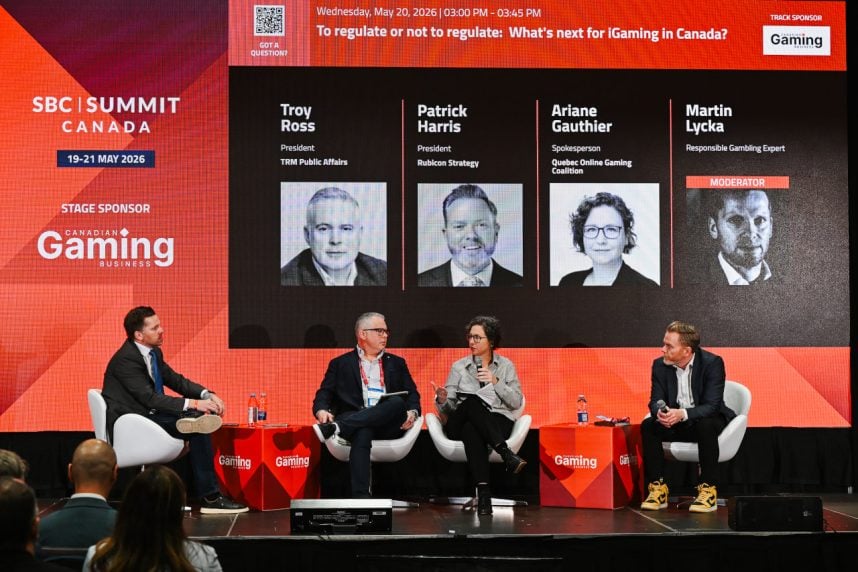
The debate about whether gambling advertising has become too widespread, especially during television sports broadcasts, was a hot topic of discussion at last week’s SBC Canada Summit in Toronto.
Critics say gambling ads are everywhere and can be connected to problem gambling and public health concerns.
Meanwhile, iGaming operators, broadcasters, other associated gaming companies and industry stakeholders have pushed back strongly against calls for outright bans.
Federal Bill S-211, the National Framework on Sports Betting Advertising Act, is currently making its way through Parliament and if passed into law would create national standards around gambling ads.
Concern Over iGaming Ad Volume
This evolving landscape is being closely monitored by Ariane Gauthier, spokesperson for the Quebec Online Gaming Coalition—an industry group representing major operators including DraftKings, Flutter, Entain, Betway, Bet99, Rush Street, and Apricot.
As the Coalition continues to lobby both the provincial government and opposition parties to adopt an Ontario-style regulated model, Gauthier notes that one massive hurdle consistently dominates the conversation.
“The big concern from almost everybody I have discussions with is promotion and advertising,” Gauthier said, adding that decision-makers routinely cite the public backlash over ad volume as the primary reason for keeping Quebec’s market closed.
However, the amount of advertising in Ontario reflects Ontario’s choices,” she said. “We can regulate private igaming offerings in Quebec with different rules, maybe stricter rules. You don’t have to cut and paste a model.”
Another reason to keep the status quo, that Gauthier said she is finding, is a desire to protect Quebec culture, in part through the government-run Loto-Québec monopoly, that would come under attack from big U.S. operators like DraftKings and FanDuel if the market opened.
That’s why, Gauthier added, that Loto-Québec will still have an important role to play in a new regulatory regime that promotes competition.
Competitive Markets in Alberta and Ontario
There was a lot of discussion at the summit about whether Quebec would be the next Canadian province to follow Ontario and Alberta (with its open and regulated market going live on July 13).
Gauthier addressed these challenges during a summit panel alongside Patrick Harris, President of Rubicon Strategy, and Troy Ross, President of TRM Public Affairs. The discussion focused on which provinces are best positioned to follow Ontario and Alberta’s lead by replacing government monopolies with competitive, regulated iGaming markets.
Moving from one to two (provinces) is significant in terms of progress,” said Ross. “But even more significant, if you take the populations of Alberta and Ontario, you have about 21 million, which is half the population of Canada. Once you’ve reached that halfway point, that’s an inflection point for regulation across the country.”
Respecting the Social License
According to Harris, the open iGaming markets in Ontario and Alberta only materialized due to pure political will from newly elected premiers willing to act as disruptors.
“I think every province in the country is looking at it,” Harris explained. “There are two things that make politicians do things: public opinion and money. There is much more money to be made by regulation [and] the public was supportive of it. The key question for the industry moving forward is how they’re acting in Ontario and Alberta—how they’re using that social license. That is going to dictate whether it’s going to be able to be run through the rest of Canada.”
However, expanding that model to Quebec faces a steep political roadblock. Speaking with Casino.org following the panel, Gauthier noted that Quebec’s ruling party, the Coalition Avenir Québec (CAQ), remains staunchly opposed to opening the market to private competitors who would challenge the province’s government-run monopoly, Loto-Québec.
Loto Quebec Monopoly
Gauthier referenced a statement made by Jean-Francois Bergeron, CEO of Loto-Québec, to cabinet, just before the summit started last week, that the igaming market in the province grew by 20% last year.
However, according to Gauthier, that means the provincial government is losing more revenue every year, and that Quebec is losing control of the online gaming industry.
“Maybe Loto-Québec is doing good job to provide a safe environment to players, but it provides it only at best to half of its players,” said Gauthier. “What happens to the other half?”
$2.3 Billion in GGR Lost to Unregulated iGaming
Gauthier wouldn’t set a timeline on when the Quebec market could potentially open, “but there’s definitely reflection going on.
“A lot of work is being done quietly, and we’re progressing,” she added.
According to research released by TRM Public Affairs, just 27% of the total available market in Quebec is being channeled to Loto-Québec, with 73% going to the unregulated market, meaning CAD $2.3 billion in GGR lost to unregulated igaming, and CAD $563.3 million in lost government revenue (assuming an 80% operators/20% government split).
Shifting Sands
However, a shifting political landscape could soon rewrite the rules. With a provincial election looming in October, polling projections from 338Canada.com show a fierce three-party race: the Parti Québécois leads the pack at 30%, followed closely by the Liberals at 28%, leaving the ruling CAQ trailing in third at 20%.
Seizing on this potential change in leadership, Gauthier noted that the Quebec Online Gaming Coalition has already initiated talks with both the PQ and the Liberals. While both parties have pressed the Coalition with “tough questions,” she emphasized that they have also signaled a distinct openness to reforming the province’s current model and introducing a regulated, competitive online market.
“They show they understand the global dynamic of this market,” Gauthier said. “Quebec is interested in other models. [The province] is looking at what Ontario is doing, what Alberta is doing, and also looking at European models.”

 Most Read

Another Shooting Near Las Vegas Strip Casino Injures Man
 972,743 views

Vintners Oppose Napa Valley Casino
556,348 views


Conversation (0)
Be the first to comment on this article.