 Main menu

Poker
Commerce, Bell Gardens Consider Tax Hike to Offset California Blackjack Ban
Posted on: March 30, 2026, 07:49h.
Last updated on: March 31, 2026, 09:51h.


- California cardroom rules threaten major revenue for local city budgets
- Commerce and Bell Gardens rely heavily on casino tax income
- Officials propose sales tax hike to offset potential financial losses
Two California cities are asking voters to approve a sales tax hike after declaring a “fiscal emergency” related to new state rules targeting cardrooms.
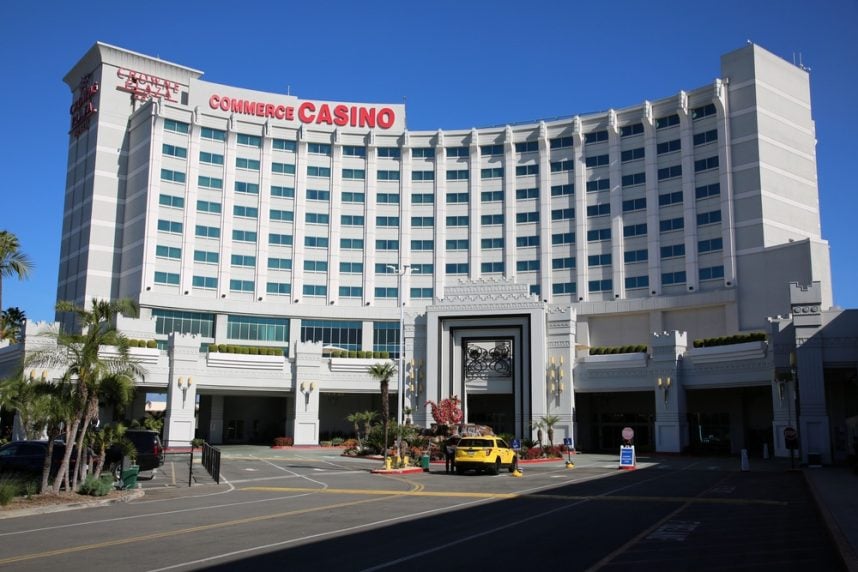
Officials from both cities say they will ask voters to approve a quarter-cent (0.25 percentage point) increase in sales tax to help offset expected revenue losses.
Commerce and Bell Gardens rely heavily on their cardrooms, the Commerce Casino and the Bicycle Casino, for revenue that helps fund police and fire services, road upkeep, and other general municipal expenses.
Both operations are huge – Commerce is widely regarded as the biggest poker room in the nation, and the “Bike” is pedaling not far behind.
But new regulations advanced by California Attorney General Rob Bonta’s office and set to come into effect on April 1 would effectively ban so-called “California Games.”
What are California Games?
These are versions of table games like blackjack and Pai Gow Poker that have been modified by cardrooms to skirt the ban on house-banked games outside of tribal land.
“They generate over $17 million in cardroom taxes annually for our city, which is more than 40% of our entire general fund,” Bell Gardens City Manager, Michael O’Kelly, explained, as reported by ABC7.
“That revenue supports the services that our residents depend on every single day. This is police, parks and recreation, senior and youth programs, crossing guards and our community family services,” O’Kelly added.
Cardrooms across the state argue these games avoid restrictions on house-banked play by charging a fixed rake on each hand while letting the role of the “bank” rotate among players, similar to a standard poker cash game.
In theory, this means the financial risk is taken on by the players acting as the dealer, rather than by the house.
Tribal Opposition
Tribes have long argued that the current rules only require the dealer position to be made available – not that it must actually rotate. In practice, this could allow a single player to act as the banker indefinitely if no one else chooses to take the role.
Because most patrons have little interest in banking the game, cardrooms often depend on state-licensed third-party providers, known as Third-Party Proposition Player Services (TPPPs), to occupy the dealer position.
Tribes argue that when rotation isn’t meaningfully enforced, these companies effectively operate as a de facto bank.
Don’t Call it Blackjack
The new regulations effectively prohibit cardrooms from offering blackjack and similar player-dealer games in their current form. Beginning in April, they will no longer be allowed to market any game using the number “21” or the term “blackjack.”
Players won’t be able to “bust” under the new rules; instead, outcomes will be determined by comparing hands with the player-dealer. An ace paired with a ten-value card will also no longer count as an automatic win.
The player-dealer must be an actively seated participant, with the role offered at the start of every hand and rotated to at least two other players within a 40-minute window, or the game must stop.
The rules will also limit the ability of TPPPs to occupy the dealer position for extended periods. While TPPPs are not banned outright, their role will be restricted significantly, reducing their ability to serve as a continuous stand-in banker.
A Gamechanger?
Cardrooms say these changes will cut into profitability by slowing the pace of play, creating interruptions when dealer rotations fail, and removing blackjack-style features that typically increase game volume and player losses.
Bonta’s DOJ estimated the blackjack rules alone would cost cardrooms about $68 million in revenue and 53 jobs per year, while the full combined regulatory package could mean roughly 364 fewer jobs annually compared with baseline.

 Most Read

Another Shooting Near Las Vegas Strip Casino Injures Man
 972,617 views

Vintners Oppose Napa Valley Casino
556,228 views


Conversation (2 comments)