 Main menu

Financial
Casinos Driving Improving Indian Country Economies, Says Census Bureau
Posted on: November 20, 2025, 11:57h.
Last updated on: November 20, 2025, 02:26h.


- Poverty level tumbled following 1990s tribal casino expansion
- Tribal casinos increase employment, wages for people of all races, says study
Congress passed the Indian Gaming Regulatory Act (IGRA) in 1988, paving the way for massive casino expansion on tribal lands in the 1990s that had a profound economic impact.

A new study by the Census Bureau and researchers at Johns Hopkins University and the University of California Los Angeles (UCLA) indicates that in 1989, 31% of people living on tribal lands lived below the poverty line. With economic contributions from tribal casinos, that percentage fell to 19.6% last year, though that’s still above the national average of 12.1%.
The research shows that tribal casino operations boost wages for American Indians and reduce unemployment for nearby people of all races employed in casino-related industries (Accommodation, Food Service and Arts and Entertainment) when compared with non-casino reservation ZIP codes in the same state,” according to the Census Bureau.
Indeed, the expansion of tribal gaming in the US has occurred at a breathtaking pace. In 1989, there were no such venues in this country. Today, the number is close to 600.
Tribal Casinos are Big Business … Literally
Gaming venues located in Indian Country are big in both size and economic impact. Regarding the former, nine of the 10 largest domestic gaming venues are tribal casinos.
Tribal casinos are also prolific revenue generators, having notched more than $40 billion in annual sales over the past several years. That success is material because the IGRA requires tribes to distribute portions of their profits for economic development and welfare on their respective reservations.
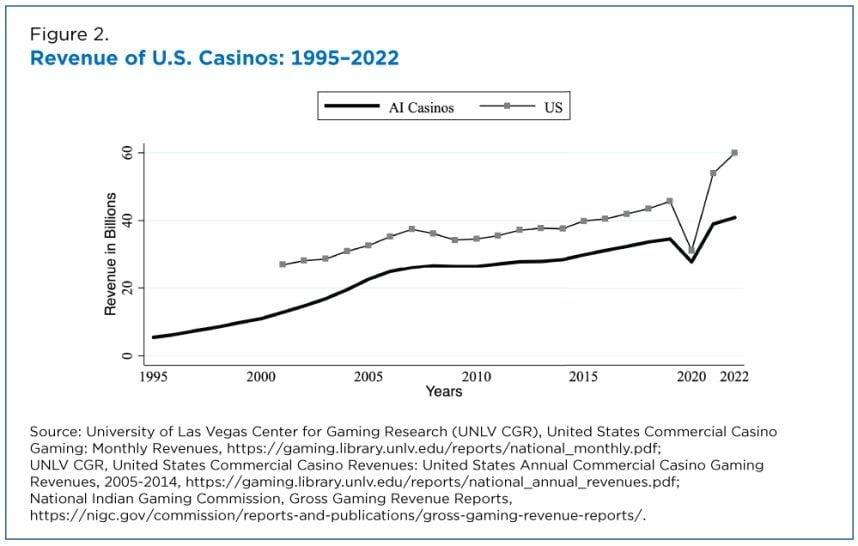
“It also indicates that direct cash transfer programs (i.e., per capita payments of casino profits) may have contributed to improved living standards, on average, for tribal citizens living on reservations,” adds the Census Bureau. “This means the IGRA, by permitting casino operations, can be viewed as a ‘place-based’ policy that targets specific geographies for economic development.”
Tribes’ revenue-generating capabilities at gaming venues located on their sovereign land also paved the way for them to branch out into commercial gaming. Today, gaming entities controlled by tribal nations run dozens of commercial casinos across the US, including in Las Vegas. In May 2021, Red Rock Resorts sold Palms to California’s San Manuel Band of Mission Indians, and the Strip property formerly known as the Mirage will be run by Hard Rock International when it reopens.
Casino Ownership Lifting Some Tribes
The Census Bureau study also confirms casinos stoked a surge in real per capita income on reservation lands while diversifying tribes’ economic bases and allowing for unconditional cash transfers, which some experts compare to universal basic income.
Citizens of casino-owning tribal nations received a significant cash infusion when their government adopted cash-transfer policies. Provided that the tribal nation has opted for unconditional cash transfers, all tribal citizens are eligible to receive the transfers, regardless of whether they live on a reservation,” adds the Bureau.
The study also points out that tribal casinos contributed to an 11% drop in childhood poverty on reservations and increased labor market participation among Native American women, along with a 4% drop in overall joblessness.

 Most Read

Another Shooting Near Las Vegas Strip Casino Injures Man
 972,698 views

Vintners Oppose Napa Valley Casino
556,303 views


Conversation (0)
Be the first to comment on this article.