 Main menu

Vegas Myths Busted
VEGAS MYTHS BUSTED: Las Vegas is the Suicide Capital Of The U.S.
Posted on: June 15, 2026, 07:21h.
Last updated on: June 16, 2026, 07:34h.


For decades, a grim piece of folklore has clung to Las Vegas’ neon façade — the idea that Clark County is the suicide capital of the U.S. The story practically writes itself: despondent gamblers, shattered bankrolls, and impulsive behavior collide in a pressure cooker of despair.
But the claim collapses when you look at actual data. Clark County has never had America’s highest suicide rate. It has never even had Nevada’s.

Myth Understanding
This myth is born of a fundamental misunderstanding of public health data, a unique demographic phenomenon known as “suicide tourism,” and the bizarre ways 40 million annual visitors blow up traditional statistical modeling.
The confusion starts with the difference between raw totals and per‑capita rates. Clark County has 2.3 million residents. Big population = big numbers. So yes, the county logs 350–400 suicides a year. To anyone skimming an annual report, that looks like a crisis.
But epidemiologists don’t rank communities by totals. They use age‑adjusted rates per 100,000 residents — the only fair way to compare a metro area to a rural county with 7,000 people.
By that metric, Clark County usually registers 16–17 suicides per 100,000 residents. While this is tragic and sits stubbornly above the national average of around 14, it is nowhere near the top tier of American communities.
Where is the Suicide Capital?
To find the true peak of America’s suicide crisis, you need to look to its rural counties — places that share the vulnerabilities of extreme geographic isolation, lack of mental-health resources, economic stagnation, and high firearm availability.
Because the Center For Disease Control (CDC) suppresses county data when annual deaths fall below 10 (to protect privacy), no given county can be definitively crowned the suicide capital for any given year.
However, multi-year CDC data reveal the highest sustained rate in the U.S. belongs to Alaska’s Northwest Arctic Borough. It averages an astonishing 68-72.5 deaths per 100,000 residents — five times the national average. Because its population is only 7,500, however, that massive rate translates to roughly 5-8 suicides per year.
In the lower 48, the highest rates consistently appear in:
- San Juan County, New Mexico
- Meagher County, Montana
- Nye County, Nevada (yes, Vegas’ backyard neighbor)
These counties regularly record annual suicide rates of 35-60 per 100,000 residents. On the County Health Rankings Interactive Mortality Map below, every single dark green area represents a county with an age-adjusted rate higher (31-124 per 100,000 residents) than Clark County’s:
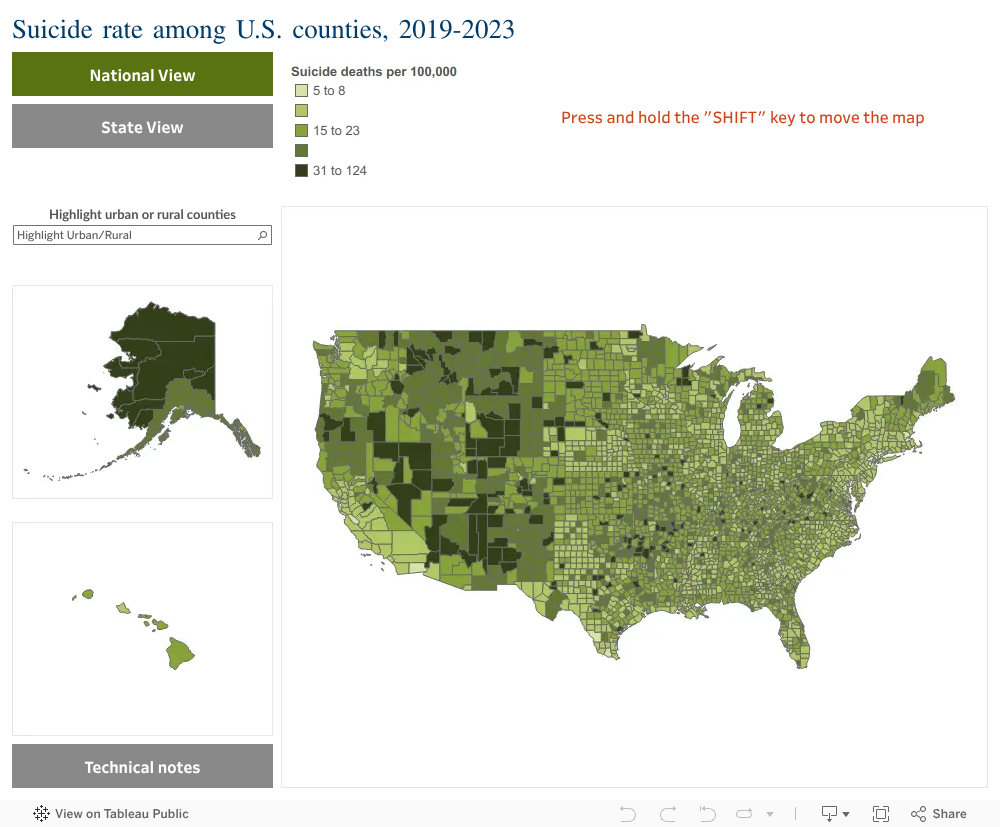
But it can be argued, comparing a big city to a small town is apples and oranges. What happens when you stack Clark County against only other counties with over 1 million residents?
Even then, both Utah’s Salt Lake County (19-20.9 per 100,000) and Arizona’s Maricopa County (17.5-17.7 per 100,000) routinely exceed Clark County’s suicide rate, as was the case from 2023-25. Yes, Salt Lake City — a region defined by strict vice laws and religious roots — has a higher resident suicide rate than Sin City.
Suicide Tourism
Where the Las Vegas story gets uniquely distorted is the roughly 40 million tourists who flood the region annually. Among these millions, 30-50 die by suicide in Strip hotel rooms each year, according to public Clark County Coroner data.
A landmark 2008 study published in Social Science & Medicine by researchers from Harvard, Temple, and UC Riverside found that a visitor’s suicide risk doubles just by stepping foot in Las Vegas.
Rather than a rash reaction to a ruinous craps roll, however, researchers found a distinct “destination effect” — people already in deep crisis elsewhere choose Vegas as the place to end their pain.
The strict rules of the National Vital Statistics System require the CDC to route all deaths back to the decedent’s legal place of residence for public health rankings, not the place where their death occurs.
But even if these 30-50 poor souls were included in the annual resident data, Clark County’s suicide rate would only increase 1.5 points, to 17.5-18.5 per 100,000 — still below Salt Lake and most rural U.S. counties.
However, not counting these deaths toward Clark County’s resident suicide rate fuels the idea of a suicide coverup. Because the victims of suicides on the Strip are transported out back-end elevators instead of hotel lobbies, could Las Vegas’ true suicide rate be vastly underreported to protect the Strip’s tourism industry?
Stay tuned to a future “Vegas Myths Busted” column for the answer.
Look for “Vegas Myths Busted” every Monday on Casino.org. Visit VegasMythsBusted.com to read previously busted Vegas myths. Got a suggestion for a Vegas myth that needs busting? Email corey@casino.org.

 Most Read

Another Shooting Near Las Vegas Strip Casino Injures Man
 972,743 views

Vintners Oppose Napa Valley Casino
556,347 views


Conversation (0)
Be the first to comment on this article.