 Main menu

Vegas Myths Busted
VEGAS MYTHS BUSTED: Casino Betting Systems Work
Posted on: September 28, 2026, 07:21h.
Last updated on: September 28, 2026, 07:46h.


Nothing destroys a casino bankroll quite like a betting system. Especially a “foolproof” one. The Martingale is the clearest example of this folly. Its logic states that you can’t lose by wagering on even-money outcomes—like red or black on a roulette wheel—if you double your bet every time you lose.

According to the Martingale system, probability dictates that you will eventually win, and that when you do, you will recover all previous losses plus a profit equal to your original stake. It reads like a guaranteed blueprint for staying above water.
Mathematics experts, however, have been debunking it for decades.
Originating in 18th-century France, the system likely got its name from the Provençal phrase jouga a la martegalo (“to play in the manner of Martigues”), which mocked the reckless play attributed to the naive residents of the coastal town of Martigues.
Mathematician Jean Ville used the gamblers’ term in his 1939 treatise to help formalize why no such system could beat a fair game over time.
No Spin Zone
The roulette wheel does not owe you a win just because you have been mugged by it. You are never due. You are never next.
The fundamental reason that the Martingale system and its subtle variations fail is that no amount of information about past results can predict future outcomes with accuracy better than chance. Win-loss outcomes are all independent and identically distributed random variables.
Just as importantly, casinos almost never offer a true coin flip. So-called “even-money” roulette always offers you less than 50% odds of winning. That’s because wheels all come either with one, two, or (with increasing frequency) three green zeroes representing a win only for the house. (These zeroes make your odds of winning a bet on either red or black 48.65% with a single zero, 47.37% with a double, and 46.15% with a triple.)
Because individual roulette bets always carry a negative expected value, summing them up over a very large series of wagers almost always yields a negative total (though anything is possible).
The house advantage on a standard American or European wheel does not magically disappear because a bet is doubled. Instead, that edge steadily grinds down your total assets over time.
Math Holes
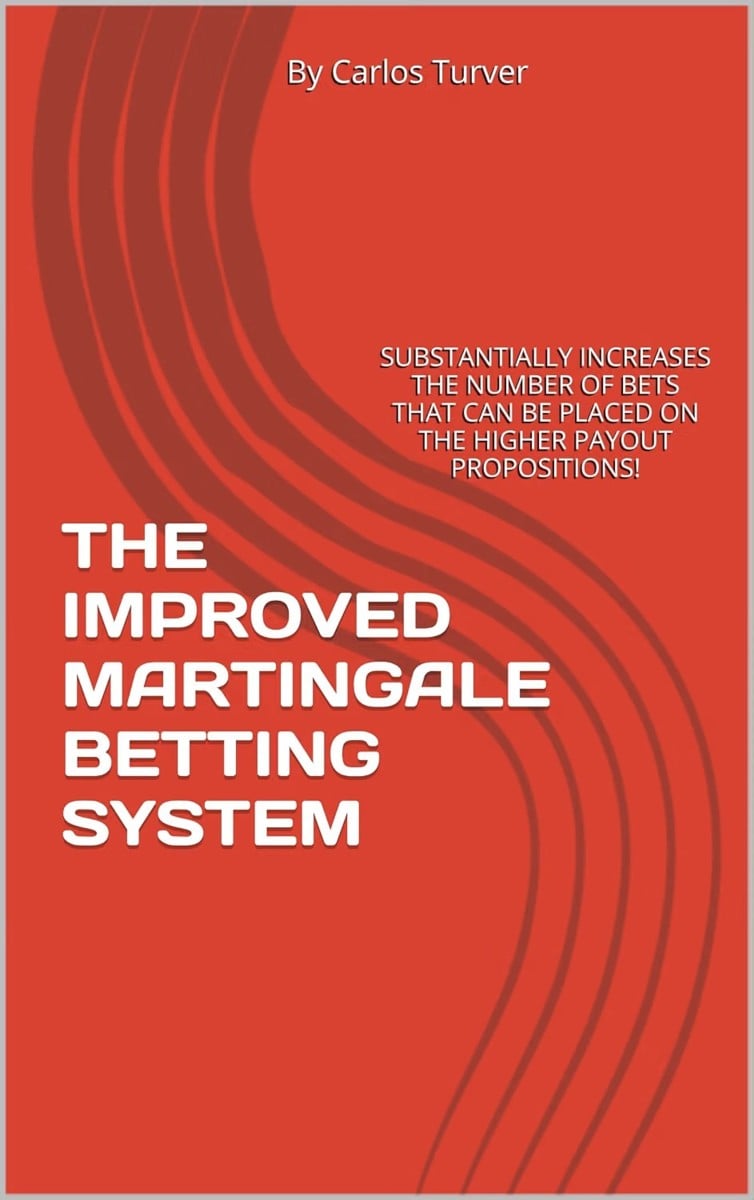
While many gamblers want to believe that a catastrophic losing streak is rare—because even short ones seem rare—probability proves the opposite.
In reality, while a streak of six losses in a row has a relatively low 1.8% probability on a single-zero wheel—assuming you can even find one on the Strip—the chances of encountering that same six-loss streak at some point during a string of 200 plays is about 84%. Even a 10-loss streak carries about an 11% chance of occurring in 200 plays, at which point you’ll need to pony up $10,240 just to try to recoup a single $10 bill.
Most of the time, the Martingale system will eventually prove impossible to play to completion even if the player has the cash. That’s because doubling an amount increases it much faster than most players realize. (It only takes 17 doublings of a $10 base bet to push a single wager to $1,310,720.)
But table bets have maximums. They vary by pit, game, and time of day but are commonly $1,000 to $2,500 on outside bets at standard Strip tables and $5,000 to $10,000 in high-limit rooms.
The house doesn’t ban this betting system. It just installs a ceiling so the doubling has to stop “just one spin” before the fairy tale ends.
Wink, Martingale
Unlike with card-counting and other forms of advantage play—complex skills that effectively lower the house edge—you will never be walked out of a casino, banned, or roughed up for employing the Martingale system.
In fact, casinos actively encourage Martingale believers because the strategy forces high-risk exposure for minimal reward. Players employing this method will routinely risk thousands of dollars across multiple hands or spins just to secure a tiny, single-unit profit.
The Martingale system—like its less-aggressive cousin, the Fibonacci system and all other betting strategies—does not conquer the house edge. It merely accelerates the speed at which the house takes all.
Look for “Vegas Myths Busted” every Monday on Casino.org. Visit VegasMythsBusted.com to read previously busted Vegas myths. Got a suggestion for a Vegas myth that needs busting? Email corey@casino.org.

 Most Read

Another Shooting Near Las Vegas Strip Casino Injures Man
 972,662 views

Vintners Oppose Napa Valley Casino
556,270 views


Conversation (0)
Be the first to comment on this article.