
National Catfish Day: Cities You’re Most Likely to Get Catfished in America

Summarize this post
Online dating was supposed to make finding love easier. But for millions of Americans, it’s become a minefield of red flags: fake photos, false identities, emotional manipulation, and financial scams.
In honor of National Catfish Day (June 25), we surveyed Americans across major U.S. cities created the Catfish Index to find out where people are getting hooked by fake online personas the most – and where residents admit to doing the catfishing themselves.
Key Findings:
- Seattle, WA ranks as the most “catfished” city in the US, while Nashville, TN ranks as the least catfished city
- Indianapolis, IN ranks as America’s biggest catfisher city, while San Diego and Sacramento, CA residents are the least likely to catfish others
- Nearly 3 in 4 Americans (73%) say they’ve suspected a romantic interest of being a catfish
- Tinder (43%) and social media platforms like Instagram and Snapchat (40%) are reported as the most catfished apps
- Americans who were catfished reported sending an average of $9,254 to someone they later discovered was fake
America’s most catfished cities ranked
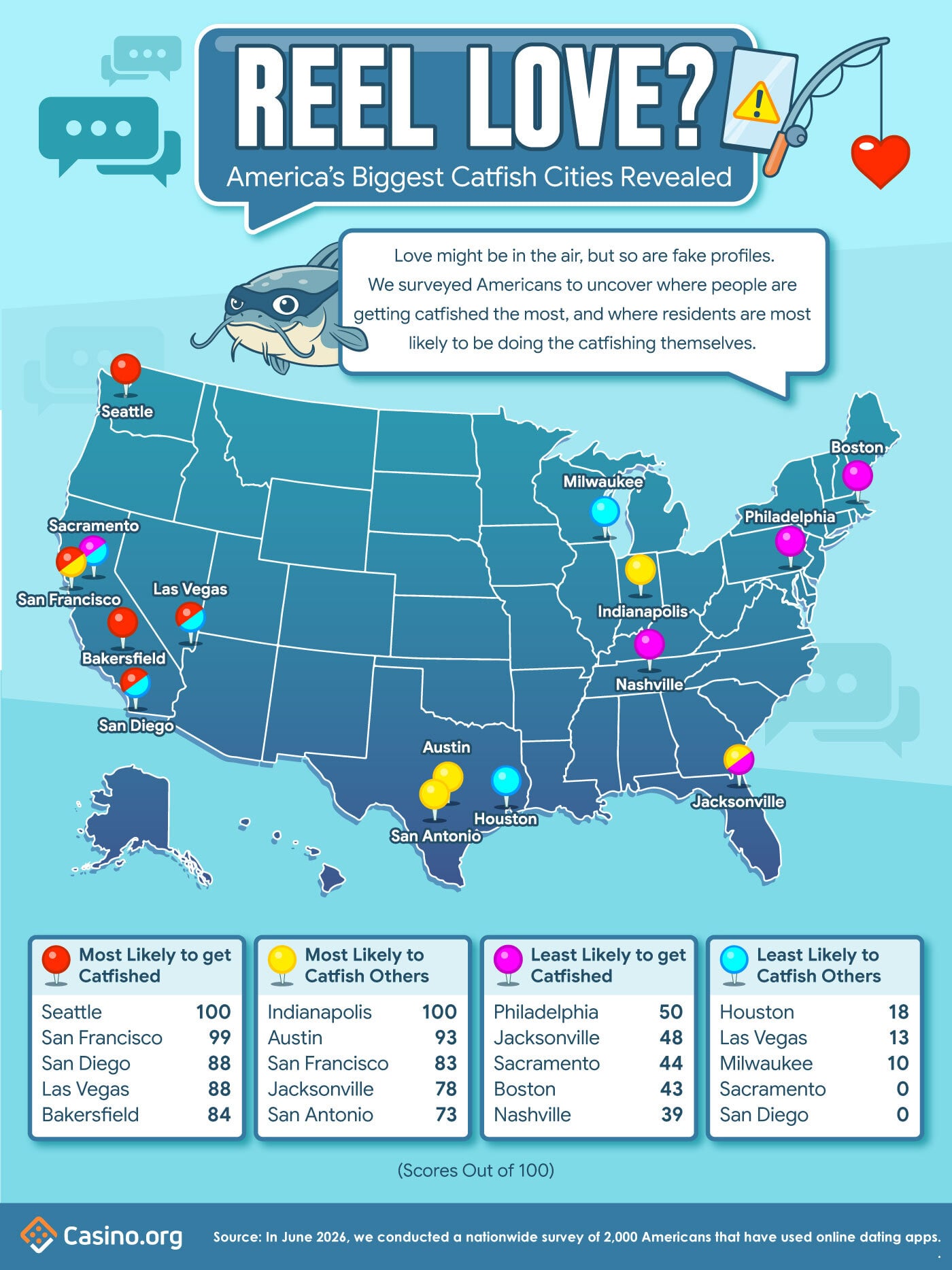
#1 – Seattle, Washington (100/100)
Seattle hooked the top stop as America’s most catfished city, with an index score of 100/100. Nearly 94% of Seattle locals said they’ve been catfished online. Of those who have been catfished, 60% said it happened 2-3 times, while 33% experienced it once and 7% said they’ve been catfished 5+ times.
The most common lies Seattle catfishers used? Fake photos ranked #1, followed by lying about age, relationship status, and location. Others pretended to be a different gender, used AI-generated photos, or exaggerated their wealth and lifestyle. Fortunately, only about 33% said they ended up sending money to their catfish.
#2 – San Francisco, California (92/100)
Welcome to Silicon Catfish Valley! Ranking 2nd nationwide, about 71% of San Francisco locals said they’ve been catfished online. Unlike Seattle, most San Franciscans said it only happened once (60%), though 20% experienced it 2–3 times and another 20% reported 4–5 separate catfishing encounters.
But here’s where things get expensive: 80% said they sent money to someone who turned out to be fake, with locals reporting an average loss of $1,500.
The most common tricks? Fake photos and pretending to be wealthier or more successful than reality. Between “startup founders,” luxury lifestyles, and perfectly curated dating profiles, San Francisco’s dating scene seems to blur the line between personal branding and complete fiction.
#3 – San Diego, California (88/100)
San Diego may be known for sunshine and beach selfies, but apparently not every dating profile is as real as the ocean view. Ranking 3rd nationwide, nearly 98% of locals said they’ve encountered catfishing online.
What makes San Diego stand out is just how extra the deception gets. Instead of just one small lie, locals reported running into fake photos, fake ages, fake locations, fake genders, AI-generated images, and exaggerated lifestyles all at once. About 1 in 9 locals said they’ve been catfished more than five times.
Luckily, San Diegans seem pretty good at spotting suspicious behavior quickly: 44% realized something was off within the first week, while 22% caught on instantly and another 22% figured it out within the same day. Only 11% said it took about a month to realize they were talking to someone fake. Even better? Just 22% said they actually sent money to their catfish.
#3 – Las Vegas, Nevada (88/100)
What happens in Vegas…apparently includes fake dating profiles. Tied with San Diego for the 3rd-highest Catfish Index score, about 85% of Las Vegas locals said they’ve been catfished online. Of those, 55% said it happened once, while 45% said they’d been reeled in 2–3 times.
Las Vegas also ranked high for over-the-top online personas. About 82% said their catfish used fake photos, 73% encountered lies about age, 46% dealt with people pretending to be wealthier than they actually were, and 27% encountered AI-generated photos. Even more concerning, nearly 45% said it took them about a month to realize they were being lied to. On top of that, 36% admitted they sent money to someone who turned out to be fake.
Cities most likely to be the catfish
#1 – Indianapolis, Indiana (100/100)
Apparently, in Indianapolis, some people aren’t just catching catfish – they’re creating them. Ranking as America’s biggest catfisher city, Indianapolis earned a perfect 100/100 Catfisher Index score. About 38% of locals surveyed admitted to misleading someone online, whether through fake photos, exaggerated lifestyles, or stretching the truth about who they really are.
The most common catfishing tactics in Indianapolis included using someone else’s photos (75%), lying about relationship intentions (38%), lying about age (25%), and exaggerating jobs or careers (13%). While many kept up the deception for anywhere from a few days to a few months, an alarming 13% admitted to maintaining the lie for more than two years.
And it doesn’t stop at fake profiles – 38% said they’ve asked a romantic interest for money, with respondents reporting they received an average of $250 from the people they catfished.
#2 – Austin, Texas (93/100)
Keep Austin weird… and apparently a little deceptive online too. Ranking as the 2nd biggest catfisher city in America, about 37% of Austin locals admitted they’ve misrepresented themselves while dating online. The most common tricks? Using AI-generated photos, using someone else’s pictures entirely, lying about where they live, and misleading people about their relationship intentions.
Unlike Indianapolis, Austin catfishers tend to keep their fake personas going for shorter periods of time, with the longest deception typically lasting just a few months (33%). But while fewer locals admitted to asking romantic interests for money (33%), those who did weren’t exactly thinking small – locals reported receiving an average of $4,000 from the people they catfished!
#3 – San Francisco, California (84/100)
Heading back to Catfish Valley, San Francisco also ironically ranks as the 3rd biggest catfisher city in America. About 29% of locals surveyed admitted they’ve catfished someone online. Unlike other top-ranking cities, most said they only did it once rather than repeatedly.
But while San Franciscans may not catfish often, they apparently think big when they do. About 50% admitted to asking a romantic interest for money, with locals reporting they received an average of $5,000 total from the people they deceived.
To catfish or to be catfished? America’s catfishing reality revealed
In fact, 73% of online daters surveyed said they’ve suspected a romantic interest of faking their identity online; and 70% admitted they’ve been catfished themselves.
For most people, it wasn’t just a one-time experience either. While 53% said they’ve only been catfished once, another 37% said it happened 2–3 times. Meanwhile, 5% reported being catfished 4–5 times, and another 5% said it’s happened 5+ times.
The most common lies people encountered included fake photos, lies about age and relationship status, exaggerated lifestyles, and even AI-generated images.
Luckily, many people catch on fairly quickly. About 42% realized they were being lied to within the first week, while 20% figured it out the very same day. Another 22% said it took about a month to realize something was off, while 9% stayed fooled for several months. Surprisingly, 7% said they knew instantly, while 1% admitted it took over a year to uncover the deception.
And where are Americans encountering the most catfish? The top platforms were:
- Tinder (43%)
- Social media apps like Instagram and Snapchat (40%)
- Facebook Dating (19%)
- Plenty of Fish (16%)
- Bumble (16%)
About 16% admitted they’ve sent money to someone who later turned out to be fake, with respondents reporting an average loss of $9,254. I guess you can put a price on “love”.
But Americans aren’t just getting catfished, some are doing the catfishing themselves! About 17% of online daters admitted they’ve misrepresented themselves online in some way. The most popular tactics included using other people’s photos, lying about their age or location, and using not so up-to-date photos.
For many self-admitted catfishers, the deception didn’t last very long. About 29% said the catfishing lasted only a single conversation, while 25% kept it going for a few days and 19% for a few weeks. Others admitted to maintaining fake personas for longer: 15% said a few months, 4% said about a year, and an alarming 8% said they kept the deception going for more than two years.
And yes, money was often part of the equation. About 30% of self-admitted catfishers said they’ve asked a romantic interest for money, receiving an average of $2,386 from the people they deceived.
Conclusion
At the end of the day, online dating has become a game of spotting red flags before getting reeled in. From fake photos and AI-generated profiles to exaggerated lifestyles and romance scams, our Catfish Index reveals just how common online deception has become across America.
Whether you’re swiping in Seattle, matching in Miami, or flirting in San Francisco, one thing is clear: in today’s dating world, if a profile seems too good to be true…it probably is.
Methodology
In June 2026, we surveyed 2,000 Americans that have used online dating sites and apps across the nation. The survey included questions on their experience with catfishers and catfishing.
Using this data, we created a proprietary Catfish Index to rank the cities most likely to experience catfishing, both as targets and perpetrators. Scores were weighted based on factors including:
- Whether respondents had been catfished
- How many times it occurred
- The severity of deceptive behavior used
- Whether money was involved
- Self-reported catfishing activity
Catfished-accounted for 70% of the final score, while self-reported catfishing behaviors accounted for 30%. Final scores were normalized to a 0–100 scale, with the highest-scoring city or state in each category receiving a score of 100.
As America is filled with thousands of cities, our seedlist include the top 50 most populated cities.
Fair use
Feel free to use the data or visuals on this page for non-commercial purposes. Please be sure to include proper attribution linking back to this page to give credit to the authors.
For any press questions, please contact rhiannon.odonohoe[at]casino.org