 Main menu

Vegas Myths Busted
VEGAS MYTHS RE-BUSTED: Gambling Streaks Can be Harnessed
Posted on: March 20, 2026, 07:21h.
Last updated on: March 18, 2026, 10:36h.


EDITOR’S NOTE: “Vegas Myths Busted” publishes new entries every Monday, with a bonus Flashback Friday edition. Today’s entry in our ongoing series originally ran on May 20, 2024.
In the long run, the law of averages always applies. All numbers, colors, and other symbols in randomized casino games will hit according to how many of each there are. However, the short run is the only period available to gamblers in which to make decisions. And in the short run, all bets on what will happen next in randomized casino games are off.

Failing to see the truth in the above statement is what’s known as the gambler’s fallacy.
Streaks of Nature
The perception of streaks in random events is a function of how our brains are evolutionarily hard-wired. We see patterns everywhere, even where none exist.
On the plains of Africa, connecting a rustle in the tall grass to a dangerous predator was quite a useful skill. And so, those ancestors of ours who used it to avoid becoming a tiger’s lunch got to pass on their genes for strong pattern-spotting all the way down to us.
Of course, the cost of falsely confusing the wind for a tiger on the plains was relatively low, especially compared to the opposite!
And that’s why, as biologists Kevin Foster and Hanna Kokko explained in their 2008 paper, “The Evolution of Superstitious Behavior,” human evolution favors “strategies that make many incorrect causal associations in order to establish those that are essential for survival and reproduction.”
The Price of Being Wrong
Incorrect causal associations are considerably more costly to make on the Las Vegas Strip, however, which is precisely why it is lined with so many expensive buildings. And, casino operators aren’t above exploiting flaws in human reasoning to finance additional expensive buildings.
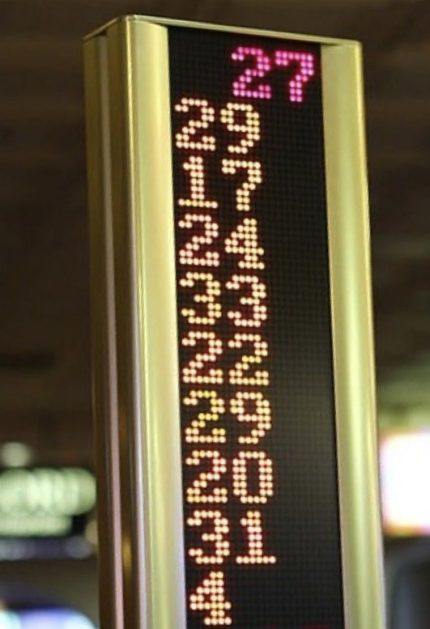
Case in point: the digital displays on roulette tables of recent winning numbers and colors. These encourage players to mistakenly perceive and take advantage of patterns that don’t really exist.
Some fancier and more brazen displays even show “hot” and “cold” numbers.
No matter how many times a number or color has come up before, its chances of coming up again are always the same.
“As the saying goes, patterns like that happen only in the rear-view mirror,” Anthony Curtis, gambling expert and publisher of the Las Vegas Advisor, told Casino.org. “You can only look back and see what they did. Hence, there’s no associated strategy you can use to predict them.”
The gambler’s fallacy also applies to patterns in our own winning and losing.
Though we have all experienced streaks of good luck that continue in the face of impossible odds, or nights when every bet we place seems cursed, neither experience ever really happened to us — at least not in the way it seemed to.
“Streaks — good and bad — will happen due to the nature of probability, but you can’t predict them,” Curtis said. “Players want to believe they can get ‘hot’ and harness that, but they never get hot. They experience normal fluctuation in results and that’s not something that can be harnessed.”
Look for “Vegas Myths Busted” every Friday on Casino.org. Click here to read previously busted Vegas myths. Got a suggestion for a Vegas myth that needs busting? Email corey@casino.org.

 Most Read
Another Shooting Near Las Vegas Strip Casino Injures Man
 972,624 views

Vintners Oppose Napa Valley Casino
556,232 views


Conversation (1 comment)