 Main menu

Prediction Markets
Spain Joins Global Push Against Prediction Markets on Illegal Gambling Fears
Posted on: May 28, 2026, 06:38h.
Last updated on: May 28, 2026, 07:27h.


- Spain has temporarily banned Kalshi and Polymarket
- Government officials contend that the prediction markets are engaged in illegal gambling
- Spain joins more than a dozen countries in cracking down on prediction markets
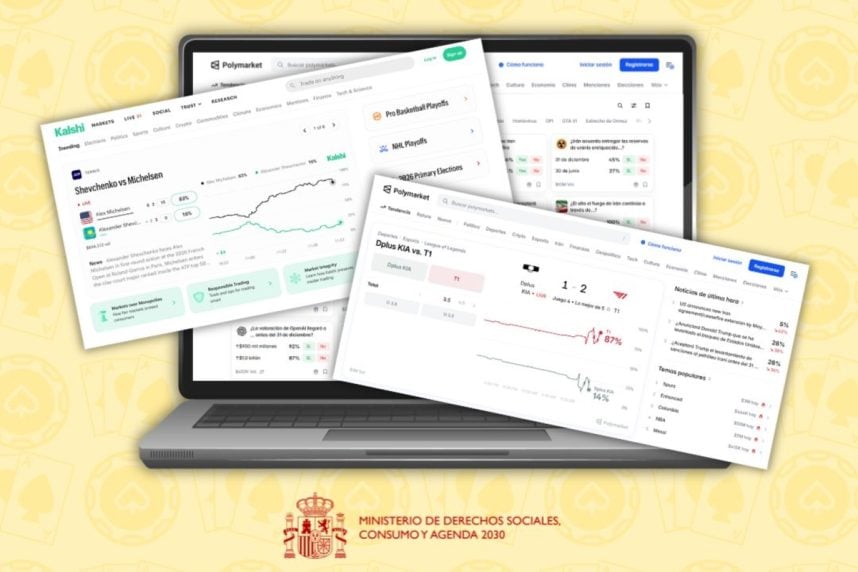
Spain has become the latest major economy to clamp down on online prediction markets, ordering immediate website blocks as global regulatory pressure intensifies against the sector.
On Tuesday, US President Donald Trump on Tuesday (May 26) expressed his strongest support to date for the controversial trading exchanges that allow users to buy and sell shares of future events. Conversely, more than a dozen countries have acted to limit their operations.
On Monday (May 25) Spain’s Consumer Rights Ministry announced a temporary ban on prediction market leaders Kalshi and Polymarket. The injunction comes as a probe into their businesses is conducted.
The ministry confirmed that disciplinary proceedings have begun against both prediction markets based on allegations that they have violated gambling regulations.
The Consumer Affairs Department has ordered the blocking of both websites within Spain as a precautionary measure until the final resolution of the proceedings,” the ministry’s release explained.
The release added that Spain considers prediction markets to be gambling when bets are placed on uncertain outcomes.
“Therefore, operating in Spain requires a specific administrative license. Unauthorized operators lack the technical and regulatory safeguards required in Spain, including identity verification systems, mechanisms to control access by minors and individuals who have self-excluded or are prohibited from gambling, and the necessary supervisory standards to protect users,” the statement read.
Global Prediction Market Crackdown
Prediction markets aren’t new, but the trading they offer is. In recent months, US-based prediction markets have debuted event offerings involving the outcomes of sports, elections, and even such global affairs as the hostile takeovers of regimes and the ousting of government leaders.
Prediction market opponents contend that the platforms facilitate gambling on just about everything. There are also concerns that they’re prone to insider trading. As a result, many countries have taken action to block access to the sites.
Spain joins Italy, France, Germany, Belgium, Hungary, New Zealand, and Brazil in requiring prediction markets to make their platforms inaccessible. Romania, Portugal, Australia, Argentina, and Indonesia have taken action specifically against Polymarket.
Unlike traditional betting, where the gambler bets against the house, prediction markets are supposedly peer-to-peer. However, Kalshi and Polymarket have both partnered with third-party intermediaries, typically large financial services conglomerates, that take the other side of traders’ bets and user-generated parlays.
Trump Support
As a Republican-controlled House Oversight Committee launched an investigation into insider trading on prediction markets, the president last night doubled down on his support of the financial exchanges.
Trump said it is “critically important” that the Commodity Futures Trading Commission maintains its “exclusive authority” over prediction markets.
Scrutiny over prediction markets, including allegations of insider trading and deciding whether sports trading constitutes sports betting, has generally been bipartisan. The US Supreme Court has been asked to decide if states have any regulatory power over what prediction markets can offer for trading.

 Most Read

Another Shooting Near Las Vegas Strip Casino Injures Man
 972,614 views

Vintners Oppose Napa Valley Casino
556,226 views


Conversation (0)
Be the first to comment on this article.