 Main menu

Prediction Markets
‘The Whole World Has Become a Casino’: Trump’s New Warning Sparks Fear for Prediction Markets
Posted on: April 24, 2026, 07:12h.
Last updated on: April 24, 2026, 10:04h.


- President Trump took a shot at prediction markets on Thursday
- The remarks come in response to a US special forces official being charged with insider trading
- The DOJ alleges the military member made over $400K by using classified insider information on Polymarket
President Trump is sounding the alarm on the gambling industry, warning that the “world has become a casino” as he signals a potential shift in federal oversight.
Despite once owning and making many millions of dollars off his casino resorts in Atlantic City and Northwest Indiana, Trump says the emergence of prediction markets, which have flourished under his second administration, is something he doesn’t like “conceptually.”
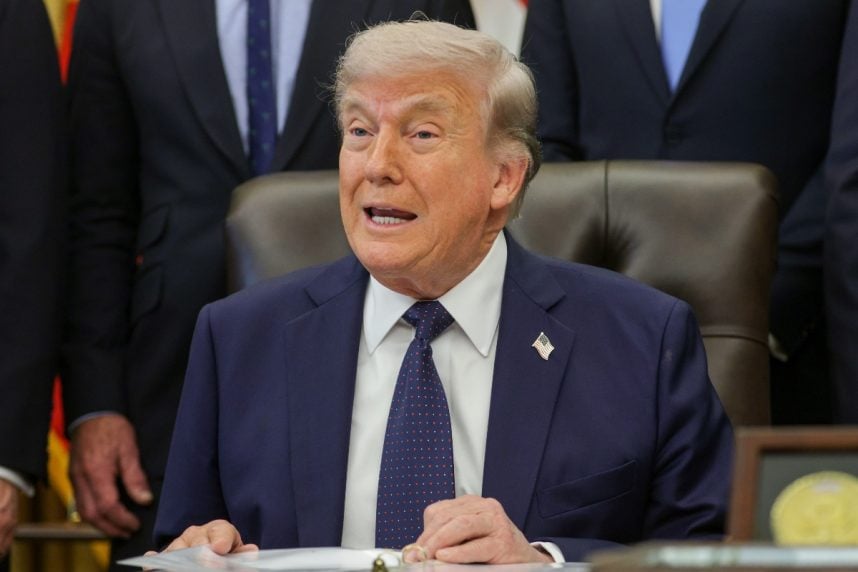
Responding to a reporter’s question inside the Oval Office on Thursday about the Department of Justice bringing charges against a US special forces soldier who allegedly used insider information to profit more than $400,000 on the capture of Venezuelan President Nicolas Maduro, Trump acknowledged the national security risks regarding prediction markets.
The whole world, unfortunately, has become somewhat of a casino. You look at what’s going on all over the world… They’re doing these betting things. I was never much in favor of it,” Trump answered.
Federal authorities allege that Gannon Ken Van Dyke was part of the January operation to capture Maduro.
In the hours leading up to the special forces’ operation, Van Dyke, 38, allegedly made $32,500 in trades on Polymarket to make a net profit of $404,000. Van Dyke also traded on other event contracts tied to Venezuela that netted another $5,000.
Is Trump Changing His Mind on Prediction Markets?
Prediction markets have exploded since platforms like Kalshi began offering trading contracts involving sports outcomes.
The Commodity Futures Trading Commission (CTFC), the federal agency assigned to regulate designated contract markets and derivatives clearing organizations, has helped prediction markets expand their reach.
Trump’s hand-picked CFTC chair, Michael Selig, has been prediction markets’ greatest advocate in Washington, DC. Since being confirmed by the US Senate and taking office in December 2025, Selig has worked to modernize the rules to support “lawful innovation.”
Selig has routinely stated that his agency’s federal oversight of prediction markets preempts state gaming laws and claims that trading on binary outcomes involving sports constitutes illegal sports betting.
The White House has, until this latest outburst, seemingly been in the corner of prediction markets.
Donald Trump Jr. serves as an advisor to both Kalshi and Polymarket, and Truth Social, the social media platform controlled by the president’s family business, in October announced plans to launch its own prediction market, Truth Predict.
Now, however, the president could be hinting that his support and position regarding prediction markets could be changing.
“I don’t like it conceptually, but it is what it is. I’m not happy with any of that stuff. They have all these different sites. They have predictive markets. It’s a crazy world,” Trump said.
Prediction Markets Need Insiders
Some say prediction markets need insider traders to make the platforms work as designed. Without insiders, the most accurate information remains hidden from the trading price.
The challenge of prediction markets that we’re facing is that we don’t know when trading on insider information actually becomes insider trading,” Yesha Yadav, a professor of law at Vanderbilt Law School, told DL News, a media agency focused on decentralized finance. “The clarity of legal rules, duties, and understanding the scope of how broadly or narrowly the law reaches in this context is really unclear.”
When prediction markets dealt only in traditional events in which they were originally intended, for example, speculative trading on soybean futures, it was key that farmers and others involved in the crop’s harvesting be allowed to participate to accurately price the agricultural commodity.

 Most Read

Another Shooting Near Las Vegas Strip Casino Injures Man
 972,524 views
Vintners Oppose Napa Valley Casino
556,149 views


Conversation (0)
Be the first to comment on this article.