 Main menu

Sports Betting
BofA: Sports Bettors Keeping 75 Cents for Every $1 Wagered
Posted on: September 8, 2026, 06:21h.
Last updated on: September 9, 2026, 05:00h.


Key Points
- Bank of America research suggests sports wagering generates less income than many bettors expect
- On average, sports bettors withdraw 75 cents for every $1 deposited
- Generation Z has the highest recovery ratio among age groups but still fails to break even


Fresh Bank of America research highlights the steep odds facing sports bettors, revealing how difficult it is to break even—much less turn a profit.

Bank of America cautions that its data only tracks customer deposits and withdrawals, meaning unwithdrawn winnings aren’t reflected. Still, the bank notes the overall results are far from encouraging for bettors.
Our analysis found the online betting cash recovery ratio has remained below 1, with total inflows less than three-quarters of total outflows on average for the duration of the series,” notes Taylor Bowey of the Bank of America Institute. “In other words, customers typically recover less than 75 cents for every dollar transferred to online betting platforms.”
The bank measured inflow and outflow data from January through July, a period in which bettors pulled out more than 75 cents per dollar deposited on only two occasions. That trend is especially concerning given that Millennials and Gen Z accounted for 88% of internet wagering activity in July.
The bank’s analysis focused strictly on sports betting and prediction markets, excluding transactions conducted on other internet betting platforms or at land-based casinos.
Income? Don’t Bet On It.
While estimates vary, it is widely noted that just 3% to 5% of sports bettors are profitable over the long term. This implies an even smaller percentage can rely on sports wagering or prediction market trading for supplemental—let alone full-time—income.
Those long odds aren’t preventing younger bettors from tempting fate with other surveys confirming bettors in younger age cohorts increasingly view wagering and prediction market trading as central to their long-term financial plans.
Yet even Gen Z, which has the highest recovery ratio of the four generations highlighted by Bank of America, is struggling to break even.
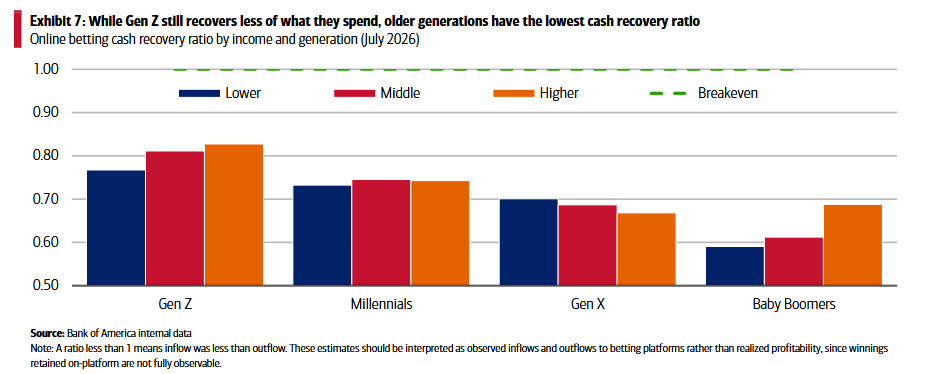
“Although Gen Z participants had the highest online betting cash recovery ratio across income groups, they still fell well short of breaking even,” observes Bowey. “Despite seemingly recovering more than older generations, total inflows remained substantially below total outflows, suggesting that online betting is not a reliable or constant source of income.”
With Age Comes Wisdom
Amid the rise of prediction markets and increased accessibility of regulated sports betting, more asset managers say the lines between betting and standard investing are blurring and that’s not a good thing. As Bank of America notes, much of the blurriness is seen among young bettors.
“According to a Bank of America proprietary survey, 20% of respondents consider sports betting as a type of investment, although more consider it not a form of investing,” says Bowey. “Gen Z is twice as likely to consider sports betting as a form of investing; however, across all generations, buying event contracts on prediction markets was more likely to be considered an investment than sports betting.”
Conversely, significant majorities of Baby Boomers and Gen X do not view sports betting as investing. While their attitudes toward prediction markets are slightly softer, roughly a third of those two demographics still refuse to consider event contracts a legitimate investment.

 Most Read

Another Shooting Near Las Vegas Strip Casino Injures Man
 972,107 views

Vintners Oppose Napa Valley Casino
555,763 views


Conversation (0)
Be the first to comment on this article.