 Main menu

Sports Betting
Nationwide Study Warns Sports Betting and Prediction Markets Curb Wealth Accumulation
Posted on: August 29, 2026, 12:58h.
Last updated on: September 1, 2026, 07:08h.


Key Points
- Nationwide finds sports betting and prediction markets draw funds directly away from standard investing
- Both activities involve financial risk, but the nature and sustainability of those risks are fundamentally different
- Time works in favor of disciplined investors, but against sports bettors facing house edges


Nationwide has joined a growing chorus of financial institutions warning that retail investors are undermining their long-term wealth by redirecting savings into high-risk sports betting and prediction markets.

In a recent report, Nationwide Chief Investment Strategist Mark Hackett sounded an increasingly familiar alarm: while sports betting, prediction markets, and traditional investing all carry risk, young investors are failing to recognize how fundamentally different those risks are.
“With investing, time is on the investor’s side as capital compounds when channeled through a well-diversified portfolio,” observes the strategist. “But time works against the gambler; gambling is structured so that a statistical edge against the player compounds through repetitive activity.”
Over time, the longer market participants remain invested, the more their stakes compound and wealth accrues. Hence the case for long-term investing. However, the longer a bettor bets, odds work against them, increasing the chances that the only winner is the house.
Going in the Wrong Direction
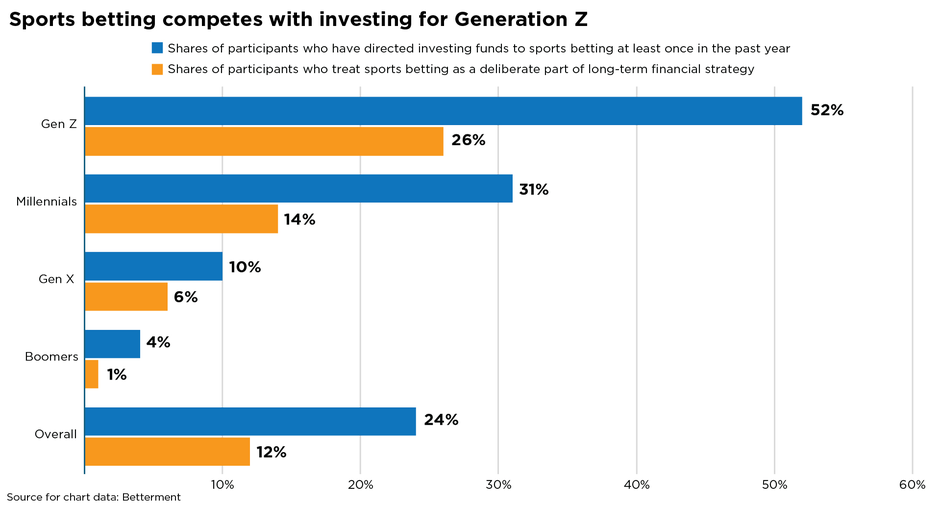
A recent Betterment survey called attention to the issue of young people are relying too heavily betting as an alternative to old-fashioned investing. It points out that 26% of Gen Zers view wagering as an integral part of their long-term investing strategies.
Making matters worse is that 52% of that demographic admit to moving money away from brokerage and retirement accounts into sports betting accounts.
That jibes with earlier research showing that as regulated U.S. sports wagering expanded, bettors didn’t divert money from other discretionary spending. Instead, they cut back on saving and investing to fund their habits.
Hackett says that’s concerning, adding that fear of missing out (FOMO) and the desire for instant gratification are steering some young people away from sound wealth-building principles into prediction markets and sports betting.
“Before worrying about the odds of the next wager, investors should make sure they’re playing the right game,” he adds. “One game (gambling) is built around prediction and is often marketed or perceived as a path to wealth creation. The other (investing) is built around economic ownership and long-term wealth creation. History suggests the latter has been the far more reliable path.”
Long-Term Investing Beats Quick Fixes
Other studies indicate bettors and retail prediction market participants, particularly young men, turn to those pursuits to fill various voids in their lives, but the problems they’re having can be compounded by activities that can prove detrimental to long-term wealth accumulation.
Hackett points out that prediction markets and sports betting offer short-term enticement, distracting some participants from the long-term superiority of the stock market.
“Just look at the historical record of the S&P 500 Index. When looking at monthly returns, stocks have been positive about 64% of the time,” Hackett noted.
“Extend that period to a year and the probability of positive returns rises to roughly 79%. Over even longer periods, stocks have been positive for every rolling 16-year period since 1928. That’s the exact opposite of gambling,” concludes the Nationwide strategist.

 Most Read

Another Shooting Near Las Vegas Strip Casino Injures Man
 972,520 views

Vintners Oppose Napa Valley Casino
556,142 views


Conversation (1 comment)