
Who Regulates Prediction Markets?

Summarize this post
Key takeaways
- CFTC prediction markets oversight dates back to 2004, when the agency began treating event contracts as derivatives under the Commodity Exchange Act.
- A 2026 split between two federal appeals courts, one backing federal authority and one backing state gambling law, has set up a likely Supreme Court fight over who actually controls these markets.
- The CFTC proposed new rules in June 2026 that would define which event contracts count as “gaming” and can be pulled from trading.
- You can confirm whether a platform is CFTC-licensed through the agency’s public registration tools before you put money on it.
Prediction markets sit at the center of a genuine jurisdictional fight in 2026. The Commodity Futures Trading Commission has treated these platforms as regulated derivatives exchanges since 2004, but a wave of state gambling complaints and two conflicting federal appeals court rulings this year mean the answer to “who regulates prediction markets” now depends on where you’re asking from. It’s also why so many traders ask a more basic question first: are prediction markets regulated at all, or is it still the Wild West? The short version is that CFTC prediction markets oversight is real and enforceable, but it isn’t the only authority claiming jurisdiction anymore.
CFTC prediction markets oversight: the primary federal regulator
The Commodity Futures Trading Commission is the federal agency responsible for prediction markets in the United States. The CFTC has overseen this corner of the market since 2004, when it first approved an exchange to list contracts based on the outcome of future events, and its authority comes from the Commodity Exchange Act (CEA), the same law that governs traditional futures and options markets.
Under that framework, a platform that wants to offer prediction market contracts has to register with the CFTC as a designated contract market (DCM). Once registered, the exchange can list new contracts, including event contracts, through a self-certification process laid out in CFTC Regulations 38.4 and 40.2. The exchange files the contract terms with the Commission, and the CFTC reviews them for compliance with the CEA’s core principles rather than pre-approving every individual listing.
That doesn’t mean anything goes. CFTC Regulation 40.11 gives the Commission the power to block or unwind event contracts that reference terrorism, assassination, war, gaming, or any activity that’s unlawful under state or federal law. This is the rule at the heart of the CFTC’s 2026 rulemaking, discussed below.
The National Futures Association (NFA) adds a second layer of oversight. As the CFTC’s registered self-regulatory organization, the NFA handles registration checks, examinations, and disciplinary actions for the brokers and intermediaries that connect you to these markets.
Registration isn’t a one-time formality. The Dodd-Frank Act’s Section 735 requires every designated contract market to satisfy a set of core principles covering market integrity, real-time trade monitoring, disciplinary procedures for member misconduct, financial safeguards for customer funds, and public disclosure of trading data. The CFTC can examine an exchange’s compliance with these principles at any time, not just when it lists a new contract.

How we got here: a brief history of prediction market regulation
Prediction markets aren’t new, and neither is the debate over who should oversee them. The first modern US prediction market, the Iowa Electronic Markets, launched in 1988 as a university research project, and the CFTC granted it no-action relief in the early 1990s that let it operate on a small scale for academic study rather than as a commercial product.
Commercial platforms tested that boundary for years afterward. Intrade, an Ireland-based site, became the dominant option for US traders through the 2000s while operating outside CFTC registration. That ended in November 2012, when the CFTC sued Intrade for offering options contracts off a registered exchange, and the platform cut off American users within days.
Congress changed the rules in 2010 with the Dodd-Frank Act, adding Section 5c(c)(5)(C) to the Commodity Exchange Act, the “Special Rule” that gives the CFTC discretion to prohibit event contracts tied to gaming or other enumerated activities if it finds them contrary to the public interest. That single provision is still doing most of the work in the 2026 rulemaking described below.
A different model emerged in 2014, when the CFTC issued a no-action letter allowing a political-only prediction market to operate under tight limits, an $850 per-contract cap and a 5,000-trader ceiling among them. That arrangement lasted until 2022, when the CFTC moved to revoke the letter. The resulting legal fight ran for three years before being resolved in 2025.
The current era of CFTC prediction markets oversight began in November 2020, when a prediction market exchange became the first to hold a full CFTC designated contract market license rather than operate under the narrower no-action relief earlier platforms relied on. Full registration let the newer wave of exchanges list a much broader range of event contracts, including sports markets, and it’s also what set up the jurisdictional fight with state gaming regulators that’s still playing out in 2026.
Key dates at a glance:
- 1988 to early 1990s: Iowa Electronic Markets launches and receives CFTC no-action relief for academic study.
- 2010: The Dodd-Frank Act adds the CEA’s “Special Rule,” giving the CFTC power to block event contracts found contrary to the public interest.
- 2012: The CFTC sues an offshore commercial platform for trading options off a registered exchange.
- 2014: The CFTC allows a political-only prediction market to operate under a no-action letter with strict trading limits.
- 2020: The first prediction market exchange earns a full CFTC designated contract market license.
- 2026: Two federal circuit courts split on whether federal law preempts state gambling law for event contracts, and the CFTC proposes new rules on which contracts count as prohibited “gaming.”
So are US predictions markets currently regulated?
Yes, at least on platforms licensed as designated contract markets, such as Polymarket and DraftKings Predictions. If a prediction market operates as a CFTC-registered DCM, it’s subject to federal oversight covering market surveillance, anti-manipulation rules, position limits, and the segregation of customer funds from company assets. The CFTC states plainly on its own consumer education page that regulated exchanges must pass “stringent vetting” and face “periodic examinations,” and that contract prices are meant to reflect “traders’ perceived probability of the event outcome,” not a bookmaker’s line.
The risk shows up with platforms that aren’t registered at all, including offshore sites that market themselves to US users without CFTC authorization. The agency’s own guidance warns that you “may have little or no protections” if you trade on unregistered platforms, and it lists guaranteed-return promises, celebrity endorsements, and suspiciously polished reviews as warning signs before you fund an account anywhere.
The State vs. Federal fight over event contracts
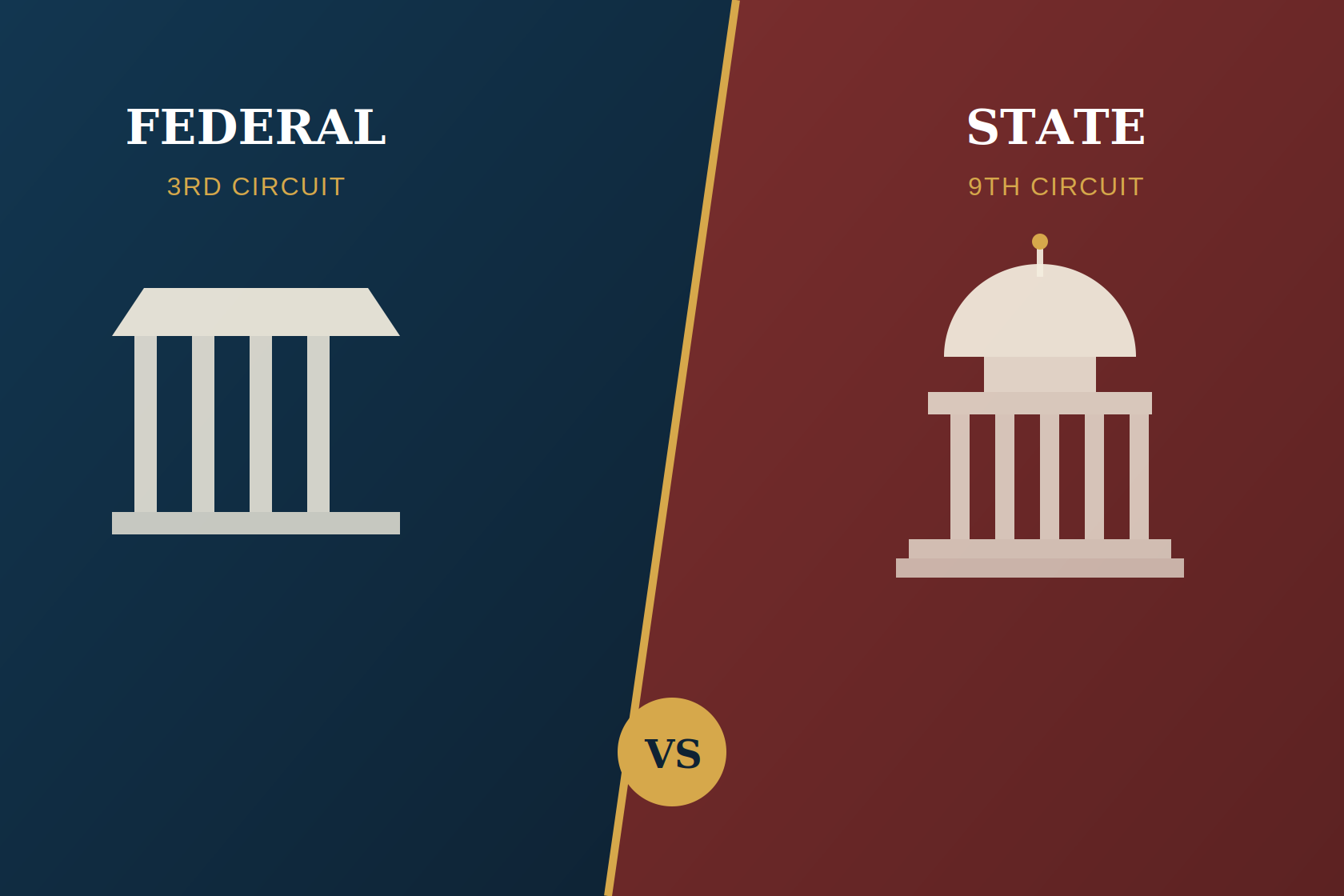
Federal registration is only half the story in 2026. A growing number of states argue that event contracts tied to sports outcomes are a form of sports betting and therefore fall under state gaming law, which requires a state gambling license the exchanges don’t hold. Exchanges and the CFTC counter that the Commodity Exchange Act preempts state gambling law once a contract is listed on a federally registered exchange. Two federal appeals courts reached opposite conclusions on that question within the same year.
In April 2026, the Third Circuit ruled that the CFTC holds exclusive jurisdiction over sports-related event contracts traded on CFTC-licensed exchanges, in a case brought by one of the industry’s prediction market operators against New Jersey regulators. The court found that these contracts qualify as swaps under the CEA and that the law preempts New Jersey’s attempt to apply its gambling statute to a federally registered exchange, both because federal law occupies the field and because state enforcement would conflict with it directly.
Four months later, the Ninth Circuit went the other way. In an August 2026 ruling on Nevada’s fight with the same industry, the court held that sports-related event contracts likely aren’t “swaps” in the way the exchanges claimed, and that treating them as such would raise Major Questions Doctrine concerns, since it would hand a federal agency authority over what has traditionally been state-regulated gambling without a clear statement from Congress. That reasoning let Nevada’s gaming law stand.
The CFTC has also gone on offense outside the courtroom. In April 2026, the Commission sued Arizona, Connecticut, and Illinois directly, asking a federal court to declare that state attempts to outlaw or restrict CFTC-registered exchanges conflict with its exclusive jurisdiction under the Commodity Exchange Act. Chairman Selig described the effort as necessary to “safeguard its exclusive regulatory authority over these markets and defend market participants against overzealous state regulators.” The lawsuit signals the CFTC isn’t just defending individual enforcement actions case by case. It’s trying to head off further state action before it starts.
With two circuits split on the same legal question, the industry is bracing for the Supreme Court to eventually settle it. Until that happens, whether a given event contract is treated as a federally regulated derivative or state-regulated gambling can genuinely depend on which state you’re in.
CFTC’s 2026 rulemaking: redefining the rules for event contracts
The CFTC hasn’t stood still while the courts sort out jurisdiction. In March 2026, the Commission published an advance notice of proposed rulemaking, withdrawing an earlier 2024 proposal and reopening the question of how prediction markets should be regulated “in light of various state regulatory actions and litigation.” That notice drew more than 3,500 public comments before its April 30, 2026 deadline.
In June 2026, the CFTC followed up with a formal notice of proposed rulemaking to amend Regulation 40.11 and add a new appendix to Part 40 of its rules. The proposal would define when an event contract “involves” a restricted activity (when its settlement depends on that activity’s occurrence) and lay out a specific definition of “gaming” as an activity typically done for recreation, governed by rules, with outcomes turning on the participants’ luck, skill, or athletic ability. It also proposes a formal list of public interest factors, covering price discovery, threats to market integrity, and compliance burdens, that the Commission would weigh before blocking a contract as contrary to the public interest under the CEA’s Special Rule. Public comments on that proposal closed July 27, 2026.
CFTC Chairman Michael Selig framed the effort as a balancing act, stating that the Commission intends to “protect the integrity of our regulated markets without standing in the way of responsible innovation.”
How to check if a prediction market platform is actually regulated
Before you fund an account, you can verify a platform’s status directly rather than taking its marketing at face value. Checking CFTC prediction markets registration takes a few minutes, not a leap of faith.
- Check the CFTC’s list of designated contract markets to confirm the exchange itself is federally registered.
- Search the NFA’s BASIC lookup tool for the exchange or any broker connecting you to it, which shows registration status and disciplinary history.
- Read the platform’s own terms for its regulatory disclosures. A registered exchange will identify itself as a DCM and name its regulator.
- Treat guaranteed profits, unlicensed offshore branding, or pressure to deposit quickly as reasons to walk away.
Frequently Asked Questions
Who regulates prediction markets in the United States?
The Commodity Futures Trading Commission regulates prediction markets at the federal level, treating event contracts as derivatives under the Commodity Exchange Act. State gaming regulators are also asserting authority over sports-related contracts, and federal courts are currently split on which framework controls.
Are prediction markets regulated in the US?
Yes. Prediction markets are regulated in the US when they operate as CFTC-registered designated contract markets, which puts them under federal oversight for market integrity, anti-manipulation rules, and customer fund segregation. Platforms that skip that registration, including many offshore sites, aren’t held to the same standard, which is why checking a platform’s CFTC status matters before you trade.
Does the CFTC regulate all prediction markets?
The CFTC regulates platforms registered as designated contract markets. Offshore or unregistered platforms marketing themselves to US users generally fall outside CFTC oversight, which is exactly why the agency warns they carry fewer consumer protections. We recommend sticking to regulated prediction markets such as DraftKings Predictions and ProphetX.
Are prediction markets legal in every state?
Not uniformly. Federal courts disagree on whether CFTC registration preempts state gambling law for sports-related event contracts, and some states have taken enforcement action against exchanges operating without a state gaming license. Check your state’s current stance before trading sports-related contracts specifically.
What’s the difference between the CFTC and state gaming regulators?
The CFTC regulates prediction markets as derivatives exchanges under federal commodities law, focused on market integrity, manipulation, and fund segregation. State gaming regulators oversee licensed gambling under state law, focused on consumer protection and licensing within that state. The two frameworks are currently in direct conflict over sports-related event contracts.
How do I know if a prediction market platform is properly registered?
Check the CFTC’s public list of designated contract markets and the NFA’s BASIC lookup tool. A properly registered platform will identify its regulatory status directly in its terms and disclosures.