Are Prediction Markets Accurate? What the Data Really Shows

Summarize this post
Key Takeaways
- Prediction markets have a solid overall track record. The Iowa Electronic Markets, one of the longest-running academic markets, beat the matching opinion poll on roughly three out of every four days researchers checked across five presidential elections.
- During the 2024 US election, Polymarket’s odds pointed to the eventual winner well before national polling did, correctly favoring Donald Trump in five of seven swing states.
- Accuracy does not come from crowd wisdom the way most people assume. A 2026 study of 1.72 million Polymarket accounts found that only about 3% of traders were statistically skilled, yet that small group captured roughly 30% of all trading gains.
- Results vary a lot by exchange. Looking at 2024 election contracts, one review found that a single platform, PredictIt, cleared a simple chance benchmark 93% of the time, versus 67% for Polymarket.
- Markets can still get it badly wrong. Thinly traded or one-off markets, covering everything from Brexit to a Super Bowl matchup to the capture of Nicolás Maduro, have produced some strikingly bad prices.
What “Accuracy” Actually Means Here
Before deciding whether prediction markets are accurate, it helps to be clear about what that question is asking. A prediction market is not a forecaster in the usual sense. It turns a contract’s price into an implied probability. If a contract tied to “Team X wins” trades at 70 cents, the market is saying Team X has roughly a 70% chance of winning. It does not mean the outcome is already settled.
That distinction changes how you should judge a market’s performance. If an event priced at 70% does not happen, the market has not necessarily gotten it wrong. A well-calibrated market should miss on about 30% of its 70-cent contracts. That is not a flaw. That is what calibration looks like.
Researchers typically check two different things when they test how accurate a prediction market really is:
- Calibration: whether events priced at 70% actually happen close to 70% of the time, once you look across many markets rather than just one.
- Discrimination: whether the market sorts likely winners from likely losers better than the alternatives, such as polling or expert judgment.
With that framing in place, here is what the research on both sides shows.
The Case for Prediction Market Accuracy
A long academic track record
Prediction markets have been studied for decades, well before platforms like Polymarket entered the mainstream. The Iowa Electronic Markets, launched by the University of Iowa in 1988, is likely the most heavily researched prediction market in academic economics.
In an early analysis, researchers Joyce Berg, Forrest Nelson, and Thomas Rietz compared the market’s vote-share forecasts against standard opinion polls across five presidential elections between 1988 and 2004. The market beat the matching poll on roughly 74% of the days they measured. That is a large sample across multiple election cycles. It is a big reason economists have taken these markets seriously for so long.
The 2024 election: markets against polls
The 2024 US presidential race introduced prediction markets to a much wider audience. What happened that cycle mostly supports their reputation, with some important caveats covered later in this piece.
A Vanderbilt University research team compared the odds implied by markets at Polymarket against national and swing-state polling averages. Their finding: the market’s odds tracked the eventual result more closely than the polls did, particularly in contested states. By mid-October 2024, Polymarket’s confidence interval had shifted clearly above the 50% mark in Donald Trump’s favor. Polling averages, by contrast, stayed close to an even split through the final weeks.
The market pointed to the eventual winner in five of the seven core swing states, Arizona, Georgia, Nevada, North Carolina, and Pennsylvania, before the polling data told the same story. Michigan and Wisconsin stayed tight in both.
Markets signaled the eventual winner first in five of seven core swing states.
Part of that gap likely comes down to what each method is actually measuring. A poll asks people how they intend to vote. A prediction market asks who traders expect to win. Those two questions usually move together, though not always at the same pace, and the “who is going to win” framing seems to pick up late-breaking information, shifting momentum, and local knowledge faster than a traditional survey can.
Why money on the line changes things
The basic argument for prediction markets is fairly simple. Putting money behind an opinion changes how carefully people form it. A poll respondent can answer quickly, guess, or say whatever sounds reasonable, all without any real cost for being wrong.
A trader who misjudges a market loses money. That is a genuine incentive to research the question before betting on it. Multiply that across thousands of traders and, in theory, the price should settle on an accurate probability faster than a poll can. New information gets reflected the moment someone is willing to trade on it, instead of waiting for the next survey to go out.
Where Prediction Markets Get It Wrong
None of this makes prediction markets foolproof, and several of the most frequently cited failures are recent enough to complicate any simple “markets beat polls” story.
Brexit and the 2016 US election
Ahead of the UK’s 2016 Brexit referendum, betting markets strongly favored a vote to remain in the EU. Most also underestimated Donald Trump’s chances in that year’s US presidential race. Economists who later studied both misses pointed to a similar pattern: traders treated the existing odds as a starting assumption and were slow to factor in new information that contradicted them. The price itself started acting like evidence, rather than simply reflecting the evidence that was actually available.
Sports markets miss too
Prediction markets are not exempt from the kind of errors a typical sportsbook makes. Going into last year’s Super Bowl, prediction markets favored the Kansas City Chiefs over the Philadelphia Eagles, who ended up winning comfortably. The advocacy group Better Markets has pointed to results like this as evidence that prediction-market prices often reflect betting sentiment, skewed toward a younger, more risk-tolerant crowd, rather than any real forecasting edge, especially on markets tied to fan interest.
Markets with few traders and little warning
Some of the worst misses show up in markets that barely trade. Shortly before Venezuelan leader Nicolás Maduro was captured, contracts on Polymarket put the odds at around 6.5%. Critics cite that number as proof that a shallow, illiquid market can miss badly, even when the underlying event was not inherently unpredictable.
Separate research out of Yale has flagged similar liquidity problems in political markets more broadly. Some races had almost no active sellers, with bid-ask spreads stretching to 50%. A trade of just a few thousand dollars could swing the implied probability by several points. That is less a collective judgment being aggregated. It is a price set by whoever happened to be trading that day.
The risk of manipulation
Thin markets are also easier to move on purpose. The Wall Street Journal reported that roughly $30 million in bets on Polymarket, placed in a pattern suggesting coordination, helped push Trump’s odds higher ahead of the 2024 election. That is the kind of position a smaller trader has no easy way to offset in a shallow market. Questions about who runs these platforms, and their political ties, give critics another reason for skepticism.
Why Accuracy Varies: A Few Skilled Traders, Not “The Crowd”
One of the more recent studies changes how this whole question should be framed. Researchers Theis Ingerslev Jensen and Howard Kung, working with a broader team, examined 1.72 million Polymarket accounts across nearly 99,000 events and $13.76 billion in trading volume. Their conclusion: prediction-market accuracy does not really come from crowd wisdom at all.
About 3% of traders in the dataset qualified as truly skilled, meaning their results beat a randomized benchmark by more than chance would allow, even after the researchers reran each trader’s actual bets 10,000 times with the outcomes shuffled to rule out luck. That small group accounted for more than 30% of total trading gains and moved prices toward the correct outcome fastest, particularly right before an event resolved or right after major news broke. The other roughly 97% of traders, who supply most of the platform’s liquidity, lost money on net to that informed minority. Put simply: most traders are not generating the market’s accuracy. They are paying for it.
A small, skilled minority of traders accounts for an outsized share of trading gains.
Here is what that means if you are reading a prediction-market price. A liquid market with real participation from informed traders, think major elections or closely watched economic releases, is far more likely to be well-calibrated. A thin, low-attention market is a different story. A handful of participants, skilled or not, can move the price on their own.
Results differ by exchange
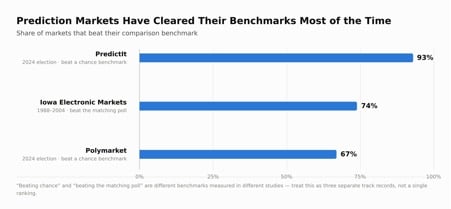
A separate look at 2024 election contracts across several exchanges, including the Iowa Electronic Markets, PredictIt, and Polymarket, found accuracy varied quite a bit depending on where a contract traded. PredictIt cleared a simple chance benchmark in 93% of its markets; Polymarket did so in 67%.
The same research also turned up real inefficiencies. Identical contracts priced differently across platforms. Daily price moves showed almost no predictable pattern. That is evidence against the idea that these markets are perfectly efficient, even when they land on the right answer.
Three separate track records, measured against two different benchmarks — not a single leaderboard.
Prediction Markets vs. Polls vs. Expert Forecasts
| Prediction Markets | Opinion Polls | Expert Panels | |
| What sets the number | Real money staked on an outcome | A respondent’s stated intention | A professional’s individual or aggregated judgment |
| How fast it updates | Close to instantly, as trades happen | Only as often as the survey runs | Varies; often infrequent |
| Track record | Beat matching polls on ~74% of days measured (Iowa Electronic Markets, 1988–2004); tracked the 2024 outcome more closely than national polling | Mixed; notable misses in 2016 and 2020 | Mixed; vulnerable to groupthink and overconfidence |
| Biggest weak point | Thin trading volume, manipulation, anchoring on early odds | Non-response bias, social-desirability effects, sampling error | Individual bias, incentive to hedge in public |
| Works best for | Liquid, well-covered events (elections, major economic data) | Reading current sentiment or intention | Specialized judgment calls with no active market |
No single method wins every comparison. The strongest evidence points to prediction markets doing best on well-traded, high-profile questions, and struggling on thin or niche ones. That is largely a liquidity story rather than a straightforward markets-versus-polls story.
Factors That Undermine Prediction Market Accuracy
A handful of patterns come up again and again when a prediction market gets it wrong. Here is what to watch for:
- Thin trading. A market with few active traders can be moved by a handful of trades, so the price reflects a small group’s opinion rather than a broad consensus.
- Manipulation. Where liquidity is thin, a single well-funded trader or coordinated group can push a price away from the true probability, at least for a while.
- Anchoring on early odds. Once a market sets an initial price, some traders treat that number as evidence in itself and are slow to update when new information contradicts it, the pattern researchers point to in both Brexit and the 2016 US election.
- A skewed trader base. Prediction-market users tend to be younger and more risk-tolerant than the general public. On pop-culture and sports markets especially, that group may be reflecting fan enthusiasm or a taste for betting more than any real informational edge.
- Favorite-longshot bias. On events priced far in advance, traders are often reluctant to tie up money for a long stretch, which tends to push long-shot prices up and favorite prices down relative to the true odds.
The Bottom Line
Often, yes. Automatically or everywhere, no.
On liquid, closely watched markets, such as presidential elections, major economic releases, and high-profile sporting events with deep betting interest, prediction markets have a genuinely strong record. In several well-documented cases, they have outperformed polls and matched or beaten expert forecasts.
The financial-incentive argument behind them holds up. The research increasingly explains why. It is not that every trader is sharp. It is that a small group of well-informed traders does most of the price-setting work, while everyone else mainly supplies the liquidity that lets those trades happen.
On thin, novel, or low-attention markets, that same mechanism can fall apart. Without enough informed traders willing to bet against a mispriced contract, prices can sit far from the true probability, sometimes for the entire life of the market. They become an easy target for manipulation, or just for noise.
Here is the practical takeaway: check the trading volume before you treat the number as gospel. A well-traded market on a major event is one of the better real-time probability estimates you will find. A thinly traded market on a niche question is closer to a guess with a price tag attached.
Frequently Asked Questions
Are prediction markets reliable?
Generally, yes, on high-liquidity markets tied to well-covered events. Research shows they have matched or outperformed polls and expert forecasts there. If you are looking at a low-volume or niche market, be more skeptical. Those are much easier for a small number of traders to skew.
How often are prediction markets accurate?
It depends heavily on the platform and the specific market. One study of the 2024 election found that PredictIt beat a chance benchmark in 93% of its markets, compared with 67% for Polymarket. Historically, the Iowa Electronic Markets outperformed comparable polls on 74% of the days studied across five election cycles.
Do people actually make money on prediction markets?
Most participants do not, at least not consistently. Research on Polymarket found that only about 3% of traders showed statistically real skill. That small group captured roughly 30% of total gains. The large majority of traders collectively lost money to that informed minority over time.
Which prediction market is the most accurate?
No single platform is accurate across the board. Accuracy has more to do with a specific market’s liquidity and who is trading it than with the platform’s brand. That said, research on the 2024 election found PredictIt’s markets beat chance more often than Polymarket’s, largely because of differences in trading volume and who was participating.
Are prediction markets just gambling?
They share some mechanics with betting markets: contracts, odds, real money at risk. Critics argue that on low-information markets, such as many sports or novelty questions, prices mostly reflect betting sentiment rather than genuine forecasting. Supporters counter that the financial-incentive structure is exactly what makes markets more accurate than polls on well-covered questions. It forces participants to back their opinions with capital instead of just stating them.