 Main menu

Sports Betting
Folarin Balogun Red Card Among Incidents Flagged in World Cup Betting Probe
Posted on: July 24, 2026, 12:17h.
Last updated on: July 27, 2026, 06:13h.


Key Points
- Group of Copenhagen issued seven Yellow Notices after identifying unusual betting indicators but stressed they do not prove match manipulation
- Polymarket contracts involving Folarin Balogun's suspension and Spain's shock result against Cape Verde drew particular scrutiny from integrity monitors
- FIFA insists its Integrity Task Force found no suspicious betting activity during the tournament despite the independent network's concerns


An international sports integrity body has flagged seven instances of potential betting or integrity irregularities at the FIFA World Cup after identifying suspicious betting patterns, including one involving the sending off of USMNT forward Folarin Balogun.
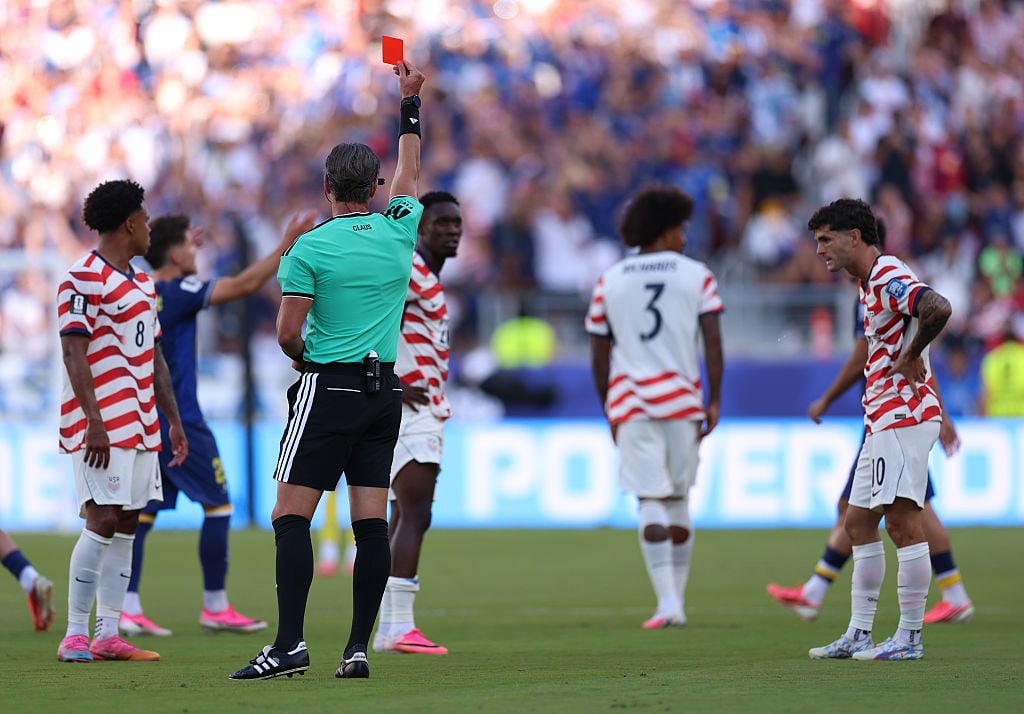
Balogun was dismissed during the USMNT’s July 1 game against Bosnia and Herzegovina, meaning he would be suspended for the subsequent match against Belgium. Many considered the call harsh. The suspension was controversially lifted after intervention by US President Donald Trump.
In a summary of its findings, the Group of Copenhagen, an independent international anti-match-fixing network, noted that prediction market Polymarket opened a market asking, “Will Folarin Balogun play against Belgium?” on July 2.
Balogun was the only one of the tournament’s 15 red-carded players to become the subject of such a market. The announcement that his suspension would be lifted came three days later, on July 5.
$4.8M Spain Bet
Also under scrutiny is a $4.8 million Polymarket position on Spain failing to beat Cape Verde in the group stage. The eventual world champions’ failure to overcome the heavily unfavored tiny island nation became one of the tournament’s biggest shocks.
Also flagged were South Africa captain Themba Zwane’s 84th-minute red card in the tournament opener against Mexico and the three-and-a-half-minute VAR review that disallowed a Ferran Torres goal during Spain’s 4-0 win over Saudi Arabia.
At this stage, the Group of Copenhagen has not explained why those specific incidents were flagged. Only a summary of its findings has been released, with the full report yet to be published.
The Group of Copenhagen issued “yellow notices” for all seven incidents—a designation indicating multiple indicators of irregularities, such as unexplained odds movements or social media rumors. The network emphasized that yellow notices warrant further investigation but do not, on their own, prove that a match was manipulated.
FIFA Disagrees
While the Group of Copenhagen collaborated with FIFA’s Integrity Task Force, it produced its findings independently. FIFA has maintained that its own monitoring detected no evidence of suspicious betting patterns during the tournament.
“Betting‑monitoring reports and other relevant data and information provided by Task Force members… was analyzed and shared in line with operational procedures,” FIFA said in a statement provided to The Athletic. “As a result, no suspicious betting activity or indications of match manipulation in connection with any fixture was identified.”

 Most Read
Another Shooting Near Las Vegas Strip Casino Injures Man
 972,739 views

Vintners Oppose Napa Valley Casino
556,342 views


Conversation (0)
Be the first to comment on this article.