 Main menu

Research
Gambling Monkeys Shed New Light on Part of Primate Brain Responsible for Risky Behavior
Posted on: September 23, 2018, 10:00h.
Last updated on: September 21, 2018, 03:37h.


Risk-taking rhesus monkeys have helped researchers pinpoint the part of the brain which propels primates to take big gambles.
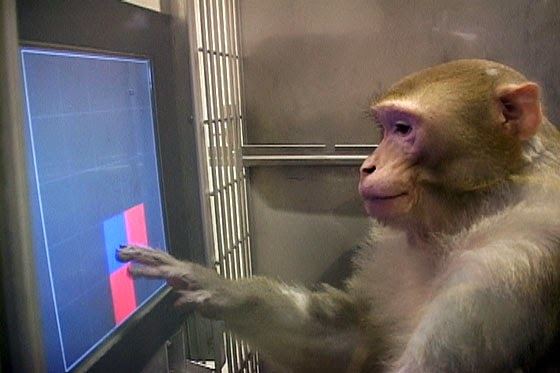
Scientists have discovered that by deactivating a specific region of the brain located in the prefrontal cortex, the monkey subjects suddenly preferred the sure thing over the long shot.
“They did not like to gamble anymore,” the study’s author Veit Stuphorn told National Public Radio (NPR).
The research builds on a recent body of findings which suggest that attitudes towards risk aren’t necessarily a personality trait, as has been previously thought. Stuphorn, who is an associate professor at Johns Hopkins University’s Main/Brain Institute, uses the example of somebody who takes a conservative approach to investing, but also enjoys skydiving.
“The change in risk attitude happens in the prefrontal cortex and our findings, for the first time, identify one critically important area,” he says.
The study suggests that one’s proclivity towards risk has less to do with personality, and more to do with the activity in this one crucial region of the brain.
Doubling Down on Juice
The two monkeys were given a computer game in which they were rewarded with juice drinks when they won.
But not all rewards were equal. Presented with the choice between getting 10 milliliters of juice 20 percent of the time and winning three milliliters 80 percent of the time, the monkeys would most often choose the longer odds, even when they were no longer thirsty.
That comes as no real surprise, as other studies have found that primates usually lean towards taking risks.
However, when the researchers suppressed the area of the brain they believe is responsible for risky activity by cooling it, the change in behavior was stark. All of a sudden, the moneys took the safer bet 30 to 40 percent more often.
“This was truly unexpected, to find a brain section so specifically tied to risk attitude,” Stuphorn wrote in the study. “The monkey’s preference markedly changed from really liking risk to liking it much, much less.”
That part of the brain is known as the supplementary eye field, which is what plays a role in eye movement. Stuphorn suspects there are other areas of the brain which also play a role in risky behavior, such as what compels a person to step into a casino in the first place.
Monkey Business, or Something More?
It’s not the first time animals have been used to help humans better understand our risk-taking dispositions.
A team of researchers won the “lg Nobel Prize” for their work which examined how hugging a crocodile may affect someone’s gambling behavior. Another study examined the differences in risk behavior between men and women, finding that females tend to spiral faster into problem gambling than males do.
The monkeys, however, are showing researchers a potential new path towards treating problem gamblers, both male and female. Scientists say the findings could eventually allow them to “develop more effective therapies” in the future.

 Most Read

Another Shooting Near Las Vegas Strip Casino Injures Man
 972,627 views

Vintners Oppose Napa Valley Casino
556,233 views


Conversation (0)
Be the first to comment on this article.