 Main menu

Vegas Myths Busted
VEGAS MYTHS BUSTED: Strip Bridges Were Built to Funnel Tourists Into Casinos
Posted on: May 18, 2026, 07:10h.
Last updated on: May 18, 2026, 07:10h.


For decades, a persistent Las Vegas myth has bounced around the internet’s least scholarly corners: that the Strip’s pedestrian bridges were built to funnel tourists into casinos.
Supposedly, casino operators in the mid -’90s pressured Clark County to eliminate street‑level crosswalks just to force visitors onto elevated walkways that conveniently deposit them onto gaming floors.
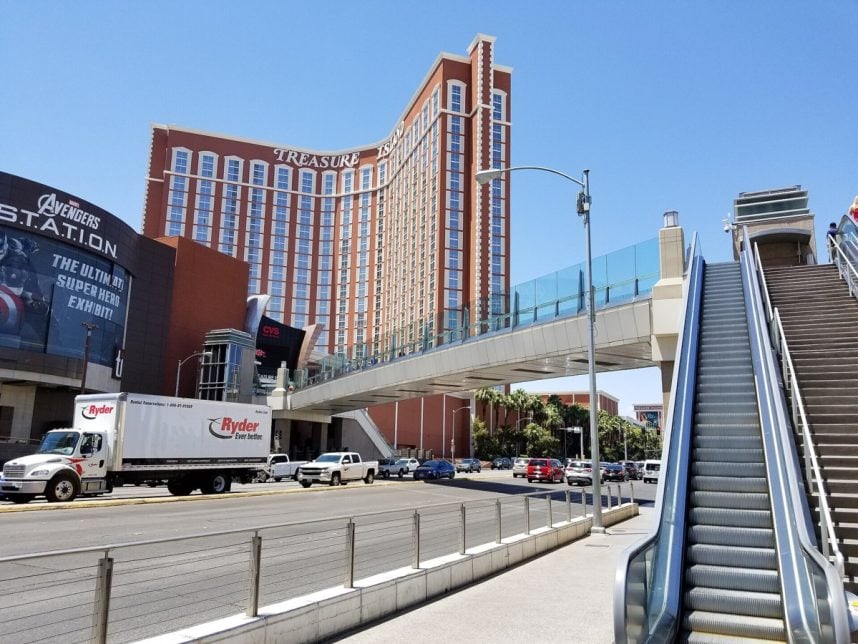
This myth — or at least a barely intelligible variant of it — was repeated in the comments beneath Casino.org‘s recent story about the prevalence of broken escalators on the Strip.
Objecting to the story’s well-supported premise that escalators remain broken longer because of a critical scarcity of specialized parts, one commenter replied: “Bull****. Parts are no problem. The casinos want the rerouting of people around slot machines and into the seats of the casino!!”
Myth Understood
The only legal way to cross the Las Vegas Strip’s busiest intersections anymore is by pedestrian bridge. When you ascend the stairs, escalator or elevator to any of them, the first thing you see on the other side is a second-floor casino entrance:
- Tropicana Avenue: MGM Grand, New York-New York, Excalibur
- Flamingo Road: Caesars Palace, Horseshoe, Bellagio
- Harmon Avenue: Cosmopolitan and Planet Hollywood
- Spring Mountain: Treasure Island and Venetian
But you know what you also find at the end of each of those bridges? A dedicated set of stairs, elevators, and up-and-down escalators leading directly to the public sidewalk on the other side of the Strip. There’s no need to enter a casino, unless you have mobility issues and one or both of the elevators is broken.
More importantly, everything at ground level on the Las Vegas Strip also sits near a casino entrance!
Bridge to Reality
The bridges were built to keep people alive, not to steer them into slot chairs. By the ’90s, traffic was exploding, visitor numbers were surging, and the Las Vegas Strip had become one of the most dangerous pedestrian corridors to cross in the U.S.
Nevada Department of Transportation records from the five years leading up to the bridge projects (1989-1994) showed more than a dozen fatalities, and hundreds of serious injuries, at the Flamingo, Tropicana, and Spring Mountain intersections.
Clark County engineers recommended elevated walkways as the only viable long‑term solution to the increasingly unsafe crosswalks.
Contrary to the myth, several major resorts (including the MGM Grand, Venetian, and Wynn) opposed the bridges. Public bridges challenged their argument that their sidewalks were private property and, therefore, they could legally block union picketing on them.
Internal county meeting minutes from the 1990s also show concerns from resorts about how the bridges would affect valet access, frontage visibility, and vehicle flow. Some casinos worried that elevated walkways would actually pull pedestrians away from their entrances, not toward them.
The county moved forward anyway, citing public‑safety imperatives. The 9th Circuit Court of Appeals later ruled that the bridges were public forums.
Today, the bridges move tens of thousands of people safely every day, especially during major events. They are, by any objective measure, a public‑safety success story.
Look for “Vegas Myths Busted” every Monday on Casino.org. Visit VegasMythsBusted.com to read previously busted Vegas myths. Got a suggestion for a Vegas myth that needs busting? Email corey@casino.org.

 Most Read
Another Shooting Near Las Vegas Strip Casino Injures Man
 972,622 views

Vintners Oppose Napa Valley Casino
556,230 views


Conversation (7 comments)