A Glossary of Common Blackjack Terms

Summarize this post
You sit down at a Blackjack table and the dealer announces “Blackjack pays 3 to 2, dealer hits soft 17, insurance open, no surrender.”
If those terms sound like a foreign language, you’re not alone. Understanding Blackjack terminology isn’t just about sounding knowledgeable. It’s about playing correctly, avoiding costly mistakes, and keeping pace with table action.
This comprehensive glossary covers essential Blackjack terms you’ll encounter at live Casino tables and online games, from basic rules vocabulary to dealer procedures, betting terminology, and strategy concepts. Whether you’re a complete beginner or transitioning from online play to live tables, these definitions will help you navigate the game confidently.
In This Article You Will Learn:
- Clear definitions of 50+ essential Blackjack terms organized by category
- How and when each term is used at actual Casino tables
- Common dealer phrases and what they mean for your gameplay
- Standard hand signals used at live Blackjack tables
- The distinction between similar-sounding terms that affect strategy differently
Table and Rules Terms
Blackjack (the “Natural”)
This is an Ace and any 10-value card (10, Jack, Queen, King) dealt as your first two cards, totaling 21.
How it’s used:
Blackjack typically pays 3:2 or 6:5 depending on table rules. A natural beats any dealer total except another Blackjack, which results in a push.
Example:
You’re dealt Ace-King on your initial deal. That’s Blackjack paying 3:2 at good tables.
Dealer Hits Soft 17 (H17)
A rule requiring the dealer to take another card when holding a soft 17 (typically Ace-6).
How it’s used:
H17 increases house edge by approximately 0.22% compared to S17. Look for this rule posted on the table felt.
Example:
Dealer shows Ace-6. At H17 tables, the dealer must hit. At S17 tables, the dealer stands.
Dealer Stands on 17 (S17)
A rule requiring the dealer to stand on all 17s, including soft 17.
How it’s used:
S17 is more favorable for players than H17. This rule is typically displayed on the table felt.
Shoe
A dealing device holding multiple decks of cards (typically 4-8 decks) used in Blackjack.
How it’s used:
Dealers pull cards from the shoe throughout the game until the cut card appears, signaling time to shuffle.
Cut Card
A colored plastic card inserted into the deck/shoe to mark when shuffling should occur.
How it’s used:
When the cut card appears during dealing, the current round finishes, then the dealer shuffles before the next round.
Continuous Shuffling Machine (CSM)
An automatic shuffling device that returns discards to the machine continuously, eliminating traditional shuffle breaks.
How it’s used:
CSMs speed up game pace and make card counting impossible since cards are continuously recycled.
Table Minimum / Table Maximum
The smallest and largest bets allowed at a particular Blackjack table.
How it’s used:
Posted on table placards (e.g., $10 minimum, $500 maximum). You must bet within this range.
Penetration
How deeply into the shoe the dealer deals before shuffling, expressed as a percentage.
How it’s used:
Deeper penetration (75-80%) benefits card counters. Shallow penetration (50-60%) reduces counting effectiveness.
Hands and Outcomes
Hard Hand
Any hand without an Ace, or with an Ace that must count as 1 to avoid busting.
How it’s used:
Hard hands risk busting if you hit. Examples: 10-7 (hard 17) or Ace-6-10 (hard 17).
Soft Hand
Any hand containing an Ace counting as 11 that can revert to 1 without busting.
How it’s used:
Soft hands cannot bust on the first hit. Examples: Ace-6 (soft 17) or Ace-2-4 (soft 17).
Bust
Exceeding 21 points, resulting in automatic loss of the hand.
How it’s used:
If you bust, you lose immediately even if the dealer later busts. If the dealer busts, all non-busted players win.
Push
A tie between player and dealer with identical totals, resulting in your bet being returned, or left on the table without any further action. Often the dealer will “tap” the table in front of your hand and chips to indicate that this is a “no action” event, known as the “Push,” or as the “Tie.”
How it’s used:
Neither wins nor loses. Your original wager is returned. Example: You have 18, dealer has 18.
21
A total of 21 points, either as Blackjack (two cards) or made with three or more cards. The best possible hand in the game of Casino Blackjack!
How it’s used:
Natural Blackjack pays bonus (3:2 or 6:5). Regular 21 made with 3+ cards pays even money.
Even Money
Taking an immediate 1:1 payout when you have Blackjack and the dealer shows an Ace.
How it’s used:
Mathematically equivalent to insurance on Blackjack. Generally not recommended by Basic Strategy.
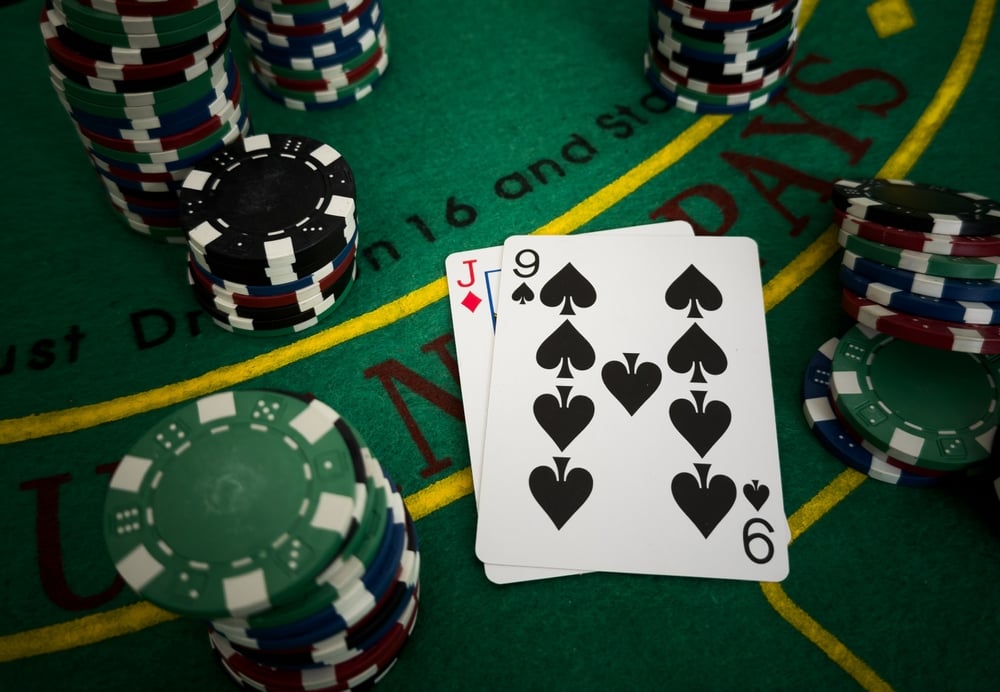
Image Credit: Netfalls Remy Musser/Shutterstock
Player Actions
Hit
Requesting an additional card to improve your hand total.
How it’s used:
Signal by tapping the table, or scratching it slightly in your direction. You can hit multiple times until you stand or bust.
Stand
Ending your turn with your current hand total, taking no more cards.
How it’s used:
Signal by waving your hand horizontally over your cards.
Double Down
Doubling your original bet in exchange for receiving exactly one additional card.
How it’s used:
Place an equal bet beside your original wager, such as another $10, if your original bet was $10 (or whatever is the equal amount to your original wager). This is best used when you have strong advantage (like 11 vs. dealer 6).
Split
Dividing a pair into two separate hands, each receiving an additional card.
How it’s used:
Place a second bet next to the split hand, equal in amount to the original. Now each card becomes a separate hand, and is thereafter played independently of the other. Effectively, you now have TWO hands instead of just the original one hand.
Resplit
Splitting again when you receive another matching card after an initial split.
How it’s used:
Most tables allow resplitting up to 3-4 total hands. Rules vary, especially for Aces.
Surrender
Forfeiting your hand and losing half your bet before playing the hand to completion.
How it’s used:
Late surrender (after dealer checks for Blackjack) is most common. Early surrender is rare. Not offered at all tables.
Insurance
A side bet (up to half your original wager) offered when the dealer shows an Ace, paying 2:1 if dealer has Blackjack.
How it’s used:
Generally not recommended by Basic Strategy. Mathematically unfavorable except for card counters in specific situations.
Dealer Procedures
Upcard
The dealer’s visible card showing face-up.
How it’s used:
All player decisions are made based on the dealer’s upcard and your hand total.
Hole Card
The dealer’s face-down card, hidden until all players complete their hands.
How it’s used:
The dealer peeks at the hole card when showing an Ace or 10 to check for Blackjack before players act.
Dealer Checks for Blackjack
The dealer peeking at the hole card when showing an Ace or 10-value upcard to determine if they have Blackjack.
How it’s used:
If the dealer has Blackjack, the round ends immediately before players can act (except for insurance settlements, or if another player also has a Blackjack, in which case that hand become a “Push” in most casinos).
Burn Card, or Cards
The top card, or multiple cards in some casinos, which are discarded after shuffling before dealing begins.
How it’s used:
Standard Casino procedure to prevent the top card, or sequence of cards, from being glimpsed during shuffle.
Betting and Money Terms
Bankroll
Your bankroll is the total amount of money you’ve set aside for gambling.
How it’s used:
Proper bankroll management means betting only a small percentage per hand to withstand variance.
Units
A standardized betting amount used as a reference (e.g., 1 unit = $25).
How it’s used:
Strategy discussions reference units instead of dollar amounts to apply universally across stake levels.
Flat Betting
Wagering the same amount on every hand regardless of outcomes.
How it’s used:
The safest betting approach for recreational players who follow Basic Strategy.
Progressive Betting
Varying bet sizes based on wins, losses, or other factors.
How it’s used:
Systems like Martingale increase bets after losses. None overcome house edge; they just redistribute variance. However, strategically varying your wagers is good, when based on solid information such as from counting cards, or at least observational knowledge of the game and the cards dealt thus far.
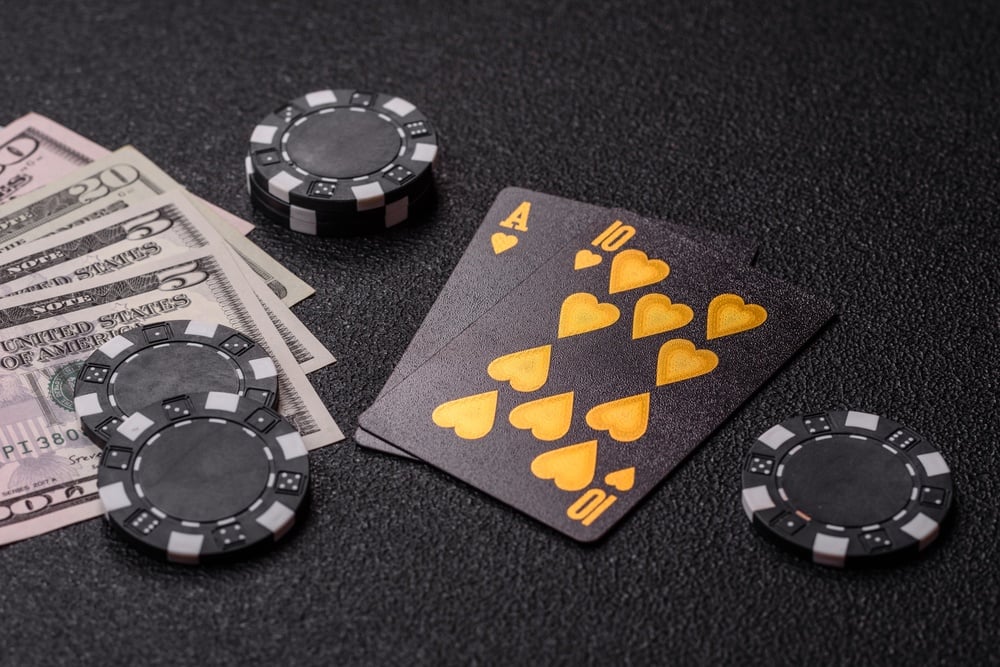
Image Credit: Tetiana Chernykova/Shutterstock
Betting Circle / Betting Spot
The marked area on the table felt where you place your wager.
How it’s used:
Each position at the table has a betting circle. Place your chips there, and BEFORE any cards are dealt.
Toke / Tokes
Tips given to the dealer, typically in chips.
How it’s used:
Place a chip in front of your betting circle to tip the dealer. Common after big wins or good service.
Coloring Up
Exchanging smaller denomination chips for larger ones when leaving the table. It’s easier to carry a few higher-denomination chips, than to try to haul a lot of smaller-value chips around, or when taking them to the Casino Cage to cash in.
How it’s used:
Tell the dealer you’re coloring up. They’ll exchange your chips for easier-to-carry denominations.
Strategy and Advantage Play Terms
Basic Strategy
The mathematically optimal way to play every hand based on your cards and dealer’s upcard.
How it’s used:
Following Basic Strategy reduces house edge to its minimum (typically about 0.5% or less with good rules).
House Edge
The Casino’s mathematical advantage expressed as a percentage, representing expected loss over time.
How it’s used:
Good Blackjack rules create a house edge around 0.5%. Poor rules (6:5, H17) push it above 2%.
Expected Value (EV)
The average amount you expect to win or lose on a given bet over the long run.
How it’s used:
Positive EV means profitable long-term. Negative EV means losing proposition over time.
Card Counting
Tracking the ratio of high to low cards remaining in the shoe to identify advantageous betting opportunities.
How it’s used:
Legal but unwelcome at Casinos. Counters increase bets when the count favors players. Casinos may ask counters to leave.
True Count
The running count divided by the number of decks remaining, used in card counting.
How it’s used:
Provides accurate betting and playing decisions by normalizing the count across different shoe depths.
Variance
The statistical measure of how results fluctuate around the expected value.
How it’s used:
High variance means wild swings. Blackjack has moderate variance, creating winning and losing streaks.
Betting Spread
The ratio between minimum and maximum bet sizes, typically used by card counters.
How it’s used:
Example: 1-8 spread means betting 1 unit at minimum, up to 8 units when the count is favorable.
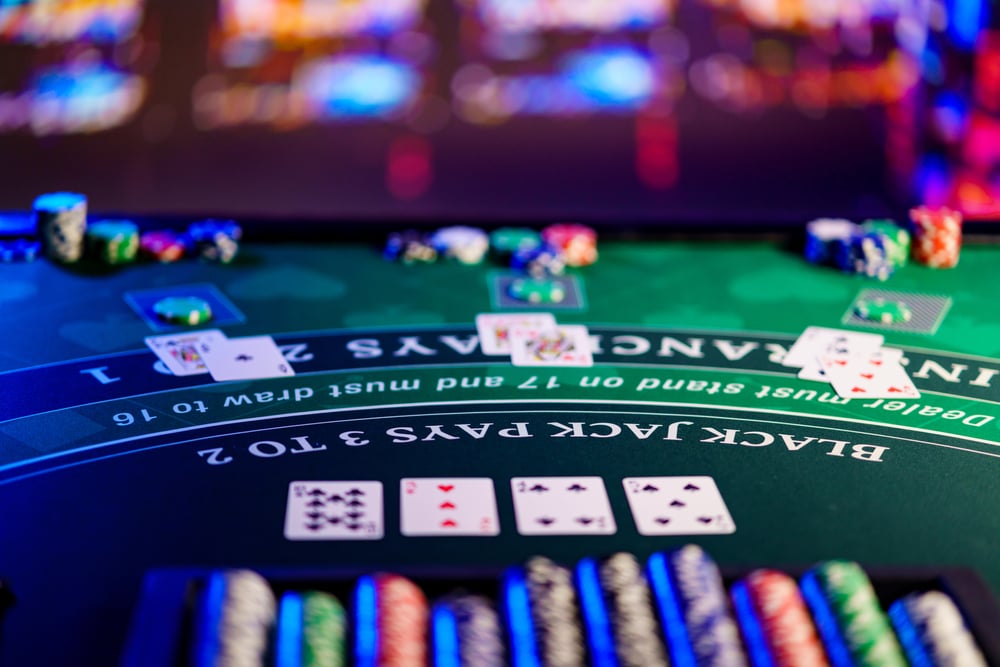
Image Credit: Tetiana Chernykova/Shutterstock
Common Blackjack Dealer Phrases and What They Mean
Here are phrases you’ll hear dealers announce and what they mean. Always follow dealer instructions. Casinos may have slight variations in accepted signals and phrases.
| Dealer phrase | What it means |
|---|---|
| “Blackjack pays 3 to 2” | Natural blackjack pays 1.5× your bet (good). Avoid tables saying “6 to 5” (poor payout). |
| “Insurance open” | Dealer is showing an Ace and offering the insurance side bet. Generally decline unless you’re counting cards. |
| “Dealer hits soft 17” | H17 rule is in effect, which slightly favors the house. |
| “Double after split allowed” | DAS rule is allowed, which is favorable for players. |
| “Surrender available” | Late surrender is offered; it can reduce the house edge when used correctly. |
| “No mid-shoe entry” | You can’t join the table until after the shuffle. Common at high-limit tables. |
Blackjack Hand Signals
| Action | Hand signal |
|---|---|
| Hit | Tap the table behind your cards with your finger. |
| Stand | Wave your hand horizontally over your cards (palm down). |
| Double Down | Place chips equal to the original bet beside (not on top of) your wager, then hold up one finger. |
| Split | Place a second bet beside the original, then hold up two fingers in a V-shape. |
| Surrender | Draw an imaginary horizontal line behind your bet with your finger (if offered). |
FAQs About Blackjack Terms
Soft 17 contains an Ace counting as 11 (like A-6) that can revert to 1 without busting. Hard 17 has no flexible Ace (like 10-7) and risks busting if hit.
A push is a tie between player and dealer with identical totals. Your bet is returned with no win or loss.
Doubling down means doubling your original bet in exchange for receiving exactly one additional card. It’s used when you have a strong advantage.
3:2 pays $15 on a $10 Blackjack (standard, player-friendly). 6:5 pays only $12 on a $10 Blackjack (poor payout increasing house edge significantly).
Insurance is a side bet offered when the dealer shows an Ace, paying 2:1 if dealer has Blackjack. It’s generally not recommended by Basic Strategy.
Mastering Blackjack Terminology
Understanding Blackjack terms transforms you from a confused beginner into a confident player who navigates Casino tables smoothly. These 50+ definitions cover the essential vocabulary you’ll encounter in live and online play.
Remember that terminology helps you understand the game, but mastering Basic Strategy determines your results. Learn the terms, study the strategy, verify table rules before playing, and gamble responsibly within your bankroll.
And now you know!
Title Image Credit: Tetiana Chernykova/Shutterstock