 Main menu

Prediction Markets
Gaming Trade Groups Demand Congress Bar Prediction Markets From Sports Wagering
Posted on: May 21, 2026, 07:06h.
Last updated on: May 21, 2026, 07:55h.


- A Senate subcommittee on Wednesday aggressively questioned whether prediction markets are being used as an un-taxed workaround to traditional sportsbooks
- Gaming trade groups formally demanded Congress intervene, arguing that allowing sports trading on prediction platforms creates a dangerous, parallel betting market
The U.S. casino industry took its fight straight to Capitol Hill on Wednesday (May 20), warning Congress that booming tech prediction markets are acting as unregulated sportsbooks in disguise.
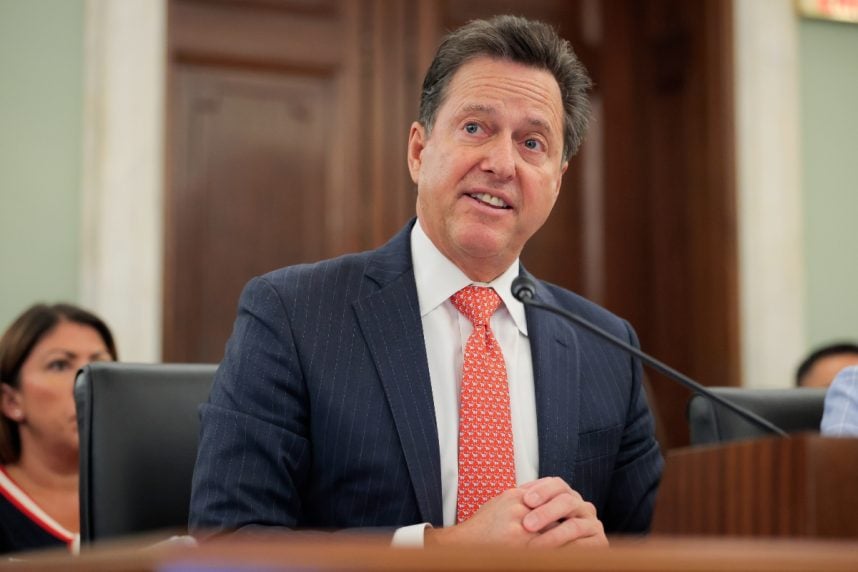
Appearing before the Senate Subcommittee on Consumer Protection, Technology, and Data Privacy, American Gaming Association President and CEO Bill Miller said prediction markets like Kalshi and Polymarket are running “backdoor sports betting operations.”
Miller said such products “undermine the work and expertise of 8,400 industry regulators, consumer protections embedded in state and tribal law, and the will of voters across the country.”
Under the second Trump administration, the Commodities Futures Trading Commission (CFTC), which regulates prediction markets, has embraced the lawful innovation of new event contracts on the speculative exchanges.
Last year, prediction markets began offering trading on the outcomes of sports games and events, which the CFTC has maintained constitutes a financial investment activity.
AGA: Prediction Markets Are Sports Betting
During his testimony, Miller opined that sports event contracts on prediction markets constitute sports betting.
These products function as sports betting in every meaningful sense. Consumers are betting money on the outcome of sporting events and player performances. Sports betting is being repackaged as a financial product bypassing the consumer protections, responsible gaming standards, and the state and tribal regulatory systems,” Miller testified.
Dr. Harry Levant, the director of gambling policy at the Public Health Advocacy Institute, agreed with Miller.
“Sports prediction markets meet the universally accepted and plain meaning definition of gambling. Sports gambling is defined as the betting or staking of something of value, with consciousness of risk and hope of gain, on the outcome of a game, a contest, or an uncertain event whose result may be determined by chance or accident or have an unexpected result,” Levant testified.
Levant, whose background includes a decades-long gambling addiction that caused him to steal almost $2 million from his law firm’s clients, said Congress allowing the CFTC to permit sports contracts on prediction markets poses consumer risks.
“Prediction markets offering sports futures contracts deliver the known addictive product of gambling to the public in an increasingly dangerous form,” Levant continued.
Most states that have legal sports betting require bettors to be at least 21 years old, though Kentucky, Montana, New Hampshire, Rhode Island, Wyoming, and Washington, DC permit 18+. Prediction markets are 18+ nationwide.
Pro Prediction Markets Lobby
Wednesday’s hearing also heard from the prediction markets. Patrick McHenry, a former US representative from North Carolina who chaired the House Financial Services Committee, contested claims that sports trades on prediction markets mimic sports betting.
Sportsbooks and prediction markets are fundamentally different products,” said McHenry, who now lobbies on behalf of the Coalition for Prediction Markets.
“In a sportsbook, the house sets the odds and profits when customers lose. In a prediction market exchange, participants trade with one another, while the platform earns transaction fees for facilitating the market. As a result, the incentives are fundamentally different,” McHenry testified.
More Testimony Likely
The hearing’s core principles were whether sports trades on prediction markets should be allowed, whether such contracts threaten the integrity of sports, and whether Congress and/or the CFTC needs to do more to prevent insider trading on the platforms.
Committee Chair Marsha Blackburn (R-Tenn.) said afterwards that the meeting would likely be the first of several regarding the future of prediction markets regulation.

 Most Read

Another Shooting Near Las Vegas Strip Casino Injures Man
 972,539 views

Vintners Oppose Napa Valley Casino
556,158 views



Conversation (0)
Be the first to comment on this article.