A Horn bet is a one roll proposition bet on 2, 3, 11, and 12, and you lose the entire wager if any other number comes up on the next roll.
Your Horn stake is split across four separate bets, so even when you hit, you only win on the number that rolled and you lose the other three portions.
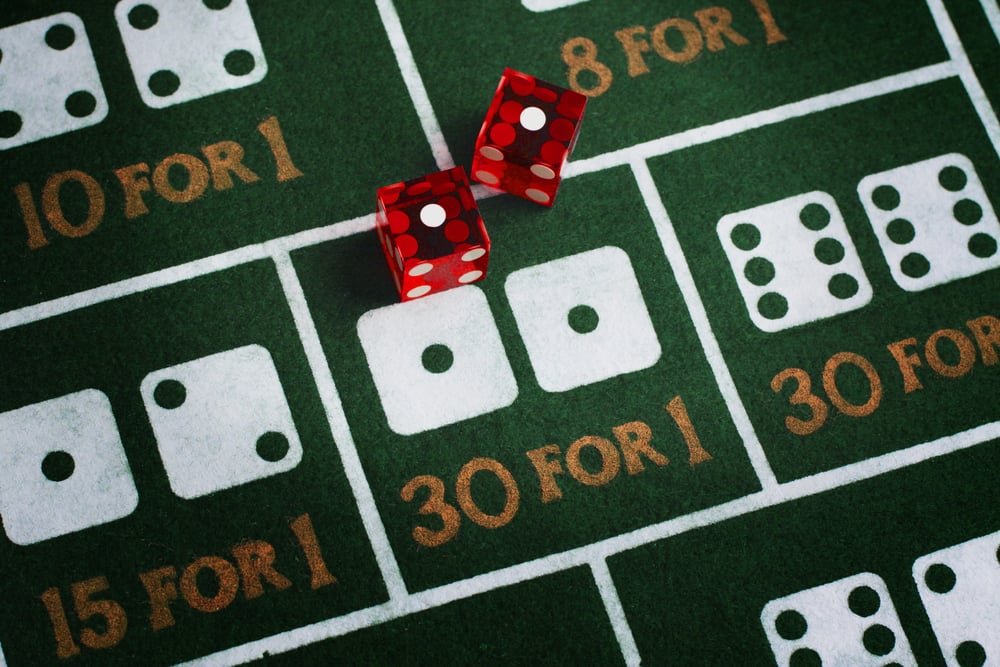
Typical payouts are 30 to 1 on 2 and 12, and 15 to 1 on 3 and 11, but some casinos pay less, so always check the layout and understand “to” versus “for.”
With standard payouts, the Horn carries about a 12.5 percent house edge, which is far higher than core craps bets like Pass Line or Place 6 and 8.
Horn High and C and E are common variations that change how coverage is weighted, but they are still high cost one roll bets, best used sparingly for entertainment rather than as a main strategy.
You are standing at a craps table watching the action, and you hear the stickman call out, “Horn bet. Two, three, eleven, twelve.” Chips slide into the proposition area, the dice roll, and someone suddenly gets paid $150 on a $5 bet. It looks like easy money, and it definitely has that one roll adrenaline that makes craps so addictive.
It is also one of the pricier ways to bet at the table. Horn bets can absolutely deliver a big hit on a single roll, but you are paying a steep premium in house edge for that quick burst of excitement. If you are going to play the Horn, you should know exactly what it covers, how the payouts work, and what the math is really doing behind the scenes.
Quick Answer: What Is a Horn Bet in Craps?
A Horn bet is a one roll proposition bet that covers four numbers: 2, 3, 11, and 12. You are betting that one of those numbers shows up on the very next roll. If any of them hits, you win on the portion of your bet that was placed on that number, while the other three portions lose. If anything else rolls, meaning 4, 5, 6, 7, 8, 9, or 10, you lose the entire wager.
The simplest way to picture it is four separate bets bundled into one call. Your money gets split evenly across the four Horn numbers, and whichever one lands determines your payout.
“The loudest Horn calls I hear are almost always right after someone else gets paid. One player hits a Horn, chips get pushed, the rail leans in, and suddenly three more people are tossing money into the prop box. It is contagious, and that momentum is exactly why the Horn is such a profitable bet for the house.”
Image Credit: Netfalls Remy Musser/Shutterstock
How a Horn Bet Works
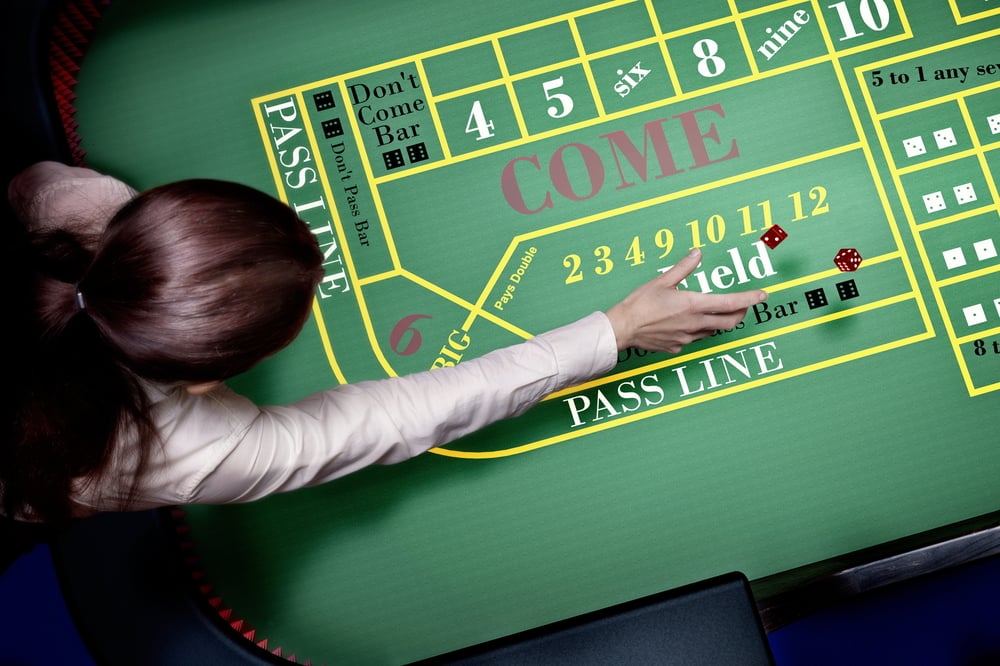
Horn bets work differently than the standard bets that stay up until they win or lose. A Horn is settled immediately on the next roll only, which is why it sits in the proposition area in the center of the layout. In most casinos, you do not place the Horn yourself. You toss the chips to the stickman, call out “Horn” with your amount, and the bet gets placed for you.
Because the Horn covers four numbers, the cleanest way to bet it is in multiples of $4 so it splits evenly:
$4 Horn equals $1 each on 2, 3, 11, and 12
$8 Horn equals $2 each
$20 Horn equals $5 each
You can bet odd amounts like $5 or $10, but many tables handle that as a Horn High bet where the extra money goes on one specific number. For the standard Horn, think in $4 units.
Here is the key detail that explains both the payout and the house edge. When one of the Horn numbers hits, you get paid on that portion, but you also lose the portions that were on the other three numbers.
Example: You make a $4 Horn bet and the next roll is 12. Your $1 on 12 wins and typically pays 30 to 1, so you win $30. At the same time, the $1 bets on 2, 3, and 11 all lose, which is $3 lost, so your net profit is $27 on a $4 total wager. If the next roll is anything else, such as 7 or 8, all four portions lose and the entire $4 is gone.
Horn Bet Payouts and Why They Vary
Horn payouts depend on which number hits, and they are based on the odds of rolling that number with two dice. The catch is that payout structures vary by casino, and the way payouts are phrased can change what you actually receive, so it is worth paying attention.
Most commonly, 2 and 12 pay 30 to 1, while 3 and 11 pay 15 to 1. On a standard $4 Horn, that typically works out to a net profit of $27 when a 2 or 12 hits, and $12 when a 3 or 11 hits, because you win on the one number and lose the other three $1 pieces.
Some casinos reduce the payouts slightly. You may see 2 and 12 paying 27 to 1 instead of 30 to 1, or 3 and 11 paying 14 to 1 instead of 15 to 1. That might not sound like a big difference, but it adds up fast if you play these bets regularly, so always check the layout.
You also want to understand “to” versus “for” language. A payout of 30 to 1 means you win $30 and you also get your $1 back. A payout of 31 for 1 means you receive $31 total including your original $1, which is the same thing in practice. A payout of 30 for 1 means you receive $30 total including your original $1, which is only $29 in winnings, and that is where players get caught.
Image Credit: Netfalls Remy Musser/Shutterstock
Horn Bet Odds and House Edge
This is where the casino really earns its keep. With two six sided dice, there are 36 possible outcomes. The Horn numbers show up this often: 2 has 1 way to roll, 3 has 2 ways, 11 has 2 ways, and 12 has 1 way. That is 6 ways out of 36 to hit any Horn number, which is 1 out of 6, or about 16.67 percent. In other words, you lose a Horn bet about 83.33 percent of the time.
Now let us put that against standard payouts on a $4 Horn. If 2 or 12 hits, which happens 2 out of 36 rolls combined, your net is +$27. If 3 or 11 hits, which happens 4 out of 36 rolls combined, your net is +$12. If anything else hits, which happens 30 out of 36 rolls, your net is -$4.
So you expect to lose 50 cents for every $4 Horn bet you make, which equals a 12.5 percent house edge. For comparison, Pass Line sits around 1.41 percent, and Place 6 or 8 is around 1.52 percent. That is why the Horn is considered expensive. You are paying roughly nine times more per dollar wagered than a Pass Line bet.
“I have seen plenty of players fall in love with the Horn right after a big hit, especially when it is a clean 12 that pays and the table erupts. The problem is what happens next. They start chasing that same feeling for the next hour, firing Horns every roll, and the bankroll drains quietly because they are paying that 12.5 percent premium over and over.”
Horn Bet Variations You Will Hear at the Table
Once you understand the standard Horn, you will hear players calling variations that lean extra money onto one number.
Horn High
A Horn High still covers 2, 3, 11, and 12, but it puts extra money on one of those numbers, which is why it is often called in $5 units. A few examples:
$5 Horn High Yo equals $1 on 2, $1 on 3, $2 on 11, $1 on 12
$5 Horn High Twelve equals $1 on 2, $1 on 3, $1 on 11, $2 on 12
Players do this when they have a favorite number or they want a bigger payout if a specific Horn number lands. Horn High Yo is the most common because 11 has better odds than 2 or 12 and it is constantly in play at the table. You will also hear it called on the come out roll as a loose hedge around other action, sometimes paired with a C and E bet, but the core point remains the same. The math does not suddenly become friendly. It is still a high house edge proposition bet.
“I still remember the first time I watched someone smash a Horn High Yo on the come out roll at a packed table. The stickman barked it out, the dice hit the wall, an 11 showed up, and the place went nuts like it was a jackpot. Three minutes later the same player tried to run it back, and it died immediately. That is the Horn in real life, a highlight reel followed by long stretches of nothing.”
C and E
The C and E bet is similar in spirit but groups numbers differently. C is Craps, which includes 2, 3, and 12, and E is Eleven, which is 11. A $2 C and E typically splits into $1 on Craps and $1 on Eleven. If any Craps number hits, the Craps portion usually pays 7 to 1. If 11 hits, the Eleven portion usually pays 15 to 1.
Compared to the Horn, C and E hits more frequently because the Craps numbers are grouped together, but the Horn can pay more on 2 and 12 because they are treated separately. C and E also tends to be slightly less expensive, with a house edge around 11.1 percent versus about 12.5 percent for a standard Horn.
Image Credit: Netfalls Remy Musser/Shutterstock
When a Horn Bet Makes Sense
Horn bets are not value bets. The house edge is simply too high to treat them as a steady strategy. But they can still have a place in your session if you are honest about what they are and why you are making them.
Horn bets make sense when you are playing for entertainment, you understand the cost, and you are using them sparingly as a small side bet for one roll action. They can also show up in specific moments where a player wants a short term hedge feel around other bets, even though it still costs money long term.
If you want better value and more time at the table, build your game around Pass or Do Not Pass with odds, Come bets with odds, and Place 6 and 8. Those are not as flashy, but they give you better math and better bankroll longevity.
A practical approach is to set aside a small amount for proposition bets if you enjoy them, then keep your main action on low edge bets. If you want to toss $5 or $10 at a Horn once or twice when the mood hits, that is the right lane. It should not be the backbone of your play.
Common Horn Bet Mistakes
Most Horn mistakes come from either confusion or emotion. Keep these in mind.
Betting amounts that do not split cleanly. Standard Horn bets are easiest in $4 units, and Horn High is usually easiest in $5 units.
Confusing “to” and “for” payouts. 30 to 1 and 31 for 1 return the same total, but 30 for 1 pays less than many players assume.
Thinking the Horn stays up. It is a one roll bet. If you want it again, you have to call it again.
Chasing losses with Horn bets. The big payout temptation is real, but pressing high edge one roll bets to get even is a fast way to empty your bankroll.
“Any time I hear a newer player say, ‘It is only five bucks,’ I know how that story usually ends. Five becomes ten, ten becomes twenty, and now they are pressing a high edge one roll bet because they want to get even fast. The dice do not care, the math does not budge, and that is how a small ‘fun’ bet turns into a session killer.”
Craps Horn Bet FAQ
What numbers does a Horn bet cover in Craps?
A Horn bet covers 2, 3, 11, and 12.
Is a Horn bet a one roll bet?
Yes. It resolves on the very next roll. It does not carry over unless you re bet it.
What does a $4 Horn bet mean?
It means $1 is placed on each of the four Horn numbers: 2, 3, 11, and 12.
What is a Horn High bet?
It is a Horn bet with extra money on one Horn number. A $5 Horn High Yo puts $2 on 11 and $1 on the other three.
What are typical Horn bet payouts?
Most commonly, 2 and 12 pay 30 to 1, while 3 and 11 pay 15 to 1. Some casinos pay 27 to 1 and 14 to 1 instead, so check the layout.
What is the house edge on a Horn bet?
With standard payouts, it is about 12.5 percent.
Can I make a Horn bet for any amount?
You can, but standard Horn bets work best in multiples of $4. Odd amounts are usually treated as a Horn High variation where the extra money goes on one number.
The Bottom Line on Horn Bets
Horn bets bring the fireworks. They can pay big on a single roll, but they cost you for the privilege. With standard payouts, the house edge is about 12.5 percent, which is far higher than the core bets most players should be building around.
If you know the math and you are using Horn bets for entertainment, fine. Keep them small, keep them occasional, and keep your main action on low edge bets like Pass or Do Not Pass with odds, Come with odds, and Place 6 and 8. Most importantly, always check the posted payouts before you bet, because small payout tweaks create meaningful changes in what the bet costs you, and remember the Horn is a one roll decision every time.
Now you know what a Horn bet is, how it works, what it pays, what it costs, and when it makes sense to play it. Use the knowledge wisely, and may the dice roll your way.
What’s your story going to be? Tell us in the comments below and become your own Gambling Legend!
And now you know!
Vegas Vic
Title Image Credit: Netfalls Remy Musser/Shutterstock