
How to Split in Blackjack

Summarize this post
Key Takeaways
- Always split Aces and 8s. This rule for blackjack split strategy the backbone of correct pair strategy in almost every common ruleset.
- Never split 5s or 10s. 5-5 is usually a strong double or hit hand, and 10-10 is already 20.
- DAS changes borderline decisions. Double After Split can turn “maybe” pairs like 2s, 3s, 4s, and 6s into profitable splits.
- Table rules are part of the strategy. Resplitting limits, split-Ace restrictions, and H17 vs. S17 affect correct play.
- A split is only step one. You still have to play each new hand properly, especially doubling opportunities.
A blackjack split looks like a simple move. You get two matching cards, add a second bet, and play two hands. But it’s also one of the fastest ways to either tighten up your game or give away value, depending on whether you split in the right spots.
If your goal is to play smart, this is not a “do you feel lucky” decision. It’s basic strategy. And basic strategy starts with one assumption. You make the mathematically best move for the rules on the felt, not the loudest opinion at the table.
If you want the big-picture context first, start with our core blackjack strategy guide, then come back here for the split-specific decisions.
“In my experience, most bad splits aren’t really about the cards. They happen when players ignore the table rules and use a chart that doesn’t match the game.” – Victor H. Royer
What does split mean in blackjack?
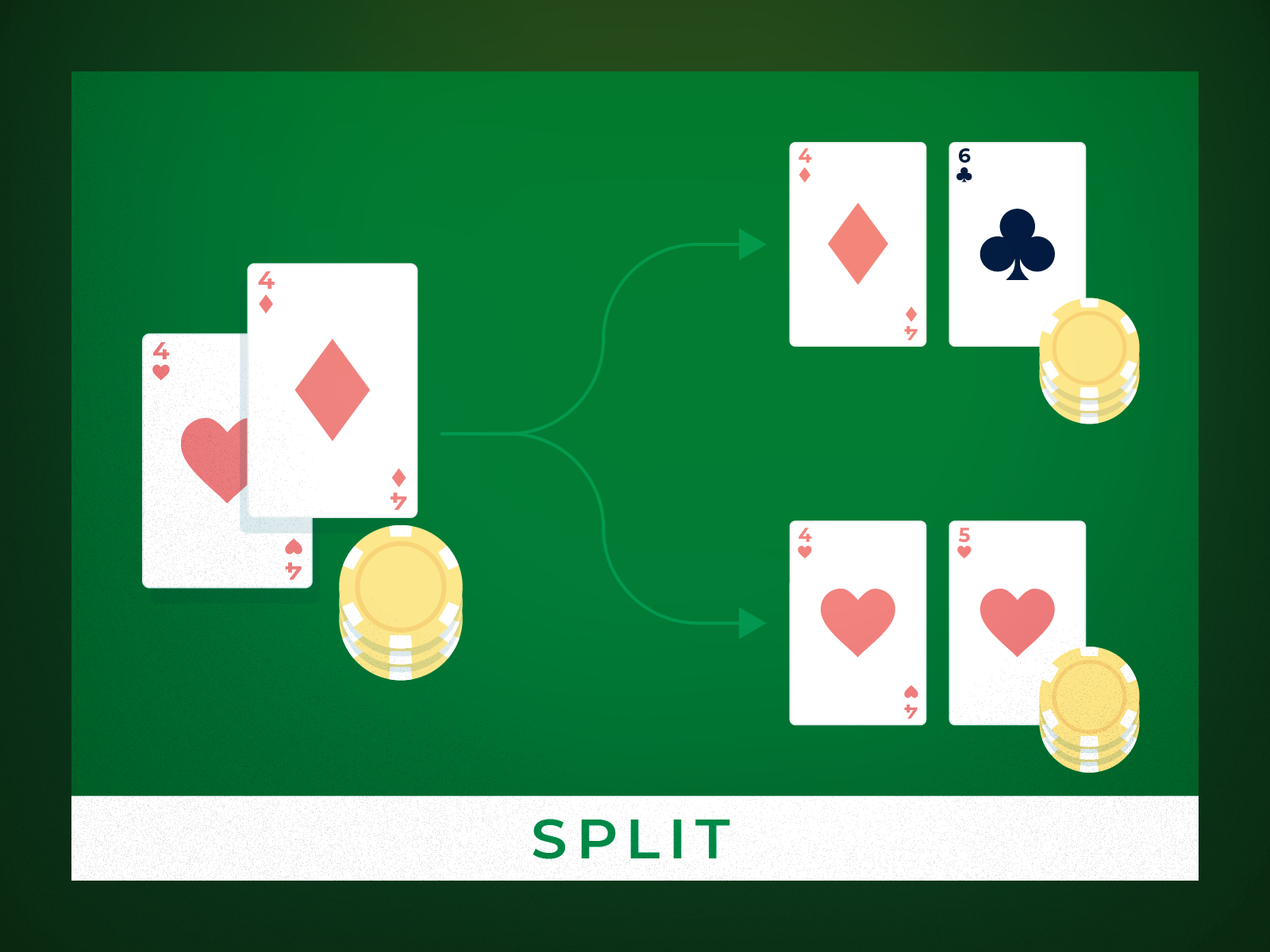
A blackjack split is when you divide your first two cards into two separate hands because they are a pair. To split, you must place a second bet equal to your original wager, and the dealer gives each new hand an additional card.
Basic strategy says you should always split Aces and 8s, never split 5s or 10s, and adjust other pair decisions based on the dealer’s upcard and table rules like Double After Split (DAS).
Example. You’re dealt 8-8. Instead of playing a hard 16, you split into two hands starting at 8 and 8, giving yourself two chances to build better totals.
What counts as a “pair” for splitting?
At most tables, you can split any two cards of the same rank, from 2-2 through A-A, including face cards like Q-Q.
The common “gotcha” is 10-value cards. Some games allow splitting any two 10-value cards, including K-Q or J-10. Many require exact rank matches, which means 10-10 only, K-K only, and so on. Always check the rules in the table placard or the online game info.
For a quick overview of how casinos structure common blackjack rules, and how strategy charts reflect them, see our blackjack strategy charts post.
How to Split in Blackjack: Rules you need to know
Splitting decisions only make sense when you understand the rules that govern what happens next.
You can only split on your first two cards
You can split only on the initial two-card hand. Once you hit, stand, or double, the option is gone.
You must match your original bet
Splitting always requires a second wager equal to the first. If you bet $25, your split costs another $25.
Resplitting is common, but limited
Most tables allow you to resplit if you draw another matching card to a split hand. Typical caps are three or four hands total. Some tables treat Aces differently.
Split Aces usually come with restrictions
Most games treat split Aces as “one card and done.” Each Ace gets exactly one additional card, then you must stand. Many tables also prohibit resplitting Aces.
If you want a deeper explanation of how Aces behave, and why they’re treated differently, our guide on Ace strategy and splitting Aces is a strong companion read.
A 21 after a split is usually not a natural blackjack
If you split Aces and draw a 10-value card, you have 21, but most casinos treat it as a standard 21 that pays even money, not a natural blackjack payout.
DAS, the rule that changes split strategy the most
Double After Split, or DAS, means you can double down on hands created by splitting. It matters because many split hands naturally land on strong doubling totals.
Example. You split 8s and receive a 3 on one hand for a total of 11. In a DAS game, doubling that 11 is often the best play.
If DAS is not allowed, several borderline splits become less attractive. This is why the strategy charts matter. They’re built around specific rule assumptions, and splitting is one of the places where rule mismatches cost the most.
“In my opinion, DAS is the single most important small rule players overlook. If you don’t know whether DAS is allowed, you don’t really know which split chart you should be using.” – Victor H. Royer
When to split in blackjack
This is the decision layer that separates “playing the cards” from playing blackjack correctly.
Always split Aces
A-A played as a single hand is weak, either 2 or 12. Split them, and you create two hands starting with the strongest card in the game. Even with typical split-Ace restrictions, splitting Aces is almost always the best move.
Always split 8s
8-8 is hard 16, one of the worst totals in blackjack. Splitting turns one bad situation into two hands that can still be built into competitive totals.
Even against a dealer 10, splitting 8s is often the correct basic strategy choice. In some surrender games, surrender can be the better option. Many players will not have surrender available, though, and the split remains the right default.
Split 9s in the right matchups
9-9 totals 18, which looks strong, but it’s not always the best way to maximize value. Against weak dealer cards, splitting 9s can outperform standing because you’re creating two hands that can each win against a vulnerable dealer.
General rule. Split 9s against dealer 2 through 6 and against 8 or 9. Stand against 7, 10, and Ace.
Split 7s against dealer 2 through 7
7-7 is generally a split against dealer 2 through 7. Against 8, 9, 10, and Ace, you typically hit 14.
Split 6s, 4s, 3s, and 2s selectively, and watch DAS
These are the hands where rules matter most:
- 6-6 is commonly a split against dealer 2 through 6, especially with DAS
- 4-4 is usually a split only against dealer 5 through 6, and typically requires DAS
- 2-2 and 3-3 are often splits against dealer 4 through 7 in DAS games, and tighter without DAS
If you want a simple way to keep your decisions aligned, use a rules-matched chart and do not improvise.
When not to split in blackjack
Just because you can split doesn’t mean you should.
Never split 5s
5-5 is hard 10, one of the best starting totals in blackjack. It’s often a double in favorable matchups. Splitting it turns a strong hand into two weak hands.
Never split 10s
10-10 is 20. Standing on 20 is almost always the best play. Yes, advantage players can sometimes justify 10 splits in rare counting situations, but that’s not how most people are playing most tables.
“In my experience, when someone splits 10s in a normal casino game, it’s usually not advanced strategy. It’s just chasing action.” – Victor H. Royer
Don’t split 9s against 7, 10, or Ace
Against 7, your 18 is strong enough to keep. Against 10 or Ace, splitting tends to underperform standing because you’re creating two hands that start from 9 against a strong dealer upcard.
How to split in blackjack chart
| Your Pair | Split Against Dealer Upcards |
|---|---|
| A-A | Always split (all upcards) |
| 10-10 | Never split |
| 9-9 | Split vs 2-6, 8-9 (stand vs 7, 10, A) |
| 8-8 | Always split (all upcards) |
| 7-7 | Split vs 2-7 (hit vs 8, 9, 10, A) |
| 6-6 | Split vs 2-6 (best in DAS games) |
| 5-5 | Never split (often double in good matchups) |
| 4-4 | Split vs 5-6 only (typically requires DAS) |
| 3-3 | Split vs 4-7 (tighter without DAS) |
| 2-2 | Split vs 4-7 (tighter without DAS) |
Chart assumptions:
- Typical multi-deck blackjack
- Dealer stands on soft 17 (S17)
- Double After Split (DAS) allowed
- Resplitting allowed (Aces usually restricted)
If your table rules differ, a few decisions can shift, especially the small pairs.
How table rules change split strategy
If you want to play a strong game, treat rules as part of the strategy, not fine print. Our overview of blackjack house edge is a useful way to understand which rules matter most.
Key rule levers that affect splitting:
- Dealer hits soft 17 (H17) vs. stands on soft 17 (S17)
- DAS vs. no DAS
- How many hands you can create by resplitting
- Whether you can resplit Aces
- Whether 10-value cards can be split by value or must match rank
- 3:2 vs. 6:5 blackjack payout, which does not usually change split choices but does affect the overall value of the table
Common blackjack split mistakes
Most players don’t lose money because they never split. They lose money because they split incorrectly or misplay what comes after.
Common leaks:
- Splitting automatically without a chart
- Using a DAS chart at a no-DAS table
- Splitting correctly, then missing doubles on the new hands
- Forgetting that splitting increases exposure because you’re putting more money into action
If you want a broader “what not to do” checklist of blackjack mistakes to avoid, our article covers the most common real-world errors.
FAQ: How to split in blackjack
Only on your initial two-card hand, and only when the cards are the same rank. Some tables also allow any two 10-value cards to be split.
Usually, yes. It often goes up to three or four hands total, depending on the rules. Aces tend to have tighter restrictions.
Only if the table allows DAS. If DAS is not allowed, your correct split decisions for small pairs can change.
Usually not. Standard rules give split Aces one card each, then you must stand.
Usually no. It counts as 21 but typically pays even money rather than a blackjack bonus payout.
Final thoughts
If you want the simplest “play it right” framework for blackjack split decisions:
- Split Aces and 8s
- Don’t split 5s and 10s
- Let DAS and the dealer upcard guide the rest
For readers who want to go deeper, and keep their decisions consistent across every hand type, check out our blackjack betting strategy article. Beginners will also benefit from how to play blackjack for dummies, which reinforces the same fundamentals in a broader “start here” format.