 Main menu

Las Vegas
Las Vegas’ Bone-Dry Red Rock May Use Seeding Clouds as Water Source
Posted on: September 22, 2022, 06:26h.
Last updated on: September 23, 2022, 11:47h.


Seeking seed money for your Las Vegas project doesn’t usually go like this. An environmental organization called Save Red Rock is asking for $150,000 in public donations to make it rain and snow in Las Vegas’ Red Rock Canyon by seeding the clouds above it. The 501(c)(3) nonprofit has raised about $38,000 so far.
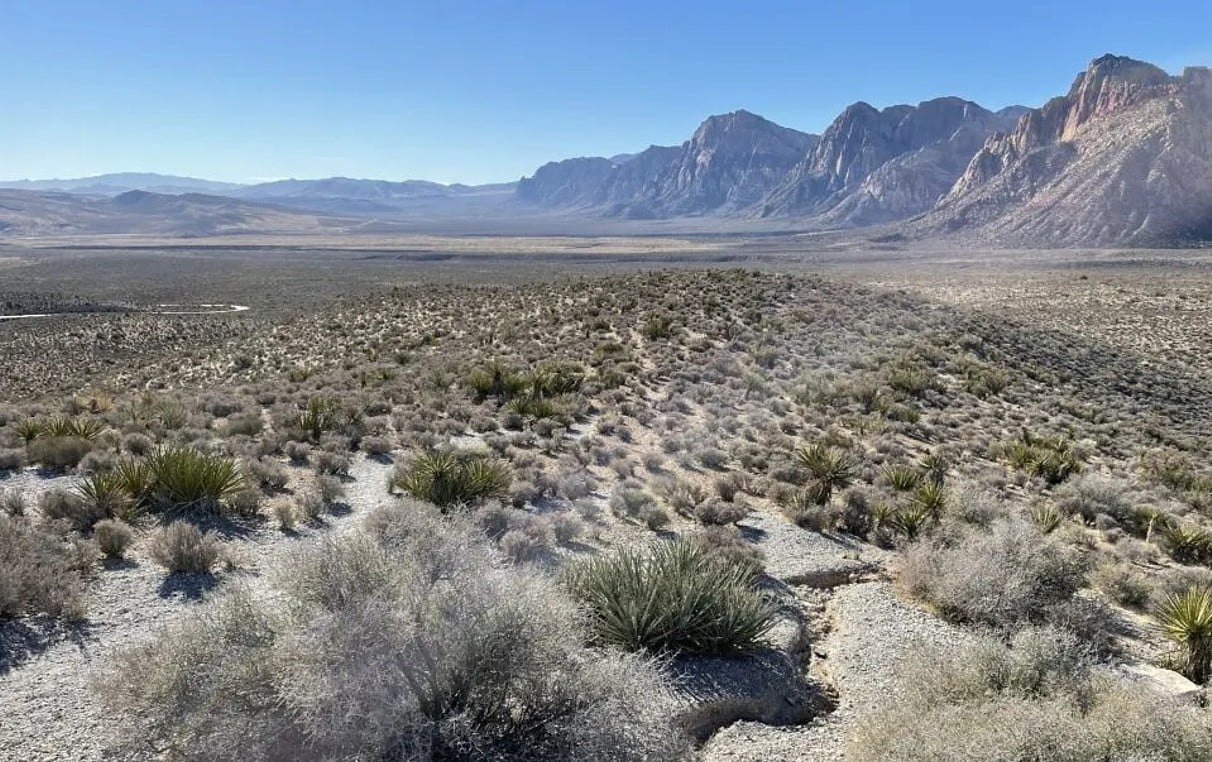
Global warming and decades of below-average rainfall have taken a severe toll on the plants and animals of the nationally designated conservation area, located 25 miles west of the Strip. And cloud-seeding could, at least in theory, bring much-needed precipitation.
We all love Red Rock Canyon, it’s not doing so well,” said Pauline van Betten, Save Red Rock’s land and water specialist, in a Sept. 8 webinar available on the organization’s website. “The Joshua trees are really dying, and it’s really in dire condition.”
According to data from the National Oceanic and Atmospheric Administration, average annual precipitation at Red Rock plummeted from 1981-2010 mean of 11.3 inches to 2011-2017 mean of 6.9 inches. That’s why, 15 years ago, Red Rock’s lower Cottonwood Springs was a 15-foot deep swimming hole filled with birds, frogs and water plants. Today, it’s just more desert.
Seed Planted in Their Head
Cloud-seeding was invented in the 1930s when scientists noticed that airplanes flying through clouds got coated in ice crystals. The idea was to make ice crystals form similarly around dust they introduced into clouds. This would then make snowflakes and raindrops that could fall to the ground in a predictable way.
The process employs an inorganic aerosol — typically silver iodide, due to its similar molecular structure to ice — around which the ice crystals nucleate.
Save Red Rock’s cloud-seeding would be performed by scientists from the Desert Research Institute (DRI), a nonprofit research campus of the Nevada System of Higher Education. For the past eight years, DRI scientists have hauled generators to mountaintops in the Spring Mountains, which encompass Red Rock. Here, they shoot a solution of silver iodide into passing clouds.
10% More Rain
Most studies of cloud seeding have found mixed results. One conducted in 2016 by the National Academy of Sciences failed to find statistically significant support for its ability to reliably increase rain or snow. In 2003, the US National Research Council found that “scientifically acceptable proof for significant seeding effects has not been achieved.”
But DRI claims that its test cloud-seedings have increased area precipitation by about 10%. These match data from the American Meteorological Society, which in 1998 found a 10% precipitation increase in supercooled clouds that develop over mountains like in Red Rock Canyon.
According to its results from seeding last year in the Spring Mountains, DRI claimed that this 10% represented 3,360-acre feet. That’s enough to meet all the water needs of 6,700 households annually.
At a cost of $8 to $10 per acre-foot, Utah, Colorado, and Wyoming have already turned to state-funded cloud-seeding projects to try and increase the snowmelt that feeds the Colorado River.
Save Red Rock and DRI aim to launch their project on Nov. 15. That’s just in time to increase the water from winter storms that already provide 70% of the Spring Mountains’ groundwater recharge.
Donations can be made to saveredrock.com/make-it-rain.

 Most Read

Another Shooting Near Las Vegas Strip Casino Injures Man
 972,624 views
Vintners Oppose Napa Valley Casino
556,232 views


Conversation (0)
Be the first to comment on this article.