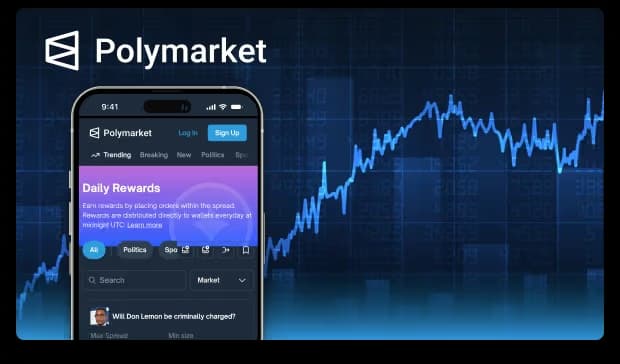

This guide breaks down what 5-minute markets actually are on Polymarket, how they compare to live betting, why crypto is the asset of choice for this format, and what you should know before jumping in.

A 5-minute prediction market is exactly what it sounds like: a contract that resolves based on what happens to an asset’s price over a five-minute window. On Polymarket, these markets are framed as a simple Up or Down question. "Will the price of Bitcoin (or another crypto) be higher or lower at the end of the five-minute window than it was at the start?"Each contract is priced between $0.01 and $1.00, with that price reflecting the market’s collective view of how likely the outcome is. If a contract for Bitcoin going Up is trading at $0.68, it means traders currently think there’s roughly a 68% chance the price will be higher at resolution. If your side of the trade is correct, the contract settles at $1.00. If it’s wrong, it settles at $0. The gap between what you paid and what you can sell for (or what it resolves at) is where the profit or loss comes from.Here’s the basics of a 5-minute trading market:
A new market opens up with a target price. Something along the lines of “Will BTC be above $80,000 in 5 minutes?”
The Up and Down contracts both start near $0.50, reflecting a 50/50 probability (roughly).
The asset’s price moves in real time, and the contract prices adjust to reflect the market’s evolving belief about which side will win.
If the asset is trading above the target price with only a minute remaining, the Up contract could trade near $0.90, while Down drops toward $0.10.
When the clock stops, Polymarket checks the final settlement price against the target. The winning side resolves to $1.00 (or $0.99, after fees) and the losing side resolves to $0.00.
Resolution isn’t left to guesswork or a single exchange’s ticker. Polymarket’s Bitcoin 5-minute markets, for example, use Chainlink’s BTC/USD data stream as the official resolution source, so the outcome is tied to a specific, verifiable price feed rather than whatever number appears on a random site.Because the window is so short, there’s very little time to sit back and analyze like you would with other prediction markets. You’re either in before the clock resets, or you’re watching from the sidelines until the next one opens.
How 5-minute markets differ from live betting
At first glance, 5-minute markets and live betting look similar. Both let you react to events in real time, but they operate quite differently under the hood. Live betting lets you place wagers on a sporting event while it’s already underway. Odds shift continuously based on the score, momentum, and game events, and sportsbooks periodically pause betting to recalculate prices before reopening markets. You’re betting against a sportsbook that sets the odds, and your bet is tied to the outcome of the game itself.Five-minute crypto prediction markets remove the sportsbook from the equation. Instead of betting against the house, you’re trading a contract on a peer-to-peer exchange, where prices are set by what other traders are willing to pay, not by a bookmaker’s odds. There’s also no ongoing "game" to follow because the event is simply the price movement of an asset over a fixed, short window. Once that window closes, the contract resolves, and a new one opens.
Here are the key facts:
5-minute prediction markets
Live betting
Win/loss
$0.00 for a loss, $1.00 (minus fees) for a win
Whatever you staked + sportsbook's vig
Time commitment
Limited to a fixed 5-minute window per cycle
Period, inning, quarter, etc. (set timeframe based on the sport)
Tools needed
Polymarket account, price to watch
Sportsbook account, streaming service/TV cable package to watch the game
Assets available
Crypto
Sports
Legal status
49 US states + DC; NV excluded
38 states + DC
Predictions aren't bets
Live betting is wagering on the outcome of an event as it unfolds, while 5-minute markets are trading a financial-style contract on price direction over a set time period. The former revolves around sports betting; the latter, at least for now, revolves entirely around crypto.
Don't expect to make money
“Treat 5-minute markets like something fun to trade instead of a way to make money. As soon as one market closes, another opens, so don't jump on each one. These markets are immediate, and it's important to remember that your bankroll will deplete quickly if you trade each one that pops up. Keep this in mind, not just for 5-minute markets but all trades, whether on Polymarket or an app like OG.com."
If you go looking for a 5-minute market on Polymarket, you’ll find they're exclusive to cryptocurrencies (Bitcoin, Ethereum, Solana, Dogecoin, and some others). That’s not an accident.The biggest reason is volatility paired with liquidity. Crypto prices can move meaningfully within a five-minute window, giving the market something real to resolve on. Try to build a 5-minute market around something like a stock index, a slower-moving commodity, or something like entertainment predictions, and you’ll often find the price barely budges in that time. There’s not enough movement to make the Up or Down question interesting, and it becomes harder to resolve fairly.Crypto also has the infrastructure to support it. Reliable, continuously updated price feeds (like Chainlink’s data streams) exist specifically for digital assets and trade around the clock, seven days a week. That constant, verifiable data flow is what makes it possible to open and resolve a new market every five minutes without interruption. Traditional markets like stocks have trading hours, settlement delays, and less standardized real-time data feeds, none of which fit a format built for nonstop, minute-by-minute trading.Other event categories or sports predictions on Polymarket do have live and short-duration options, but so far, the ultra-fast 5-minute format has is rooted in crypto, where the underlying data and volatility make it possible.
Crypto markets have big swings
“Crypto assets swing hard and fast, making them ideal for short-term quick trades. I could see weather predictions opening up to these kinds of markets in cities/areas where the climate is variable and volatile, but we're a long way from that."
New markets open every five minutes, so there’s always another opportunity right around the corner
Binary Up or Down decision, which makes it easy to understand
You’ll know within minutes whether your prediction paid off, rather than waiting hours or days
Contract prices reflect real trading activity from other participants, resolution sources are stated upfront
Cons
Short time windows and constant price movement mean outcomes can flip quickly
Once in a contract, there’s only a narrow opportunity to sell early before resolution
Tips
Trading on these quick markets isn't rocket science, but there are things you can do to ensure your trades have value.
🏷️ Check price action first
Most platforms, including Polymarket, let you review a short-term price chart before you trade. It won’t predict the future, but it gives you context on recent momentum. Don’t assume a trend will simply continue. You don't have to memorize the chart or anything, but definitely keep it handy while your trade is in progress.
🌊 Don't get swept up in the crowd
Trading activity from other users can be visible on the platform, and it’s tempting to follow what everyone else seems to be doing. Do your own research on the situation rather than chasing the herd. We're not all crypto analysts by day, so John in Des Moines probably knows just as much (or even less) as you do.
🤔 Understand the resolution source
Know exactly which price feed determines the outcome (for example, Chainlink’s BTC/USD stream) so there’s no confusion about how a trade settles. Polymarket will tell you where exactly its data comes from, giving you insight into how the market shifts.
🎁 Take advantage of bonuses
Sign-up bonuses can give you an extra boost to your bankroll, letting you trade without using your own funds. The majority of prediction markets provide easy-to-claim welcome offers to new users. For full details on all offers, check out our predictions markets bonus page.
🪙 Trade responsibly
These markets are volatile and fast by design. Only trade with money you’re prepared to lose, and take breaks. The constant five-minute cycle is built to keep you engaged, so it’s on you to pace yourself. Don't forget about trading fees either. While they might seem small on one contract, they add up over time. Decide in advance how much you’re willing to risk, and treat that as a hard limit.
Are 5-minute markets worth your time?
The simplicity of 5-minute markets is what draws most traders in. You're predicting whether a crypto asset will go Up or Down by a set price. But, these quick markets are still trades, whether they're presented in a condensed way or not. The usual risks are still there, and although a beginner trader can still wrap their head around how they work, approach with caution. My suggestion is to get familiar with prediction markets first before dipping your toe into the 5-minute waters. Polymarket is a good start, and there's also others like Crypto.com that'll help you understand trading in general. However, if you're a seasoned trader looking for something new, these short markets could be right up your alley.
FAQs
What are 5-minute prediction markets?
It’s a contract that resolves based on whether an asset’s price goes up or down over a five-minute window. On Polymarket, this format is currently used for cryptocurrencies like Bitcoin and Ethereum, with contracts priced between $0.01 and $1.00 based on trader activity.
Where are 5-minute markets legal?
Polymarket operates as a CFTC-regulated exchange in the US, and it’s accessible in all states. You’ll need to be at least 18 to trade.
How are prices on contracts determined for 5-minute markets?
Prices are set by supply and demand among traders on the platform, not by a bookmaker. A contract trading closer to $1.00 reflects that more traders believe that outcome will happen, while a contract trading closer to $0.01 reflects the opposite. These prices shift continuously as people buy and sell during the window.
How do you get paid on a 5-minute market?
If your contract resolves correctly, it settles at $1.00 per contract, and the difference between that and what you paid is your profit. If it resolves incorrectly, the contract settles at $0. You can also choose to sell your contract before it resolves if the platform allows it, locking in a gain or loss based on the current price rather than waiting for the final outcome.
Is live betting the same as 5-minute market trading?
No. Live betting involves wagering against a sportsbook on the outcome of an ongoing game, with odds set by the book and adjusted as the game unfolds. Five-minute market trading involves buying and selling contracts on a prediction market exchange, where prices are set by other traders and the “event” is simply a short-term price movement rather than a sporting outcome.
Chris has been working in iGaming for 15 years. He has previously worked on online casinos, sportsbooks, iPoker, and the crypto industry, all of which help inform his expert coverage of the emerging prediction markets scene.
We may earn a small commission from some links, but Chris's trustworthy insights are always impartial, helping you make the best decision.

As a fact-checker, and our Chief Gaming Officer, Alex Korsager verifies all prediction market details on this page. He manually compares our pages with the prediction app, and if anything is unclear, he contacts the operator. In short, Alex ensures you can make an informed and accurate decision.