

Weather prediction markets: How to bet on weather

Weather prediction markets have become more popular on the top US platforms. Users can trade contracts on temperature, rainfall, storms, and even long-term climate trends. Read on to learn more about the best platforms, how contracts work, and trading strategies.
Our top prediction market apps for October 2026
#1 Prediction market
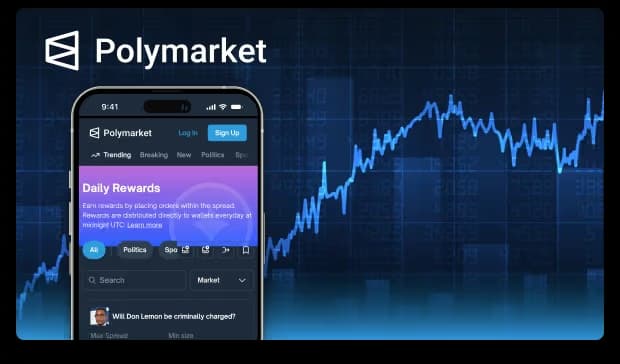


- Top prediction market by volume
- Get a $50 trading bonus
- Blockchain-powered predictions
- 2% fees only apply to winnings
- $20 trading bonus with code CORG
- Custom odds available upon request






- 5-day 100% profit boost up to $100
- Dedicated parlay building feature
- Wide variety of sports contracts
- Up to $50 bonus available
- Crypto or fiat deposits
- 50% first deposit match bonus
- Low $10 minimum deposit
- A wide variety of sports markets
Our top recommended weather prediction market apps
While there are several weather prediction market apps, some stand out more than others. Here are the top prediction market platforms that we recommend and what makes each of them stand out.
Polymarket - Best for market versatility and liquidity

Pros
Cons
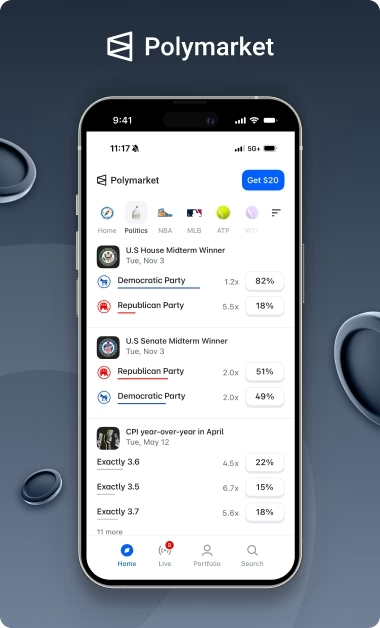
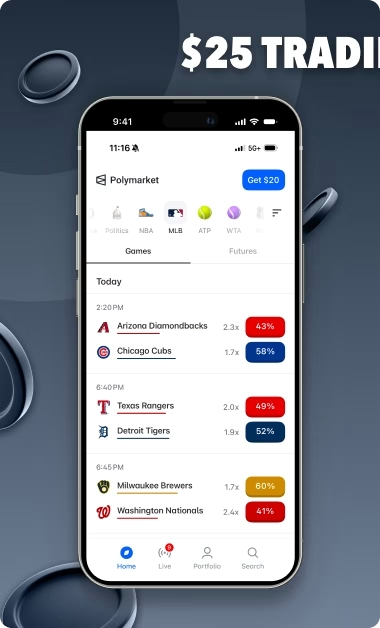
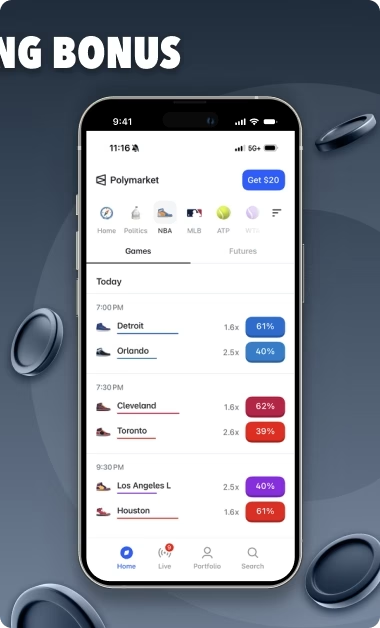
Payout timeInstant | Year established2020 | Banking options |


Crypto.com - Best for crypto users
Pros
Cons
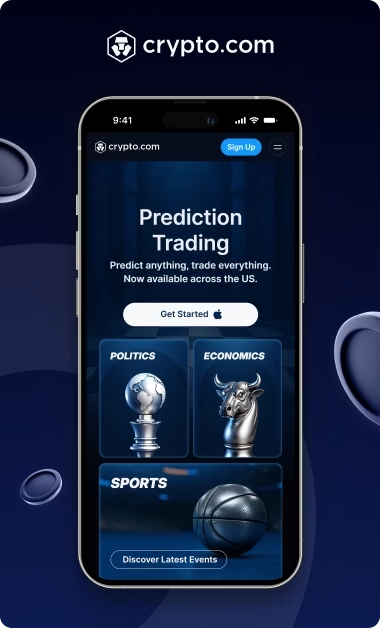
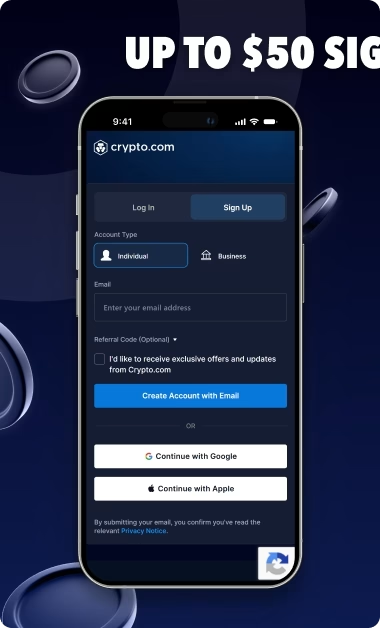
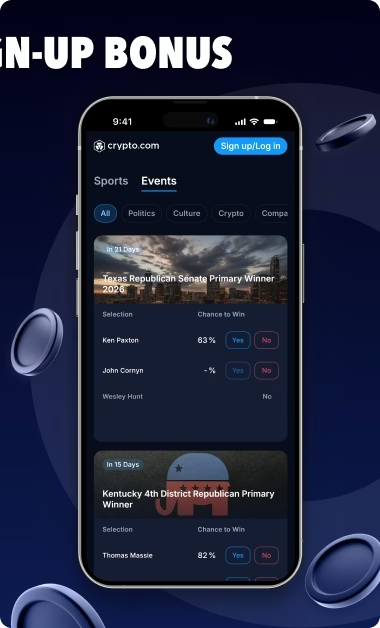
Payout time24 hours | Year established2024 | Banking options |


DraftKings Predictions - Best for an introduction to weather contract trading
Pros
Cons
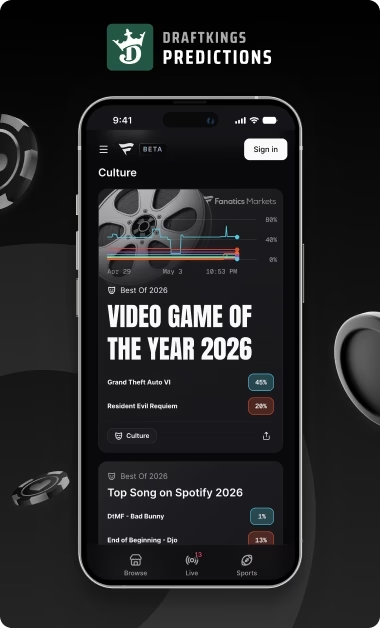
Payout time0-2 days | Year established2025 |
What are weather prediction markets?
- Yes/no contracts: Will the high temperature in New York City exceed 90 degrees on July 4, 2026? You pick a side.
- Range contracts: What range will the average July temperature in Miami fall into? You pick a bracket.
- Multi-outcome contracts: How many named Atlantic storms will form this season? Multiple outcomes are available to trade.
“The objectivity is what draws me to these markets. A disputed call or a referee's decision can blow up a sports bet. Weather betting doesn’t have that problem. The thermometer reading is the thermometer reading, and that cuts out a whole category of risk that shows up in other prediction market categories.”
Can you bet on weather?
Yes, and on regulated platforms it's a straightforward process for most US traders. That said, there are a few things worth knowing before you fund your account:
- Not every platform covers weather: Each exchange builds its own contract catalog. Temperature contracts on Crypto.com may not be available on Polymarket, and vice versa.
- Your state matters: Even CFTC-regulated exchanges like Polymarket have state-level eligibility restrictions. Check the platform's availability before depositing anything.
- Settlement is data-driven: Weather contracts resolve against verified meteorological records, which puts them in a different category from markets where outcomes can be contested.
- Liquidity isn't equal across contracts: A potential Category 4 hurricane landfall will draw a crowd. A temperature contract for a mid-sized city in October probably won't.
“Before you put money in, go to the platform's eligibility page and confirm your state is listed. I've talked to traders who assumed CFTC regulation meant open access for everyone in the US. It doesn't work that way. A two-minute search can save you a headache later.”
Types of contracts for weather betting
There's more variety here than most people expect going in. There are several prediction market sign-up offers to help you get started. Here's a rundown of the main contract categories you'll come across.
Temperature contracts
Temperature contracts are the most common weather market on platforms like Crypto.com and Polymarket. They're typically yes/no or range-based, tied to official thermometer readings at designated weather stations. Because temperature data is recorded around the clock and available publicly, these contracts tend to settle quickly and cleanly.🌡️ Daily high above threshold
Will the high temperature in Chicago exceed 95°F on August 15, 2026? Settles against NOAA O’Hare station data.🌡️ Monthly average temperature range
Will the average daily high in Phoenix for July fall between 105°F and 110°F? You choose a temperature bracket.🌡️ Record temperature event
Will any US city set an all-time record high temperature in June 2026? Settles against NOAA historical records.
Precipitation contracts
Precipitation markets cover rainfall, snowfall, and drought conditions. They're more active during hurricane season and in winter, when forecast uncertainty is higher. As a result, there's more room for the market price to drift away from what the models are showing.🌧️ Monthly rainfall above threshold
Will Miami receive more than 8 inches of rainfall in August 2026? Settles against NWS Miami station totals.❄️ Seasonal snowfall total
How many inches of snow will Boston record for the 2026-27 winter season? Multiple outcome ranges available.☀️ Drought designation contract
Will any part of California be classified as D4 (Exceptional Drought) by the US Drought Monitor in Q3 2026?
Severe weather and storm contracts
Storm contracts pull in some of the biggest trading volumes in the weather category. Traders who follow NHC advisories and NOAA outlooks closely are often drawn to hurricane landfall contracts because forecast updates can move prices quickly and create short windows of mispricing.🌀 Named storm landfall (US)
Will a named Atlantic hurricane make landfall in Florida during the 2026 season? Settles against NHC official records.⚡ Atlantic named storm count
How many named Atlantic storms will form in the 2026 hurricane season? Trade your predicted count bracket.🌪️ Major hurricane (Cat 3+) landfall
Will a Category 3 or higher hurricane make landfall on the US Gulf Coast before September 30, 2026?
Long-term climate contracts
Climate contracts are the newest category, and they're growing fast. They run over months or years and track things like global average temperatures, Arctic sea ice extent, and CO2 concentration milestones. They suit traders who follow climate science closely and are comfortable holding a position for a long time. The Crypto.com prediction market offers some of these contracts.🌍 Annual global temperature anomaly
Will 2026 rank as the hottest year on record globally? Settles against NOAA or NASA GISS annual temperature data.🧊 Arctic sea ice minimum
Will Arctic sea ice extent fall below a specified threshold in September 2026? Settles against NSIDC satellite data.📊 CO₂ concentration milestone
Will the Mauna Loa Observatory record an average monthly CO₂ reading above 430 ppm in 2026?
“Climate contracts look appealing, but I'd suggest starting with shorter-duration markets first. The further out a contract resolves, the harder it is to model what might happen, and most platforms are still figuring out how to handle edge cases like data revisions or major policy changes. Temperature and precipitation contracts in the 1-14 day range give you better data quality and more frequent opportunities to refine your approach.”
How to trade weather prediction market contracts
- 1Pick a platform: Start with one that supports weather markets and is available in your state. Check eligibility before you create an account.
- 2Set up and fund your account: You'll need to verify your identity on regulated platforms. Generally, fiat-based exchanges accept bank transfers. The Polymarket app is an example of a platform that requires USDC or another supported crypto asset, but it's easy to convert funds once you're on the app.
- 3Find a market: Browse the weather or climate section of the platform. You can usually filter by contract type (temperature, storms, precipitation) and by resolution date. Read the settlement rules before you go any further.
- 4Do your research: Pull up the latest NWS, ECMWF, or NOAA forecasts before entering a position. Compare at least two models. Then look at the current contract price to see if it reflects what the forecasts are actually showing.
- 5Enter your position: Choose yes or no, set your size, and review the payout. A contract priced at $0.70 that pays $1.00 on resolution reflects a 70% market-implied probability. Limit orders will generally get you a better fill than market orders.
- 6Keep an eye on it: Check for forecast updates as the resolution date gets closer. Some platforms allow early exit by selling your position in the secondary market, which is worth knowing if the forecast shifts against you.
- 7Settlement: Once the event date passes, the platform pulls data from its official source (NOAA, NHC, NSIDC, etc.) and settles the contract. Payouts on winning positions are typically processed within 24 to 48 hours.
How weather contracts work
Every contract has a question, a resolution criteria, and a data source. The three main structures you'll run into are:- Yes/no contracts: The most common format. Something either happens or it doesn't. Resolves to $1.00 for yes or $0.00 for no. For example: Will it snow in Denver on December 25, 2026?
- Multi-outcome contracts: Several possible outcomes are listed, each priced on its own. The prices across all outcomes add up to around $1.00. Used for things like storm counts and temperature ranges.
- Time-based contracts: The question is about timing rather than whether something happens. For example: In which week of August will the first named Atlantic storm form?
“Multi-outcome contracts are worth paying attention to. Most casual traders stick to yes/no questions because they're easier to think about. But the less popular brackets in a multi-outcome temperature range contract often get mispriced, especially early in the trading period. If you're comfortable with ensemble model output, those are worth a look.”
Official resolution sources for weather betting
The reliability of a weather contract comes down to the data source it uses. These are the main ones you'll see referenced across the major platforms:| Data source | Covers | Used for |
|---|---|---|
| NOAA / NWS | US temperature, precipitation, wind | Temperature and rainfall contracts |
| National Hurricane Center (NHC) | Atlantic and Pacific storm tracks, intensity | Hurricane landfall, storm count contracts |
| US Drought Monitor | National drought severity classifications | Drought designation contracts |
| NSIDC | Arctic and Antarctic sea ice extent | Long-term climate contracts |
| NASA GISS / NOAA NCEI | Global temperature records and anomalies | Annual temperature ranking contracts |
| Mauna Loa Observatory (NOAA) | Atmospheric CO₂ concentration | Climate milestone contracts |
Why should you trade weather prediction market contracts?
- No judgment calls in the resolution: A NOAA temperature reading is what it is. There's no disputed referee decision, no scoring controversy, no way for anyone to argue about what happened.
- The research data is free: NOAA, NWS, ECMWF, and GFS model output is publicly available. You don't need a Bloomberg terminal or a paid data feed to do serious research here.
- Contracts close out fast: Most temperature and precipitation contracts resolve within days or weeks. Your capital isn't tied up for months waiting on an outcome.
- The market doesn't always catch up instantly: When forecast models update, prices on weather contracts don't always move right away. If you're watching the NWS discussions regularly, you'll sometimes spot a gap before the rest of the market does.
- It moves independently of financial markets: A July temperature contract has nothing to do with interest rates or earnings reports. For traders who want exposure that doesn't track the S&P, that's a real benefit.
“People underestimate how much the free data access matters. Stock traders pay thousands per month for real-time feeds. In weather markets, the NWS Area Forecast Discussion is free, updated several times a day, and full of forecaster commentary you can actually use. Spend some time learning to read those and you're already ahead of most people trading these contracts.”
Is weather betting legal?
- State rules can limit access even on federally regulated platforms: Not every state allows trading on CFTC-licensed exchanges. Check the platform's eligibility page for your state.
- Crypto prediction markets carry more regulatory uncertainty: The SEC and CFTC both have potential jurisdiction over digital asset platforms, and the rules in this space are still being worked out.
- Read the Terms of Service before funding an account: Eligibility rules change. What was available in your state six months ago may not apply today.
| Platform | Regulatory status | US availability | Notable restrictions |
|---|---|---|---|
| Polymarket | CFTC approved DCM | Legal throughout US with some state restrictions | Some states restrict certain market categories. Check availability before you sign up |
| Crypto.com | Varies by product | Varies by state | Prediction market availability differs from exchange products; check terms |
“Polymarket's DCM license isn't just a piece of paper. It means the exchange has to meet capital requirements, file reports with regulators, and follow customer protection rules that unregulated platforms don't have to bother with. For traders who want to know the platform they're using is being watched by someone, that's the distinction that matters most.”
Strategies to bet on weather
Use multiple forecast models
The NWS, ECMWF (the European model), and GFS (the American model) all have different strengths. ECMWF generally outperforms GFS on forecasts beyond five days. When the two models show significantly different outcomes for the same event, it's a signal that the market may not have fully priced in the uncertainty. That's often where opportunities show up.Track model updates
Forecast models run several times a day, but contract prices don't always move in step with them. Keeping an eye on the 06z and 18z NWS model runs and comparing them to current prices can turn up situations where the market is a few hours behind a meaningful forecast change.Focus on short-term contracts
Model skill drops off sharply with contracts more than a week out. Contracts that resolve within a week are based on the most accurate, most frequently updated forecasts available. New traders should stick to short-term contracts to keep the feedback loop tight and uncertainty at a manageable level.Understand market biases
Markets sometimes chase recent conditions further than the data supports. A hot stretch in May can push summer temperature contract prices up even when the models are pointing toward a return to normal. Spotting those situations and trading against them is one of the more repeatable strategies in this space.“Recency bias shows up constantly in weather markets. After an unusual run of weather, I've watched contract prices drift well past what the ensemble averages support. Traders often focus on what just happened rather than what models are projecting. If the NWS forecast discussions are talking about a pattern change and the market hasn't moved yet, that's worth paying attention to.”
Reasons to be cautious when weather betting
⚠️ Trading weather contracts involves real financial risk. No forecast is certain, and positions can lose value. Only use money you're comfortable losing.
- Uncertainty grows with time: Even well-calibrated ensemble models show significant spread past seven days. The further out a contract resolves, the wider the range of plausible outcomes and the harder it is to find a real edge.
- High-volume city markets are competitive: Temperature and precipitation contracts for New York, Chicago, Miami, and other major metros attract experienced traders and tight pricing. Finding a mispriced contract in those markets is harder than it sounds.
- Rare events are genuinely hard to price: Record-breaking temperatures or exceptional rainfall totals sit in the tail of the distribution. Meteorologists struggle to assign accurate probabilities to them, and markets tend to as well.
- You can't always exit early: Secondary market liquidity varies a lot across contracts. On thinly traded markets, getting out before settlement at a fair price may not be possible.
Weather prediction markets: Are they worth it?

“For traders who enjoy research and want markets that reward preparation over gut feeling, weather contracts are worth serious consideration. The data is free, outcomes are objective, and mispriced contracts do exist, particularly in less-followed markets and around forecast model updates. That said, this isn't passive income. You have to put in the work to find the edges.”
Pros
- Outcomes settle against objective, verifiable data
- Free, high-quality forecast data is widely available
- Short-term contracts turn over quickly
- No overlap with financial market movements
Cons
- Forecast accuracy drops off sharply past 7-10 days
- Popular city contracts are well-traded and hard to beat
Explore other market categories
Weather contracts are one part of a broader prediction market ecosystem. If the data-driven approach appeals to you, these categories are worth a look.
🗳️ Political prediction markets
Another market gaining popularity is political prediction markets. Election outcomes, approval ratings, and legislative votes are some examples of contracts users can trade. Contracts settle based on official public records and share a lot of the same research-driven appeal as weather markets.
🎬 Entertainment prediction markets
Award show results, box office performance, and streaming numbers have all become more popular in recent months under the umbrella of entertainment betting predictions. These markets tend to move fast and attract a lot of community activity, which can create short-lived pricing gaps for traders paying attention.
FAQs
Are weather prediction markets legal?
What are the best platforms for trading weather prediction market contracts?
What data sources are used to settle climate contracts?
Can you exit positions early with weather contracts?
What happens if a weather station goes offline?
Chris has been working in iGaming for 15 years. He has previously worked on online casinos, sportsbooks, iPoker, and the crypto industry, all of which help inform his expert coverage of the emerging prediction markets scene. We may earn a small commission from some links, but Chris's trustworthy insights are always impartial, helping you make the best decision.

As a fact-checker, and our Chief Gaming Officer, Alex Korsager verifies all prediction market details on this page. He manually compares our pages with the prediction app, and if anything is unclear, he contacts the operator. In short, Alex ensures you can make an informed and accurate decision.
