Why Is It Called Craps?

Summarize this post
Key Takeaways
- Why Craps is most likely named after “crabs,” an old dice term for unlucky low throws.
- What the game of Hazard was, and how it became the ancestor of modern Craps.
- How New Orleans fits into the American history of the game and its name.
- Why the name “craps” is not connected to the modern vulgar meaning of the word.
- When the word “craps” first appeared in print, and what that tells us about the game’s history.
Craps is most likely called “Craps” because the name evolved from “crabs,” an old dice term for low losing throws in the European game of Hazard.
The word appears to have traveled through French or Louisiana French usage before arriving in American English as “craps” in the early 19th century. It has no reliable connection to the modern vulgar meaning of the word.
This article traces the name’s origins, explains the Hazard connection, addresses the New Orleans chapter of the story, and clears up the most common myths about where the name came from.
The History of the Name and Game
Craps is probably called Craps because the name evolved from “crabs,” an old English dice term for low losing throws in the game of Hazard. That word appears to have passed through French or Louisiana French usage before becoming “craps” in American English sometime in the early 1800s. The name has no reliable connection to the modern vulgar meaning of “crap.” The gambling term has its own separate history, rooted in dice slang, not bathroom vocabulary.
That is the short answer.
The longer answer is a story about how an older, more complicated European dice game, gradually became the fast, loud, socially electric game we know today, and how the slang of the table has a way of outlasting everything else.
Why Is It Called Craps?
The short answer is Craps is probably called Craps because gamblers once used the word “crabs” for unlucky low dice throws. The word changed as the game moved through different places, languages, and gambling circles, and what arrived in American English was “craps.”
In the older dice game of Hazard, certain low rolls were losing outcomes depending on the stage of the game. The word “crabs” became associated with those bad throws, the kind that ended your turn and emptied your pockets. That table slang did what table slang often does: It stuck, it shifted, and it eventually became the name of the game itself.
The Online Etymology Dictionary traces “craps” to Louisiana French, which adapted it from an 18th century English term “crabs,” used for a throw of two or three in dice. Oxford Learner’s Dictionaries also notes the early 19th century origin, and connects the word to “crab” or “crab’s eyes,” used for low dice throws. The OED places the earliest known use of the noun “craps” in the 1840s, with the earliest documented evidence from 1843.
Old gambling terms rarely travel in a straight line. But every path through the “craps” etymology leads back to that same unlucky throw.
The Link Between Craps and Hazard
Craps did not appear from nowhere. It developed from Hazard, an older dice game that was popular in England and across Europe for several centuries before the American game took shape.
Hazard was the ancestor. Craps is the faster, leaner descendant.
What is the game of Hazard?
Hazard was considerably more complicated than modern Casino Craps. Players set a “main” number before rolling, and the outcome of each throw was judged against both the main number, and a second thrown number called the “chance.”
Different combinations of numbers had different meanings depending on what had been set at the start of the hand. The game had layers of rules and terminology that made it engaging for serious gamblers, but difficult for casual players to pick up quickly.
Over time, and across different gambling cultures, simplified versions of Hazard began to circulate.
The complications were stripped away. But the essential drama of the dice throw, and the anticipation of “will this roll win or lose right now,” remained. What emerged on American soil was a game that kept Hazard’s core tension, but replaced its elaborate structure with something that could be learned quickly and played anywhere.
That simplified version is, in broad strokes, what became Craps. The name came with it, already worn smooth by time and use.

What Did “Crabs” Mean in Dice Games?
This is where the etymology gets interesting, even if it also gets a little fuzzy.
“Crabs” was a term for low or unlucky dice throws, documented in 18th century English dice slang. The exact explanation for why low throws were called “crabs” is not perfectly settled, and that is not unusual for gambling terminology from this period. Old table slang was informal by nature, passed mouth to mouth around gambling dens and card rooms, and rarely written down with care.
A few theories have circulated over the years:
- Some sources connect the word to the physical appearance of the pips on a pair of dice showing ones, which may have resembled crab eyes to some gamblers.
- Others connect “crabbed” as an adjective, meaning sour, contrary, or ill-tempered, which would make “crabs” a natural label for a throw that goes badly wrong.
- Still others suggest a connection to crab apples, which were small, bitter, and generally undesirable, making them a fitting metaphor for a losing roll.
What is consistent across these explanations is the core meaning, “Crabs” was bad news at the dice table. It was the throw you did NOT want. Experts on the period describe it exactly this way, noting that “crabs” was used for a low throw and was documented in the 18th century as a term within the dice-playing tradition that eventually produced Craps.
Whether the visual, the metaphor, or something else entirely gave rise to the term, the word carried that meaning clearly enough to travel across an ocean and two languages, and still be recognizable at the heart of the game.
Did Craps Get Its Name in New Orleans?
New Orleans is where the name and the modern American game become harder to separate, and the city deserves its chapter in this story.
The most commonly cited figure in the American Craps narrative is Bernard Xavier Philippe de Marigny de Mandeville, a Louisiana Creole aristocrat and gambler who is frequently credited with bringing or popularizing a simplified version of Hazard in New Orleans in the early 19th century. The story goes that he introduced the game to Louisiana society, that it spread from there into the city’s gambling culture, and that New Orleans street and riverboat gamblers carried it up the Mississippi and across the country.
This is a colorful account, and New Orleans certainly played a genuine role in the American development of the game. The city’s French, Creole, and gambling cultures created exactly the kind of environment where a game with French-inflected slang could take root, evolve, and spread. The transition from “crabs” to the Louisiana French “craps” fits the linguistic geography of 19th century New Orleans better than almost anywhere else on the continent.
That said, the exact path from European Hazard to American Craps is not perfectly documented at every step. The Marigny account is widely repeated, but not uncontested in detail. The safest and most accurate framing is this, New Orleans helped shape and popularize the American form of the game, and the city’s particular cultural mix is the most plausible explanation for how the word “crabs” became “craps” in American English.

Does “Craps” Come From the Word “Crap”?
This question comes up constantly, and the answer is NO.
The Casino game’s name is not generally believed to come from the modern vulgar meaning of “crap.” The two words traveled different roads to their current meanings, and the timing does not support a connection. The gambling term is older in its American form, than the widespread vulgar usage.
The name sounds like it should have a crude origin. But that is almost certainly a modern misunderstanding, looking backward and finding what it expects to find. Craps was gambling slang before most players today ever heard the word used as bathroom slang.
That does not mean the confusion will ever completely go away. The phonetic coincidence is too strong. But from an etymological standpoint, the connection is not supported, and serious sources do not make it. The name’s origin is gambling, not bathroom humor. The game earned its name the hard way, at the dice table.
When Did the Word “Craps” First Appear?
The OED places the earliest known use of the noun “craps” in the 1840s, with the earliest documented evidence from 1843. The Online Etymology Dictionary gives 1843 as the date for the game of chance in American English.
That makes “craps” a 19th century American gambling word in its modern English form, even though its roots in “crabs” and Hazard are older. The game existed, and was being played, before the word was widely written down. That is typical of gambling culture in this period, the play preceded the paperwork by a considerable margin.
What the 1843 date confirms is that the American game was sufficiently established by the middle of the 19th century to have a fixed name. The word had settled. The game had found its form. Both would keep moving west as the century went on.
How the Name Fits the Game
Once you know the etymology, the name makes complete sense in the context of gameplay.
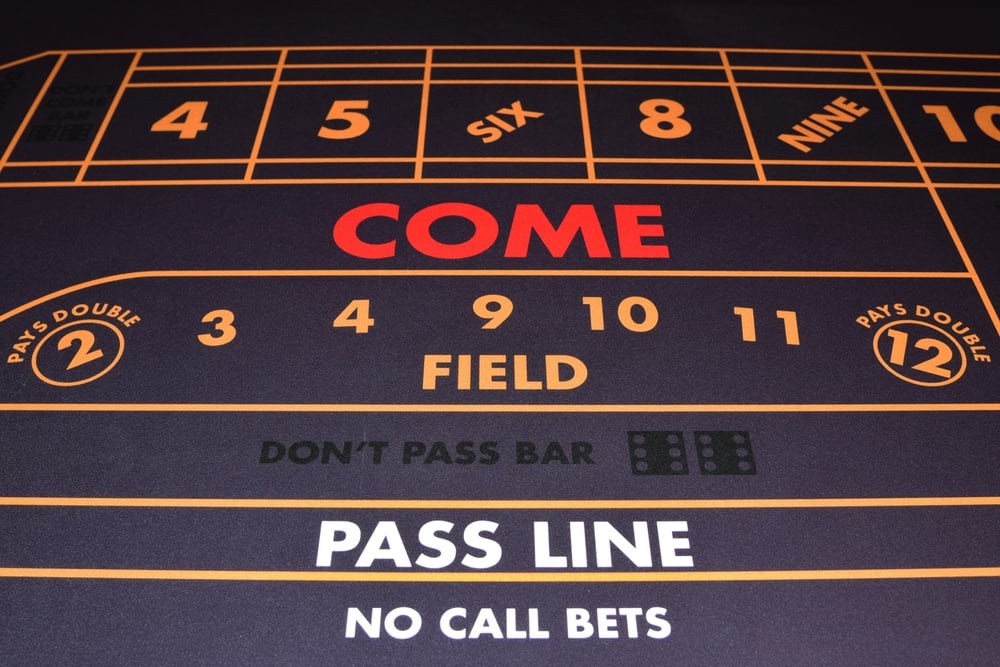
Craps has always been built around the drama of individual dice throws. The come-out roll on the Pass Line can win immediately (7 or 11), lose immediately (2, 3, or 12), or establish a point. Rolling a 2, 3, or 12 on the come-out is called “crapping out,” and the same applies when the shooter fails to make the point and “craps out” as a result. The terminology is baked into the game, and it connects directly to those original “crabs,” the low unlucky throws that ended hands badly.
The name’s history makes sense once you know the game. Craps has always revolved around the drama of one dice throw turning good or bad fast. An old word for the worst possible throw became the name for a game that lives or dies on exactly that moment.
Frequently Asked Questions
Craps is most likely called Craps because the name evolved from “crabs,” an old dice term for low losing throws in the game of Hazard. The word appears to have shifted through French or Louisiana French before becoming “craps” in American English by the early 1840s.
No. The Casino game’s name is not generally believed to come from the modern vulgar meaning of “crap.” Etymology sources consistently connect the gambling term to “crabs,” Hazard, and older dice slang, not to bathroom vocabulary.
Craps developed from Hazard, an older European dice game that was popular in England and on the Continent before the simplified versions of the game traveled to America. Hazard was more complex; Craps became the faster, leaner version that took hold in American gambling culture.
“Crabs” referred to low or unlucky dice throws, often associated with losing outcomes in games like Hazard. The term is documented in 18th century English dice slang and is widely cited as the root of the name “craps.”
Modern American Craps is strongly associated with New Orleans, where French, Creole, and gambling cultures helped shape the game’s American form. Stories about Bernard de Marigny popularizing a simplified version of Hazard there are widely repeated. But the game’s deeper roots go back to European dice games, particularly Hazard, which predates the American version by centuries.