The Bubble Craps Strategy


Summarize this post
Key Takeaways
- The strategy centers on low-house-edge bets. The bubble craps strategy focuses on the Pass Line or Don’t Pass, Come or Don’t Come, and Odds bets, with Place 6 and Place 8 as optional additions. The idea is to stick to the most mathematically favorable wagers.
- Odds bets are the main value play. Odds bets have no house edge, so the strategy recommends backing Pass Line and Come bets with as much odds as your bankroll and table limits reasonably allow. This lowers the blended house edge of your overall action.
- Avoid the flashy, high-edge bets. Don’t fall for Buy bets, Field bets, Big 6/8, Any 7, Any Craps, Hard Ways, and other proposition bets because they carry much higher house advantages and erode your bankroll faster.
- The strategy is meant to balance action with bankroll control. Rather than chasing big swings the bubble craps strategy it aims for steadier play: start simple with a Pass Line bet, then add a Come bet, then possibly Place 6 or 8. The goal is to stay involved without overexposing yourself during cold streaks.
- It works both “right way” and “wrong way.” While this article mainly teaches Pass Line/Come play, it says the same philosophy can apply to Don’t Pass/Don’t Come betting. Betting “wrong way” is also mathematically strong, but it can feel socially awkward at a live table since you win when others lose.
The Bubble Strategy is a straight-forward, low-stress approach to play Craps. It’s known as one of the best ways to get the most out of your gambling experience, whether you’re online or throwing dice in a real casino.
What you’ll learn in this simple guide:
- Understanding each bet in the bubble strategy, what it is, and when to make it
- A simple actionable betting plan
- Sample rolls and outcomes
- Tips on what to focus on, and what to avoid
NOTE: Bubble Craps is also the name of a dealerless game on some casino floors where players make bets at a kiosk overlooking an acrylic bubble containing a pair of big dice. Bubble Craps often has the same rules as any other Craps game, but with lower minimum bets. This guide is for any Craps player at a table, at a kiosk, or on the Internet.
What is the Bubble Craps Strategy?
The Bubble Craps Strategy is built to smooth out the wild swings and to keeps you engaged while you wait for the next hot roll. There’s no complex bet sequence or bet sizing algorithm, you build your action stepwise using the following core wagers (listed with their house edge):
- Pass Line (1.41%) / Don’t Pass (1.36%)
- Come (1.41%) / Don’t Come (1.36%)
- Odds (no house edge)
In my experience, the blended house edge on a Pass Line/Come bet backed with Odds varies depending on how big of an Odds bet you’re allowed to place behind your bets. 2x and 3x are very common, that is, twice or three times your base Pass Line or Come bet.
These two Place bets serve as the outer edge or your bubble:
- Place 6 (1.51%)
- Place 8 (1.51%)
All other bets on the table are strictly outside bubble. Why? Their high house advantage makes them verboten. Here’s a sample of these bad-news bets and their house edge.
- Buy Bets (4.76%)
- Field Bets (5.56% for most tables)
- Big 6/8, Any 7, Any Craps, Hard Ways and other props (9% house edge and up!)
By limiting your play to only the most mathematically advantageous craps bets, you contain your risks and make cold streaks survivable. And once the dice get hot, you’ll be there ready to ride the wave.
Image Credit: Netfalls Remy Musser/Shutterstock
The Bubble Craps Strategy Starting Line
No matter what, the bubble strategy starts with a Pass Line bet when the dice are coming out, or before a point has been established.
In my opinion, if you aren’t sure what stage of the game a table is in, look for the marker buck – or puck. It will say ‘ON’ and be placed on a number square to indicated an established point. Make your Pass Line bet when it’s flipped to read ‘OFF.’
To refresh, your Pass Line bet wins even money on a 7 or 11, lose on 2,3, or 12, and ‘passes’ to the next phase of rules on a point roll (4,5,6,8,9, or 10). When a point has been established, that number must come up again before a 7 for the wager to win, no other dice throw impacts a Pass Line bet with an established point.
Come Bets
Betting on the Come is like placing a brand new Pass Line bet, and it’s the second key bet in the bubble strategy. Place a Come bet in the betting square once your Pass Line bet has established a point. That Come bet must follow the same rules sequence as a Pass Line bet, which means you can have two bets subject to very different outcomes on the same throw of the dice.
For example:
- You bet the Pass Line
- Shooter rolls 9. The Pass Line bet wins if another 9 appears, and loses if a 7 appears.
- You place a Come bet.
- Shooter rolls 11. The Come bet wins even money since it hasn’t ‘passed’ yet, but the Pass Line bet is unaffected.
- Shooter rolls 10. The Come bet has ‘passed’ and now needs another 10 to appear before a 7 to win. You’re now cheering for either a 9 or a 10.
- Shooter rolls a 7. Both bets lose.
Odds: Backing Your Bet
The bubble strategy uses Odds bets to reduce the house advantage on Pass Line and Come bets, they win or lose with the base bet.
But these bets are special because instead of paying even money, they pay what’s known as ‘true odds’. That is, they are paid out higher to precisely match, and compensate for, the underlying bet’s winning probability:
- 6 or 8: Pays 6-to-5
- 5 or 9: Pays 3-to-2
- 4 or 10: Pays 2-to-1
If you’re fuzzy on this, consider that a 7 is twice is likely to come up on any throw as is a 4 or 10. So if you’re on one of these ‘long shot’ points, backing with Odds tilts things back in your favor.
You can back your Pass Line and Come bets with any multiple of the initial wager up to the maximum allowed by the house (usually 2x or 3x)
Max Odds?
By making the maximum Odds bet allowed by the table, you’re lowering the blended house advantage on your wager as much as possible. Consider the difference between a Pass Line bet of $20 versus a Pass Line bet of $5, followed by a $15 Odds bet after a point has been established.
With an overall 1.41% house edge, you can expect to lose 28 cents per $20 Pass Line wager. On the other hand, a $5 wager with $15 odds will only lose 7 cents pepr wager. Those pennies add up over a session, or a weekend. So the more you weight your bets towards Odds bets, the more you’re reducing the house advantage.
Striking a Balance
Now we have to backtrack a little bit. Maximum Odds bets are indeed mathematically advantageous, but not if it means you’re making bet sizes that don’t make sense given your bankroll. The goal of the bubble strategy is to strike a balance.
Make good smart wagers, but have fun! You’re not playing to get rich, you’re playing for the excitement and camaraderie. A good rule of thumb is to break your bankroll up so that you can make eight to ten individual 1-unit wagers, plus an Odds multiple you can afford.
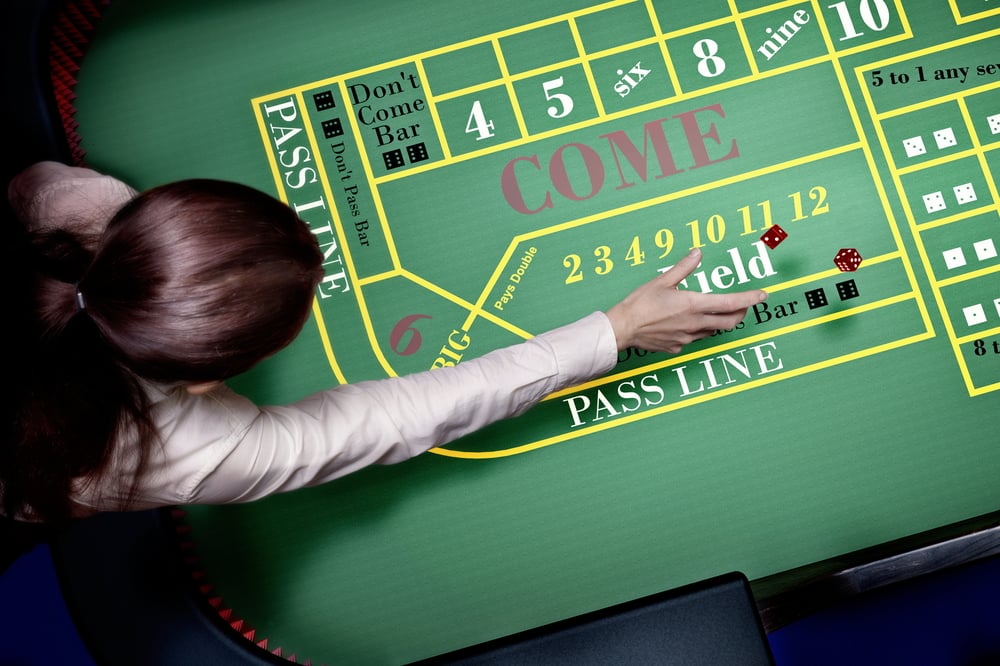
Image Credit: Nic Neufeld/Shutterstock
What Are The Different Bubbles?
Understanding Pass Line, Come, and Odds bets means you have a great toolkit for a Craps table. Let’s start simple
The Basic Bubble
If you’re relatively new to the game, consider rolling with the shooter on the Pass Line alone until you get the feel of the game.
- Place a 1-unit bet on the Pass Line prior to a come out roll.
- Replace it as necessary until a point is established
- Back the Pass Line bet with an Odds bet.
- Sit tight, let the game play out. You’re cheering for a single point.
Bubble Plus One
- Place a 1-unit bet on the Pass Line prior to a come out roll.
- Replace it as necessary until a point is established
- Before the next roll:
- Back the Pass Line bet with an Odds bet.
- Place a 1-unit bet directly in the Come bet area
- Replace the Come bet as necessary until a second point is established.
- Pass chips to the Dealer and declare an Odds wager for your Come bet.
- If your Come bet wins, take your winnings and leave a 1-unit bet in the Come bet area. (Your goal is to always have two numbers ‘in play’)
Bubble Plus Place
Now that you’re comfortable with the basic workings of Pass Line, Come, and Odds bets, you can mix two new bets into your repertoire: the Place 6 and Place 8 bets. If they win they pay $7 per $6 wagered.
Just like a Pass Line or Come bet they win if the number comes up prior to a 7, but lose if a 7 comes first. Unlike a Come bet where you’re not sure what number it will ultimately be connected to, a Place bet is an explicit bet on a number. You can temporarily de-activate a Place bet, or take it down altogether if you choose.
- Place/Replace a 1-unit bet on the Pass Line until a point is established.
- Before the next roll – slide chips in increments of $6 toward the dealer and ask to “Place the 6” (or if the point is 6, make a Place bet on the 8)
- If your Place bet wins, dealers typically will slide the profits to you and leave your original bet in place. But you can always ask for the whole stack.
Casinos offer Place bets on any point, but bubble strategy players stick to 6 and 8 where the house edge is acceptably low.
Example Game Sequence – $150 bankroll, $5 minimum table, 2x Odds allowed
- Before a come-out roll, you wager $5 on the Pass Line
- Shooter rolls 3. Crap dice – your $5 is raked so you replace it.
- Shooter rolls 5 to establish the point.
- Before the next roll, you place $10 in chips directly behind your Pass Line wager as a 2x Odds bet. (You don’t need the Dealer’s help placing this bet.)
- You place a $5 chip on the Come bet area
- Shooter rolls 11. Collect $5 from your winning Come bet and your Pass Line bet is unaffected.
- Shooter rolls 10. The Dealer moves your $5 Come bet to the square marked ‘TEN’
- Back your Come bet with Odds. Slide $10 in chips toward the Dealer and say “Odds on my Ten.”
You now have two numbers ‘working’, 5 and 10.
- Shooter rolls 2. None of your bets are affected.
- Shooter rolls 10. Your Come bet is a winner! The Dealer slides your base $5 Come bet toward you plus $5 in winnings, and your $10 Odds bet plus $20 in winnings (remember, Odds on 4 and 10 pay 2-to-1).
At this point you’re back to a single number working. You could do a Come bet here, but you opt instead for a Place bet.
- Before the next roll, collect your winnings, slide $6 in chips to the Dealer and say, “Place the 6.” The Dealer will move your $6 wager just outside the box marked ‘SIX’
- Shooter rolls 11. No affect on either your Come bet or your Pass Line wager.
- Shooter rolls 6. Nice timing! Dealer pays you $7 on your Place 6 wager. By default they will often hand you your profit but leave a $6 bet in place. Since it’s a place bet, you can take it down anytime you like.
- Shooter rolls 5. Remember your Pass Line bet? It’s a winner! The dealer pays you $5 (even money) on your base wager and $15 (3-to-2) on your Odds wager.
- You decide it’s been a good day at the office and ask the Dealer to take down your Place bet on the 6. The Dealer slides the chips to you, and you gratefully tip $1.
Hitting three numbers, two of them backed with an Odds bet, is a great feeling in Craps. Just remember had a 7 come up, any active Place, Pass Line, Come, and Odds bets would be toast.
Image Credit: Oleh Tiurkin/Shutterstock
The Wrong Bubble Done Right
Now that you understand how essential Craps bubble bet sequencing works, you might be interested to know the ins-and-outs of betting against the dice, or the ‘wrong way’.
Don’t Pass/Don’t Come are almost an exact mirror of Pass and Come bets. These bets lose immediately on 7 or 11, win immediately on 2 or 3, and 4,5,6,8,9, and 10 become established points. Except this time you are hoping the 7 comes first rather than the point.
Although a 12 is an auto-loser for Pass Line and Come bets during the come-out sequence, in my opinion, it’s merely a push for wrong-way players. Casinos can’t mirror right-way and wrong-way betting exactly or they’d be creating a bet with a negative house advantage.
Odds on the Don’t
Once a point is established, Don’t Pass and Don’t Come bets are more likely to win than lose. You still want to back them with an Odds bet, but you ‘ll be laying odds (wagering more than you profit) according to the following schedule:
- 6 or 8: 5-to-6
- 5 or 9: 2-to-3
- 4 or 10:1-to-2
So, for example, if bet $5 on the Don’t Pass, and the shooter rolls a 6, you can back your bet by laying increments of $6, which will pay $5 should it win (on a roll of 7.)
Bottom line on the wrong way? It’s a mathematically advantageous way to play and is therefore a valid option for bubble play. And it can be thrilling as well, when you’re with the dice, a 7 kills all of your bets.
But when you’re against the dice, a 7 means your Don’t Pass and Don’t Come bets (backed with Odds bets) all win at once! Just beware, as a wrong way bettor at a physical craps table, you’ll be cheering when the rest of the table is crying (and vice versa).
Final Takeaway: Play Smart, Stay in Control
The bubble strategy is a great way to play Craps regardless of whether you’re playing at a full-sized table, playing at a Bubble Craps kiosk, or playing online. It’s meant to be a flexible structure that lets you operate among the Pass Line, Come, Odds, and a subset of Place bets to suit your appetite for risk without requiring you to venture into disadvantageous bets or forcing you to memorize complicated odds structures and bet-pressing sequences.
It is:
- Low volatility – you’ll see fewer fluctuations of your bankroll
- Solid balance of action and safety – you’ll stay at the table longer
- Good for surviving cold streaks – hopefully until the dice turn hot again
It is not:
- A certain winner – any time you play a casino game with a house advantage, you’re more likely to lose than win.
- A get rich/high action strategy – just remember that the person next to you collecting a stack of chips for winning a Hard Way is happy at the moment, but in the long run is bleeding money on that bet.
The Bubble Strategy isn’t about conquering craps, it’s about coexisting with it. By focusing on the best bets, limiting exposure, and resisting the urge to chase action, you give yourself something rare in a casino: control.
Title Image Credit: Netfalls Remy Musser/Shutterstock