 Main menu

Prediction Markets
Why Prediction Markets Are Still Ruled by Everyday Traders
Posted on: May 4, 2026, 05:45h.
Last updated on: May 5, 2026, 03:21h.


- 80%+ of Polymarket users traded under $10,000 in Q1.
- Only a fraction of a percent reached six-figure volumes.
- Category expansion is now the primary lever for user growth.
While prediction markets aim to attract institutional and whale capital, retail market participants continue to drive the industry’s volume.

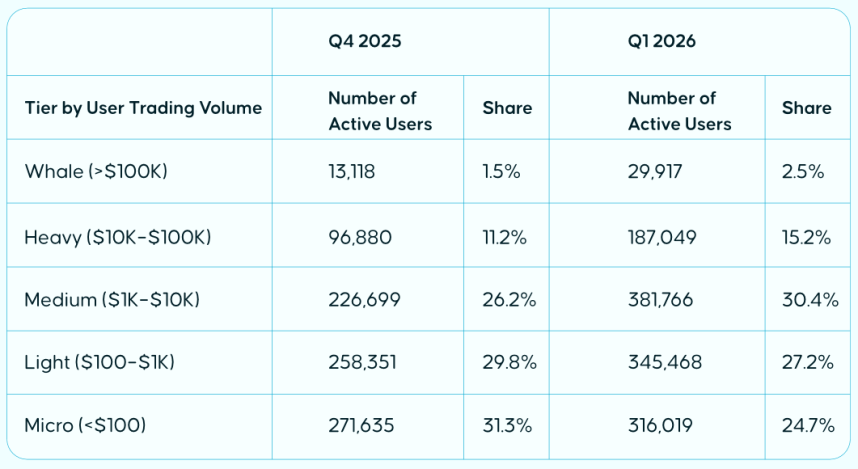
A new study carried out by Bitget Wallet and prediction market giant Polymarket indicates that of the 1.29 million active wallets on Polymarket, 82.3% traded less than $10,000 in the first quarter, implying some level of retail behavior.
Conversely, just 2.5% of those wallets drove more than $100,000 in trading volume in the first three months of the year.
This structure differs fundamentally from traditional financial markets such as derivatives or ETFs, where liquidity is typically concentrated among a small group of large players,” the study states. “Here, growth is driven by high participation at small ticket sizes, closer to consumer platforms than institutional trading environments.”
That jibes with previous data indicating the average trade size on Polymarket is just $89 and that 80% of traders on the platform place bets/trades at less than $500.
Some Signs Larger Traders Are Entering the Arena
On a quarter-over-quarter basis, the number of Polymarket users in the whale and “heavy user” grew in both population and share terms — a positive sign for reduced dependence on retail traders — but there was also significant growth in the “medium” cohort, suggesting retail traders powering prediction market growth.
Another point of interest is that some heavy users slightly dial back activity (as measured in active days) over time while micro users do the opposite, expanding their active days as they become more familiar with Polymarket.
“Looking at users who remained active from Q4 2025 through Q1 2026, activity patterns diverge across tiers,” notes the Bitget/Polymarket study. “Higher-volume users saw a modest decline in active days, while lower-volume users became more active over time, especially micro users, nearly doubling from 3.1 to 6.2 days. This suggests that while high-volume participation remains stable, a significant increase in engagement is occurring among smaller users.”
Crypto Is the Gateway
Some prediction market operators are heavily rooted in sports event contracts and while that is an industry-wide phenomenon, it’s actually cryptocurrency derivatives that bring many new retail market participants to prediction markets.
In the first quarter, crypto accounted for 39.6% of activity among micro users on Polymarket, but that pattern shifts the longer market participants remain engaged with yes/no exchanges.
“Crypto lowers the barrier to first interaction, but long-term engagement is sustained by markets tied to recurring, real-world events,” according to the study.
“As users become more active, engagement shifts toward real-world event categories. Sports participation rises from 22.7% (micro users) to 29.2% (mid- tier users), while politics remains consistently significant at ~26–28% across segment.”

 Most Read

Another Shooting Near Las Vegas Strip Casino Injures Man
 972,710 views

Vintners Oppose Napa Valley Casino
556,316 views


Conversation (0)
Be the first to comment on this article.