 Main menu

Financial
Las Vegas Sands Capitalizes on Credit Upgrade with $1B Bond Sale
Posted on: May 5, 2026, 09:58h.
Last updated on: May 6, 2026, 07:40h.


- ThS&P recently boosted its rating on the casino operator to BBB from BBB-
- That’s one of the highest grades among gaming companies
- Las Vegas Sands is selling $1 billion debt
Las Vegas Sands’ (NYSE: LVS) credit rating was recently lifted to BBB from BBB- by S&P Global Ratings and the gaming company is capitalizing on that upgrade by selling $1 billion corporate debt.
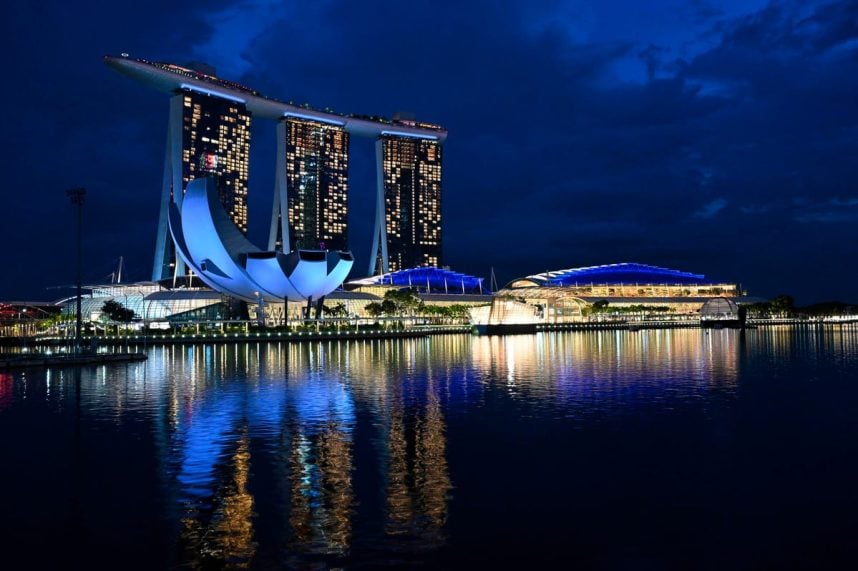
The Venetian Macau operator filed plans with the Securities and Exchange Commission (SEC) to sell $500 million in senior notes maturing in 2031 and $500 million in senior notes coming due in 2033 at coupons of 5.3% and 5.65%, respectively.
Those sales will be used to refinance $1 billion worth of corporate debt which matures in August.
It’s common for companies to issue new debt with further out maturities to eliminate or refinance obligations coming due over the near-term. With the new bond sales, Sands — the largest casino operator by market capitalization — extends its maturity profile while potentially reducing its annual interest expenses.
While BBB and BBB- are both investment-grade ratings, the latter is the lowest rating in the category. As a result, investors require higher yields, meaning higher interest expenses to issuers, as a form of compensation for taking on higher risk.
During times of economic duress, spreads on BBB- bonds increase more rapidly than BBB equivalents as fixed income investors demand elevated compensation for higher default risk.
S&P Lauds Sands Prudence
In upgrading Sands, S&P cited low likelihood the operator takes on a major new capital project over the next several years, noting Sands pulled out of the race for New York City-area casino permit while adding that it’s unlikely that Texas approves casino gaming anytime soon.
We believe the company can absorb shareholder returns and potential operating volatility from rising macroeconomic risks because of anticipated leverage cushion compared with our 3x downgrade threshold,” said the ratings agency.
The global ratings agency also notes that while Sands could pursue a gaming license in Thailand, changes in the government there likely ensure that casino gaming is off the agenda for at least several years. The research firm also notes Sands isn’t pursuing opportunities in Japan or the United Arab Emirates (UAE).
“Given the long lead time for the legislative and licensing process in new markets, in addition to development planning, we no longer believe LVS will incur material development capital expenditures (capex) before it completes its $8 billion project in Singapore,” observes S&P.
Sands Likely to Lean Into Buybacks
Sands is likely to deliver total shareholder rewards of $3.2 billion this year and $3.3 billion in 2027, according to S&P, with the operator tipped to lean more heavily into share repurchases. This payout was suspended during the coronavirus pandemic and was later reinstated in July 2023. Since then, it’s been increased twice.
S&P sees the gaming company spending $1.05 billion on dividends this year, well below the $3 billion mark notched in 2019 and that may be the result of share buybacks being a more flexible avenue for returning capital to investors.
“We believe this sustained shift toward a higher level of share repurchases provides LVS with greater flexibility to allocate capital to growth opportunities that arise over time or to manage liquidity during periods of operating volatility,” concludes the research firm. “This is because dividend policies are inherently more rigid, while share repurchase serve as a more flexible lever to modulate capital returns during periods of cash flow volatility.”

 Most Read

Another Shooting Near Las Vegas Strip Casino Injures Man
 972,594 views

Vintners Oppose Napa Valley Casino
556,213 views


Conversation (0)
Be the first to comment on this article.