 Main menu

Vegas Myths Busted
VEGAS MYTHS BUSTED: Strippers Spin Around a Fixed Pole
Posted on: April 27, 2026, 07:21h.
Last updated on: April 27, 2026, 11:21h.


Being an exotic dancer is hard physical work. But those dramatic, physics-defying rotations aren’t quite the effort they appear to be anymore. That’s because all modern strip clubs — especially those in Vegas — have switched to poles that rotate along with the performer. Yes. The poles. Spin.

Polar Shift
In 1995’s Showgirls, Elizabeth Berkley had to personally generate every ounce of force it took her body to rotate around fixed metal poles. But, beginning in the early 2000s, gentlemen’s clubs began secretly upgrading to models equipped with ball-bearing assemblies. These allow an outer shell to rotate smoothly around a fixed inner pole.
Companies like X-Pole, Pole-Danzer and Specialized Dance Poles — the industry’s major commercial suppliers — now primarily sell spinning poles.
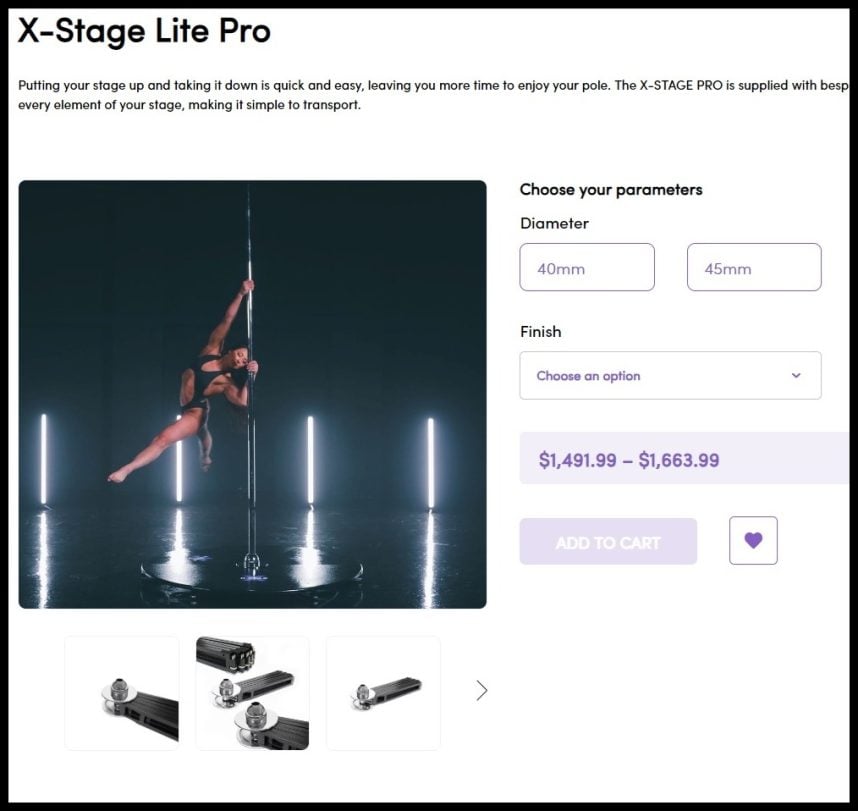
“A pole that doesn’t spin is just a tube,” reads the promotional copy on the Specialized Dance Poles’ site. “Our commercial poles are designed with multiple bearing assemblies throughout, allowing dancers to spin endlessly and effortlessly while performing.”
Rotating poles offer four key benefits:
- Less friction burn
- More spin from one kick
- Access to more advanced aerial shapes
- A smooth, continuous rotation that enhances the illusion of weightlessness under stage lighting.
- Spin Doctoring
To the untrained eye — especially one too distracted to watch the pole itself — the rotation reads like superhuman strength. In reality, it’s just Newton’s First Law: an object in motion stays in motion unless acted upon by an external force.
Once the performer applies a high-heeled kick-off, the system has angular momentum and very low friction thanks to the bearings. The rotation can continue for 20-30 seconds before needing another push. And, as with figure skaters, pulling arms and legs inward increases rotational speed.
That effect comes from conservation of angular momentum. And your high-school physics teacher would be delighted to know you that you clicked on an article just to brush up on your laws of motion and not to read about dancing naked ladies.
Bi-Polar
Modern rotating poles all also feature a static mode, activated by inserting a locking pin into the base. This is essential because certain maneuvers — especially high-impact “drops” — are significantly safer and easier on a fixed, unmoving anchor.
Static poles haven’t vanished entirely. You can still find them in smaller venues and on side stages where the economic advantage of a $1,000-$2,500 rotating pole don’t pencil out.
Look, we’re not implying that the artistry, athleticism and stamina of exotic dancing isn’t still very real. It’s just that, as with so many shows presented on Las Vegas stages, the magic is now a partnership between human skill and hidden mechanical hardware.
Look for “Vegas Myths Busted” every Monday on Casino.org. Visit VegasMythsBusted.com to read previously busted Vegas myths. Got a suggestion for a Vegas myth that needs busting? Email corey@casino.org.

 Most Read

Another Shooting Near Las Vegas Strip Casino Injures Man
 972,622 views

Vintners Oppose Napa Valley Casino
556,230 views


Conversation (0)
Be the first to comment on this article.