
Prediction Markets Search for Growth Outside Sports Contracts
Posted on: December 12, 2025, 01:20h.
Last updated on: January 6, 2026, 09:06h.

- By some estimates, sports event contracts account for 75% to 80% of prediction market volume.
- Some say it’s higher than that.
- One research firm says that percentage could significantly decline over the long-term.
Though they claim to not be in the business of sports betting, prediction markets are inextricably linked to that form of wagering because massive percentages of their volumes are generated by sports event contracts. That underscores the need to find other growth outlets.

In its “U.S. Prediction Markets: How Big, How Fast, What’s Next?” report, Eilers & Krejcik Gaming (EKG) estimates that over the long-term, sports event contracts will account for 44% of turnover on major US prediction markets.
That represents a significant drop-off from the 75-80% of trading volume that sports represents today, reflecting growth in categories like finance/crypto, politics, news, and culture/entertainment,” according to the research firm.
Sports event contracts, particularly those pertaining to popular sports such as football and basketball, are popular offerings on prediction markets such as Kalshi and those platforms are expanding, not paring, their sports-related menus.
Non-Sports Growth Essential for Prediction Markets
While platforms like Kalshi and Polymarket gained mainstream prominence leading up to the 2024 presidential election, it’s been their forays into sports event contracts that sparked growth, legal challenges, and regulatory scrutiny.
While EKG estimates 75% to 80% of prediction market volume is currently driven by sports contracts, in any given week, that percentage can be higher. For example, during the week of Nov. 23-29, 17 of the 20 most actively traded contracts on Kalshi were sports derivatives. Roughly $604 million changed hands on NFL and college football games alone.
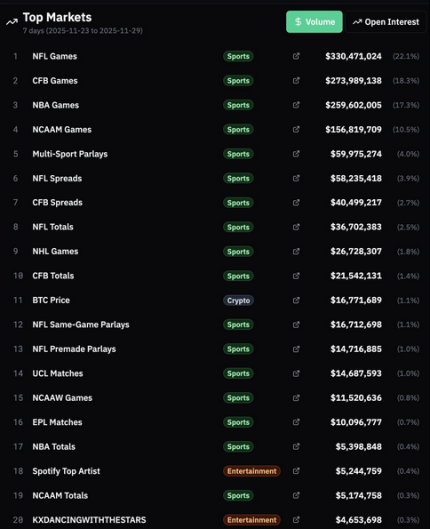
That implies that if sports’ volume contributions to yes/no exchanges declines in percentage terms over time, it will likely be because of growth in other categories, not declining sports turnover. Kalshi and competitors would do well to engineer that growth because sports contracts are what state regulators focus on when challenging prediction markets in court.
EKG forecasts sports will remain the largest category for prediction markets at the aforementioned 44% clip, followed by cryptocurrency price derivatives at 31% and news at 16%. The research firm adds non-sports growth is vital for prediction markets, namely Kalshi and Polymarket, when it comes to justifying the 11-figure valuations investors are assigning to the closely held firms.
How Prediction Markets Can Generate Non-Sports Growth
Whether it’s cryptocurrency or other markets, finance makes for ideal territory through which prediction markets can grow in non-sports categories. Operators appears to know as much as both Kalshi and Polymarket recently notched deals with Google Finance. The former is also partnering with CNBC while the latter has an accord with Yahoo Finance.
Additionally, event contract purveyors can and do partner with brokerage firms, gaining direct access to client bases that are crypto-enthusiastic and many of whom are already sports bettors. Better permeating the cultural lexicon — something Kalshi’s partnership with CNN could accomplish — would also spark non-sports growth.
“Greater cultural visibility over time as specific markets surface more frequently in news cycles (e.g., politics on the CNN ticker) or album sales totals/discussions on social media,” concludes EKG.
No comments yet