
Study Links Legal Sports Betting to Game-Day Crime Spikes
Posted on: December 17, 2025, 07:01h.
Last updated on: December 17, 2025, 07:03h.

- Researchers link legal sports betting to higher game-day violent crime.
- Assaults rise most after kickoff, home games, and underdog wins.
- Spillover seen in nearby states; stress, overtime, close scores matter.
New research claims that regulated sports betting in the US is responsible for a significant spike in violent and impulsive crime on game days.
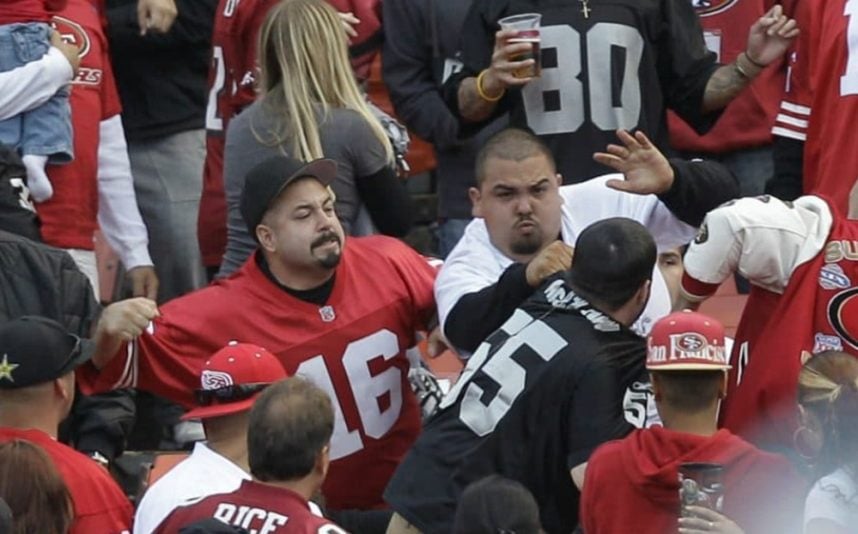
The study by the University of Michigan and Rice University, published in the Journal of Sports Economics, analyzed crime data from the National Incident-Based Reporting System (NIBRS) between 2017 and 2021.
It claims that overall crime increases by 30% to 70% from kickoff through several hours after games in legalized states, with assaults showing the largest jump, increasing by up to 93%.
The effects appear strongest during home games, especially after an unexpected loss, suggesting emotional reaction to “underdog win” are a big trigger, according to the study.
Emotion Vs. Financial Stress
The authors also report spillover effects into neighboring states without legalized betting, which they attribute to cross-border betting activity.
“It is also worth noting that aggression may not stem solely from financial stress, as often observed in other forms of betting,” said Wenche Wang, an assistant professor of kinesiology at the University of Michigan, who led the research.
We find recent evidence of increased crime associated with stressful games, such as those with close or tied scores throughout, as well as games that extend into overtime.”
She added that changes in bettor behavior indicate that jurisdictions with legalized betting may be especially susceptible to increased aggressive behavior, as even games in which bettors experience no financial losses may be linked to higher crime rate.
Crucially, the study does not claim that sports betting causes violence through financial losses alone. The authors suggest that legalized betting may amplify emotional stress surrounding games, intensifying reactions to wins and losses.
This chimes with earlier research, such as a University of Oregon study, which found that unexpected losses by local football teams are associated with increases in domestic violence, an effect that appears stronger in states with legal sports betting.
Other Factors
Of course, sports events themselves are associated with alcohol consumption, large gatherings, and heightened emotions, which are all factors that have been independently linked to spikes in violent or disorderly behavior.
Distinguishing the incremental effect of legalized betting from these long-standing game-day issues is methodologically challenging.
Nevertheless, Wang believes her study shows there are “serious social consequences we cannot ignore,” from sports betting.
“Lawmakers should consider safeguards, better consumer protections and public awareness efforts as the industry continues to expand,” she said.
Last Comments ( 1 )
Losers want their money back and they can’t afford to lose.