
LOST VEGAS: The Original Welcome to Las Vegas Sign
Posted on: March 27, 2026, 02:05h.
Last updated on: March 27, 2026, 02:22h.

- Las Vegas built a wooden arch in 1929 to impress visiting federal dam officials
- Federal leaders rejected the city due to local vice and built Boulder City instead
- No other official welcome signs were built until the famous neon version in 1959
The famous Las Vegas welcome sign wasn’t the first. That distinction went to a wooden arch thrown up over downtown’s Fremont and Main streets in 1929. But the most interesting thing about that sign — and the thing that gets lost in almost all internet retellings of its history — is that it was erected to achieve a specific goal that it failed to accomplish.
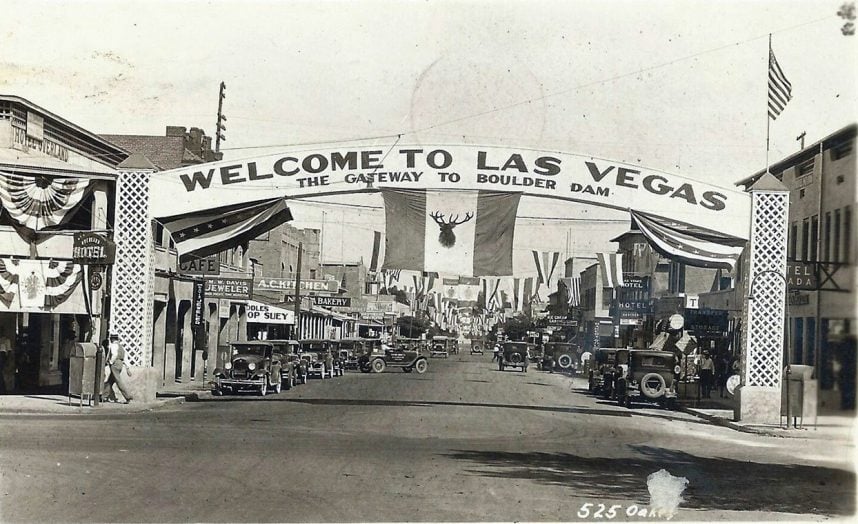
The sign was built not to welcome tourists — there weren’t many yet — but two men whose decisions would shape the entire region: U.S. Secretary of the Interior Ray Lyman Wilbur and Bureau of Reclamation Commissioner Elwood Mead (the lake’s namesake).
“Painters worked from 11 o’clock last night until 6 this morning before the giant arch of welcome, built especially to extend the felicitations of the city to her noted guests, was finished,” the Las Vegas Evening Review wrote on June 22.
Wilbur and Mead were in town to decide whether Las Vegas would become the construction headquarters for Hoover Dam or whether the federal government needed to build a separate town to house the dam’s 5,000 workers. Construction would begin in September 1930.
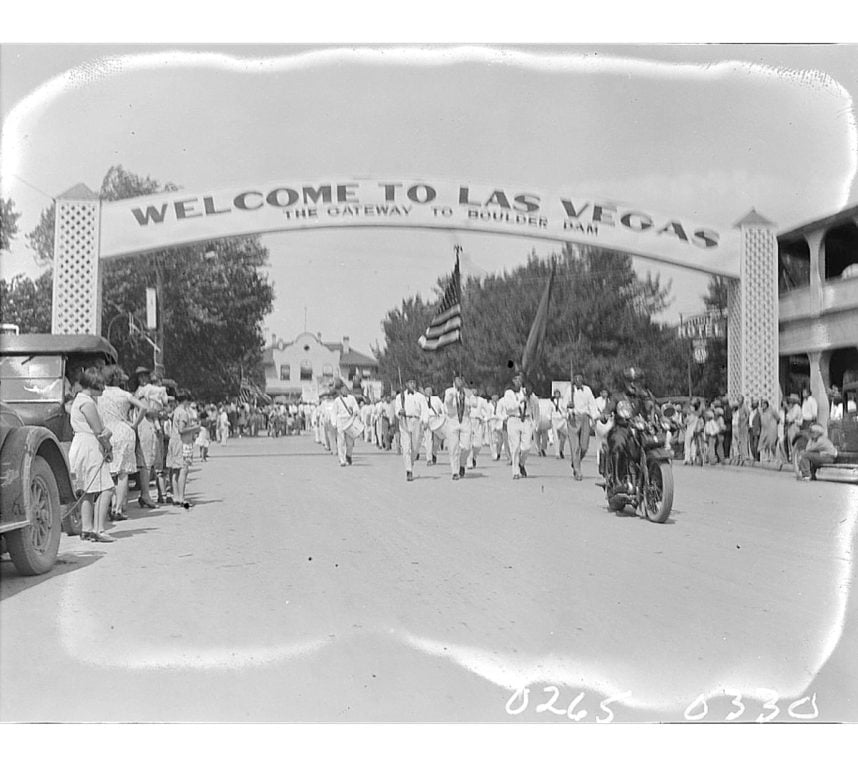
The arch faced the Los Angeles & Salt Lake Railroad station so that its ambitious message — “Welcome to Las Vegas, The Gateway to Boulder Dam” — would be the first thing the government officials saw when they stepped off the train.
Vice Principles
To prepare for the visit, local authorities also ordered a temporary shutdown of Block 16, the red-light district where drinking and gambling were outlawed but tolerated, and prostitution was legal.
Las Vegas was selling itself as a wholesome town. But despite the cleanup, their impressive sign and a warm reception held for the two officials at the Elks Lodge, the plan failed.
Wilbur’s executive assistant, Northcutt Ely, conducted an unsupervised tour of the town during which he encountered a worker who was clearly under the influence of alcohol.
Shortly afterward, Wilbur and Mead decided they didn’t want dam workers exposed to Sin City’s booze, gambling, and loose women. Instead, the feds built Boulder City adjacent to the dam site — a model town where gambling, alcohol and prostitution were forbidden. (Gambling is still illegal in Boulder City, and hard liquor couldn’t be sold until 1969. Prostitution has been officially illegal in Clark County since 1971.)
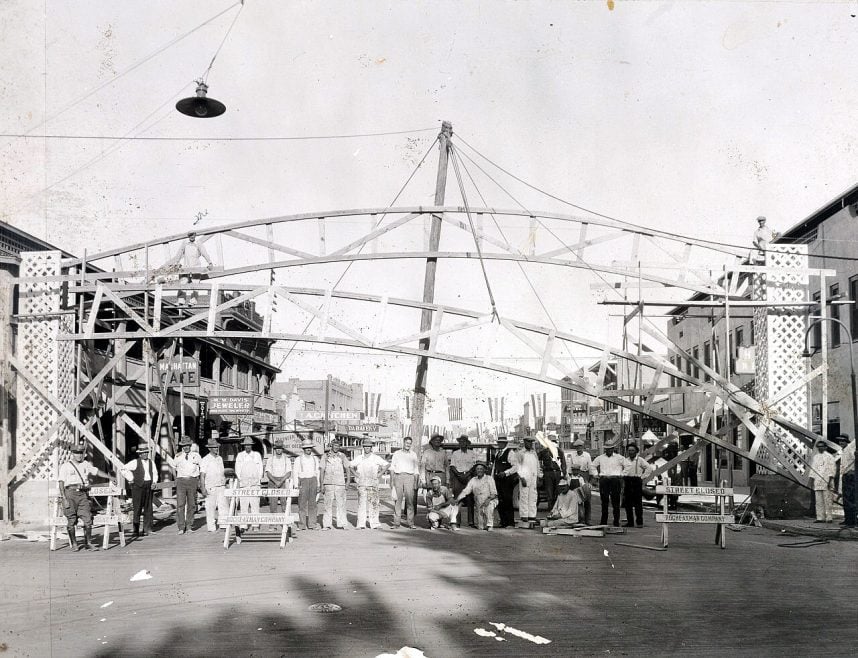
The arch came down on April 3, 1931. Having failed at its mission, it served only to remind locals of the failure. It was also obsolete; seven months earlier, Wilbur had changed the dam’s name to honor President Herbert Hoover. (Since opening in 1936, the dam was never officially known as Boulder Dam.)
Other than standard highway “city limits” signs, no other Las Vegas welcome sign would appear until the famous one went up on the southern end of the Las Vegas Strip in May 1959. (Downtown wouldn’t get its own welcome sign again until 2002.)
One Photo, Two Firsts
The main photograph accompanying this column not only shows Las Vegas’ first welcome sign, but also its first neon sign. (These were separate firsts, since the welcome sign had no neon.)
The small tombstone shape on the left, announcing the name of Fremont Street’s Overland Hotel, represented Las Vegas’ first use of the inert gas it would one day become synonymous with.
“The Overland Hotel is displaying a new neon gas-electric sign, of the most modern design, adding considerably to the appearance of that section of the city,” the Las Vegas Evening Review reported in its Sept. 28, 1928 edition.
And no, no one bothered saving Las Vegas’ first neon sign, either. When the Overland replaced its first neon sign with a bigger one three years later — something it would also do seven years after that, owing to an escalating neon arms race — nobody imagined that a bird-poop-encrusted metal sign would ever qualify as historical.
“Lost Vegas” is an occasional Casino.org series spotlighting Las Vegas’ forgotten history. Click here to read other entries in the series. Think you know a good Vegas story lost to history? Email corey@casino.org.
No comments yet