
Brightline’s Las Vegas High-Speed Train Now Running More Than a Year Late
Posted on: January 19, 2026, 01:42h.
Last updated on: January 19, 2026, 01:49h.

- The timetable for the Brightline West high-speed rail line between Las Vegas and Southern California has been revised from December 2028 to late 2029
- The only heavy construction underway so far is on the Las Vegas station and a vehicle maintenance facility in Sloan, Nev.
- The cost has nearly tripled since the project was first announced, and a $6 billion loan crucial to the project has yet to be approved
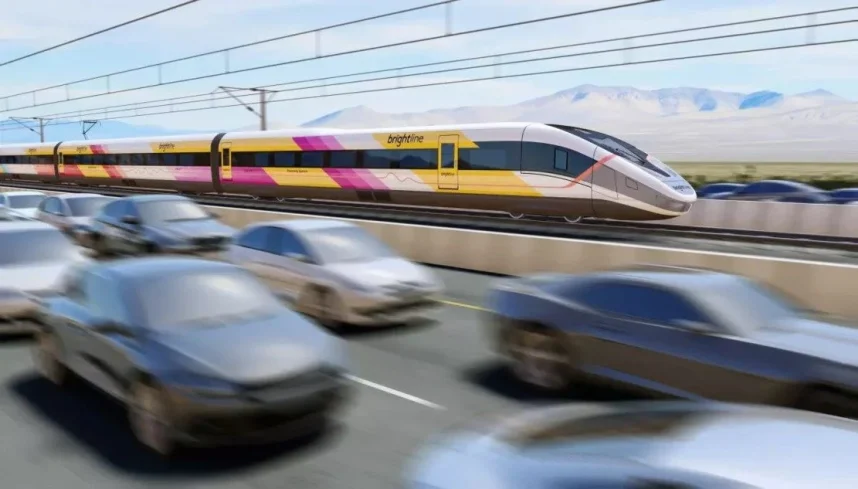
The Brightline West train may be high-speed, but its construction is not. The latest timetable announced last week pushes full passenger service from Las Vegas to LA from December 2028 to “late 2029.”
In May 2023, Brightline CEO Mike Reininger claimed the project would be up and running in time for the 2028 Los Angeles Olympics. That goalpost was first changed to December 2028 in bond documents released early last year, and continues to move.
Slow Train Coming
Though its official groundbreaking was in April 2024, construction remains limited to early‑stage work: McCarthy Building Co. is handling a parking‑garage build and site preparation at the future Las Vegas station site (on 110 acres near Las Vegas Boulevard near Blue Diamond Road), while a separate crew builds a vehicle maintenance facility near Sloan, Nev.
Heavy construction on the rail line itself isn’t expected to begin until later this year, Brightline said.
The main problems cited for the past two years have been material cost inflation, labor shortages, and shifting funding requirements. The project’s budget nearly doubled since last year, from $12 billion to $21.5 billion, which is nearly triple its original $8 billion estimate.
“Cost escalations across the board in the construction market have been relatively significant,” Reininger told the Las Vegas Review-Journal in an interview published Sunday. “They have certainly had an impact to our overall project budget. Having said that, we do remain confident in our ability to pull together all the capital, that the increase in cost is going to be made up for, in large part, by an increase in the amount of equity that will be aggregated for the project.”
Brightline previously locked in a $3 billion Federal Railroad Administration grant and sold $2.5 billion in private activity bonds from Nevada and California. Last October, the Florida-based company went back to Washington seeking an additional $6 billion federal loan through the Railroad Rehabilitation and Improvement Financing program, administered by the US Department of Transportation.
Brightline West’s financial future hinges on this loan, according to financial news website Bond Buyer. However, as of this writing, it hasn’t yet been approved.
High Speed, High Hopes
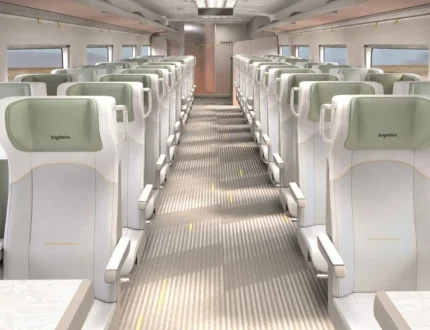
According to Brightline, the train will travel 218 miles on the median of Interstate 15 at speeds of up to 200 mph, making the trip in about two hours. The Southern California terminus will drop passengers in Rancho Cucamonga, where Metrolink connections can carry them the final 37 miles into downtown LA, which for most people will take about an hour.
That makes the total trip roughly three hours each way, which is comparable to flying once airport waiting time is included.
Additional stations are planned in Hesperia and the Victor Valley in California. Brightline West plans to feature 35 departures every day.
No comments yet