
5% Federal Sports Betting Tax Could Raise Nearly $100B, Says Policy Group
Posted on: March 20, 2026, 03:15h.
Last updated on: March 20, 2026, 03:15h.

- The federal tax on sports wagering is just 0.25% today
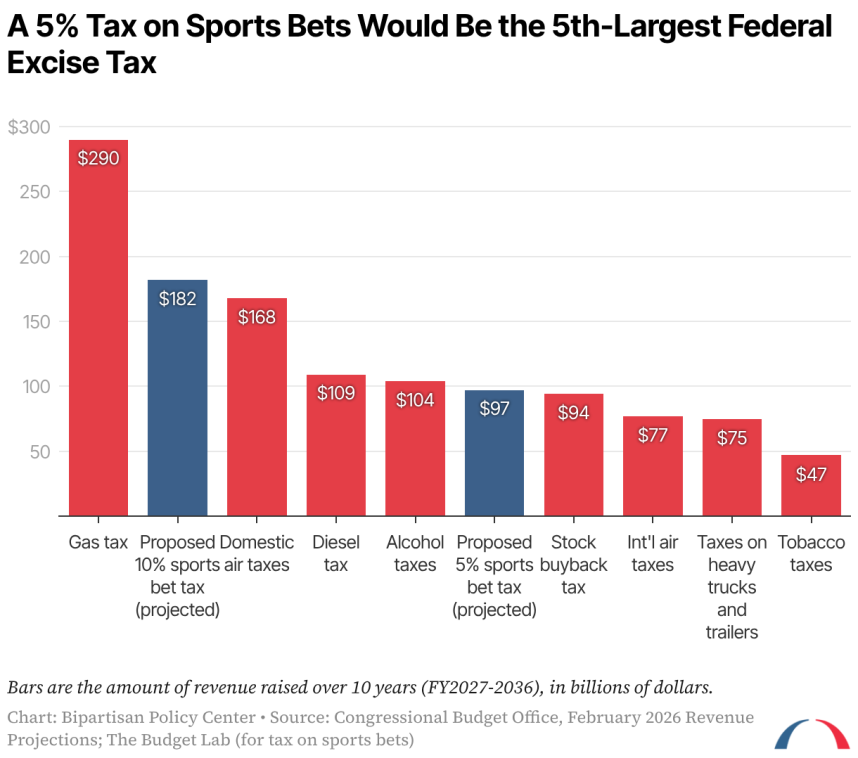
- If it was raised to 5%, it’d generate $97 billion in revenue over a decade
- At 5%, it’d be the fifth-largest federal excise tax
Plenty of states aren’t shy about raising sports betting taxes or considering such moves. It may be time for Uncle Sam to consider doing the same.
Currently, the federal excise tax on sports betting is just 0.25%, but the Bipartisan Policy Center argues that if that rate is boosted to 5%, making it the fifth-largest federal excise tax, $97 billion in revenue could be generated over a decade. Take it to 10% and the sports betting tax would be the second-largest excise tax behind only the gas levy and it’d raise $182 billion over 10 years.
The policy group points out that if Congress were to pass a law raising the federal sports betting tax to 5%, it’d likely result in the number of bets placed declining 4% on a yearly basis. If the more ambitious 10% tax hike was implemented, the amount of placed wagers could decline by 10%.
Some states that have implemented sports wagering tax increases have experienced declines in the number wagers placed, but no material declines in handle or collected revenue. That is to say that when taxes are passed onto bettors, they may bet less, but they make up for the decreased volume with increased wager size.
Federal Sports Betting Tax not Capitalizing on Post-PAPSA World
Since the 2018 Supreme Court ruling on the Professional and Amateur Sports Protection Act (PAPSA), regulated sports bets placed in this country swelled 24f-fold in dollar terms, but federal tax policy isn’t capitalizing on that growth. It’s actually been declining for decades.
Congress reduced the tax rate on legal wagers from 10% to 2% in 1974, and from 2% to 0.25% in 1982. The 1982 law also added a separate 2% tax on illegal wagers. The 0.25% rate for legal wagers and 2% rate for illegal wagers have been in place since then,” according to the Bipartisan Policy Center.
The policy group also notes that a federal per bet tax of five cents would generate significantly less revenue than the flat 5% levy.
“It projected this option would raise a much smaller amount of revenue, only $1.3 billion from FY2027-2036, than the 5% ad valorem tax, but in the long run its impact could be greater by reducing the number of bets: While overall betting volume might not decrease as much under a $0.05 tax as a 5% tax, gamblers could place fewer higher-dollar bets to reduce the tax’s effects under this option,” notes the Center.
Revenue Would Rise Even if Bettors Respond
Illinois is instructive in terms of how bettors respond to increased taxes. Last year, the state implemented a levy of 25 cents per bet is applied on the first 20 million bets booked, with that figure doubling to 50 cents for every bet after 20 million.
That’s been passed onto consumers in the form of transaction costs (DraftKings, Fanatics and FanDuel) or increased minimum bet size (other operators). Data indicate the number of bets placed in the state have declined in recent months, but handle has not. The Bipartisan Policy Center said that even if bettors reacted to a 5% federal tax, the government would still raise substantial revenue.
“However, even a significant response from gamblers—say, an elasticity of -3 instead of -0.5, which would translate to a 3% decrease in sports-betting volume for every 1% increase in after-tax price—would still generate tens of billions of dollars in revenue over 10 years,” according to the group.
No comments yet