
President Trump Will Hype ‘No Tax on Tips’ in Las Vegas, But Gamblers Want Answers on Deductions
Posted on: April 9, 2026, 11:49h.
Last updated on: April 9, 2026, 11:49h.

- President Trump is set to visit Las Vegas on April 19
- His visit comes a day after Tax Day
- Trump is expected to promote his No Tax on Tips policy
President Donald Trump will travel next week to Las Vegas, where he’s expected to promote his “No Tax on Tips” at a to-be-announced rally somewhere in Southern Nevada.
Trump is scheduled to appear in Las Vegas next Thursday, April 16. The president’s stop comes the day after the federal deadline for filing taxes with the IRS without an extension.
The president will discuss how the One Big Beautiful Bill (OBBB) will help casino and hospitality workers in Las Vegas and across the country by reducing their federal tax liabilities on tips. The Republicans’ tax bill allows tipped workers to deduct up to $25,000 of their tips from their federal tax obligations beginning in 2026.
You’ll hear a lot from the president about how his policies have benefited the American people, and I’m proud to report that the president will be traveling next week to the great states of Nevada and Arizona to tout this historic accomplishment over the course of the next week,” said White House Press Secretary Karoline Leavitt.
The OBBB authorized the tips statute for the 2026 tax year through at least 2028, when Congress would need to extend the provision for it to continue.
No Tax on Tips
No federal tax on a worker’s first $25,000 in tips was welcomed by even Trump opponents, including the Culinary Union, the largest casino workers’ trade group in the country. The aid comes after a difficult year in Las Vegas, where visitation was down 7.5% in 2025.
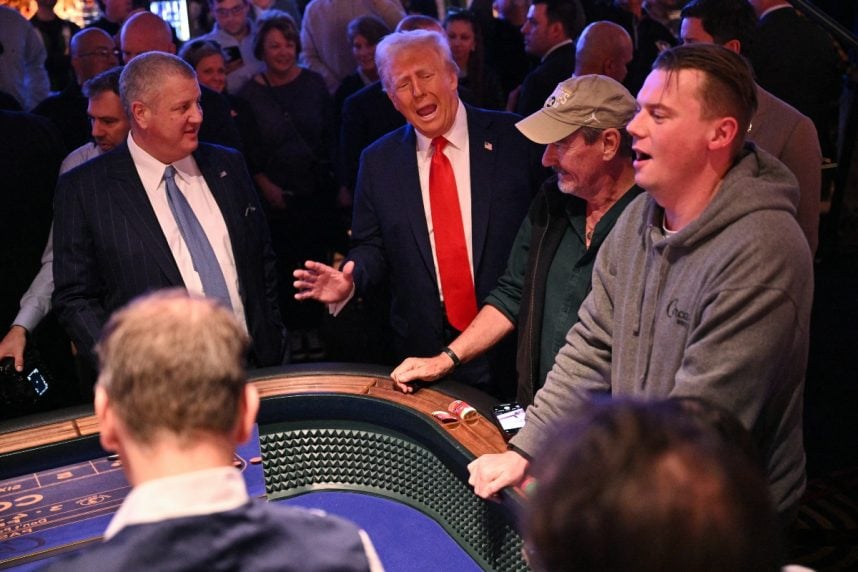
During a stop at Circa Resort & Casino in downtown Las Vegas in early 2025, Trump touted the no tax on tips pledge.
“If you’re a restaurant worker, a server, a valet, a bellhop, a bartender, one of my caddies, I go through caddies like candy, your tips will be 100% yours,” Trump said.
Another OBBA Tax Provision Targets Gamblers
Another key provision of the OBBB, as it relates to gaming, threatens the health of Nevada and other gaming states because it reduces the amount of losses a gambler filing an itemized federal tax return can deduct against their winnings.
The Republicans’ tax overhaul lowered the gambling deduction for losses against winnings from 100% to 90%. The change means a gambler who wins $100,000 during the year but also loses $100,000 would still be responsible for federal taxes on $10,000 of phantom income.
The gambling deduction had allowed professional and casual gamblers to deduct losses against winnings, similarly to how businesses are allowed to deduct most expenses against revenue. US Rep. Dina Titus (D-NV) and Sen. Catherine Cortez Masto (D-NV) have filed legislation in Congress to restore the gambling deduction to 100%.
When @POTUS us here in Nevada talking taxes next week, let’s ask him to fix the 90% gambling loss deduction,” Titus wrote on X.
Titus’ FAIR Bet Act would allow tax filers to deduct 100% of their gambling losses against their winnings. The law, should it pass, could be retroactive to the start of 2026. Cortez Masto is behind similar legislation called the FULL House Act.
Proponents of keeping the 90% cap on gambling losses argue that gambling is a form of entertainment, and therefore expenditures shouldn’t be deductible.
“Some may argue that if gambling winnings are taxed, fairness requires offsetting losses, as with stocks or other investments. But the tax code already denies deductions for income-producing activities if they are infused with personal consumption, such as taking a prospective client to a Broadway show. Consistency requires the denial of the gambling loss deduction,” Mirit Eyal-Cohen, the Joseph D. Peeler Professor of Law at the University of Alabama School of Law, and Jay Soled, the distinguished professor of Taxation at Rutgers Business School, wrote in a recent op-ed published in The Hill.
No comments yet