

Shocker: Downtown More Profitable Than The Strip in 2025, Strip Casino Profits Take 81% Nose Dive

If you’re a Las Vegas visitor, just here to gamble and cavort, you might not care a lot about casino inside baseball. But maybe you could pause your cavortation for three minutes to hear what the newly released Nevada Gaming Abstract from the Nevada Gaming Control Board has to say because not only will your mind be blown, what you learn might just clinch your “Jeopardy” win someday.
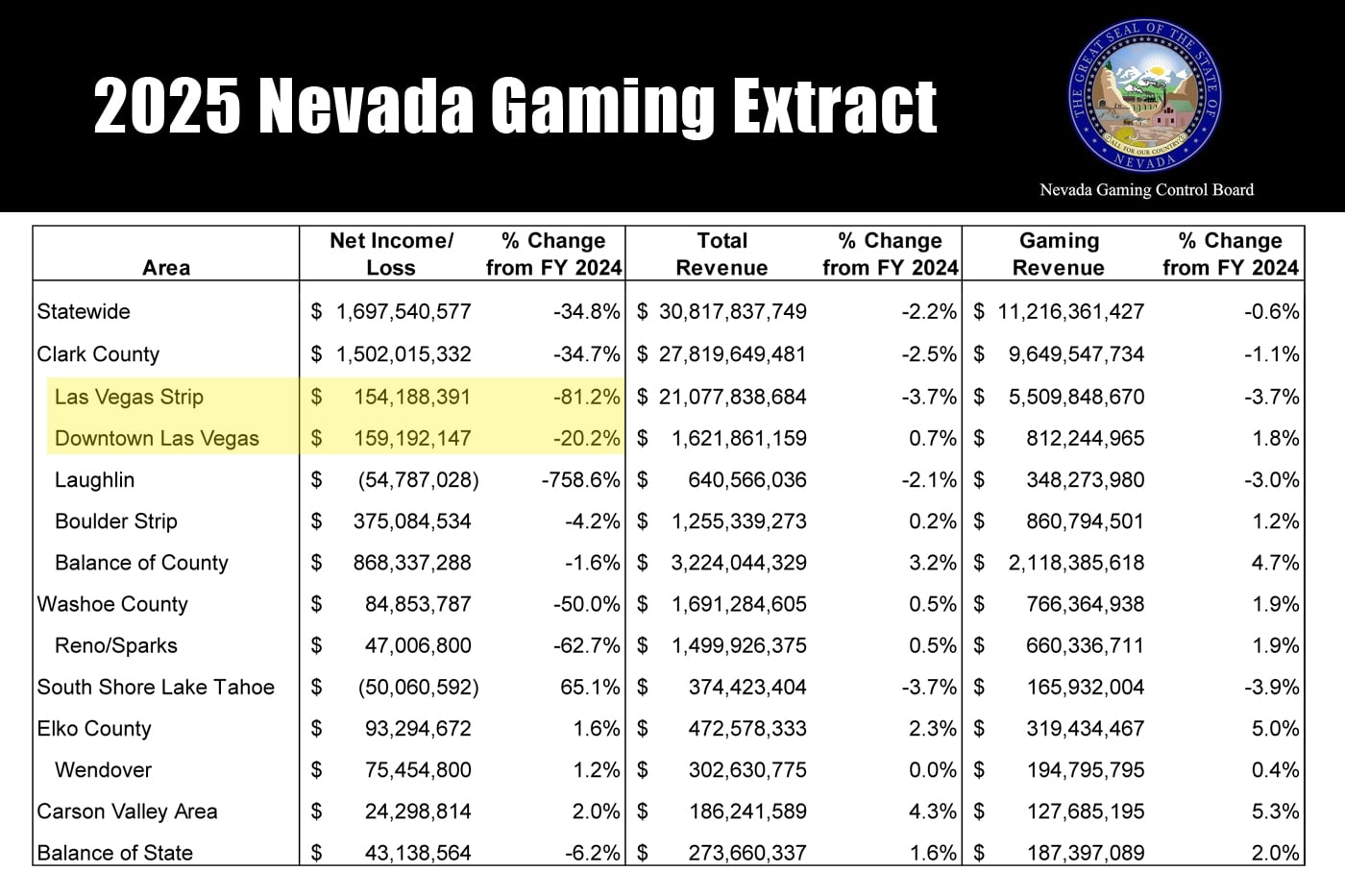
Key takeaways? According to the report, The Las Vegas Strip’s profitability drove off a cliff like Thelma and Louise in 2025, a reference we are fully aware is now 35 years old, but we are making a point here: The Strip generated net income of $154.2 million in 2025, a jaw-dropping 81.2% decline from the previous fiscal year.
Net income on The Strip: $154.2 million. Net income downtown: $159.2 million. In other words, downtown’s handful of casinos made more profit than all the big boys on The Strip. In layperson’s terms, The Strip is FUBAR.

We, like you, are already fairly bored by this story, so we’ll try to keep it superficial and short. If you thought, “Just like you, Vital Vegas!,” well, rude and hurtful. We are 5-foot-8-inches tall, for the record. We just appear shorter sometimes because we bear the weight of being the only one in Las Vegas who regularly invents words like “cavortation” just to try and keep you from nodding off.
You’re welcome.
Here’s the quick version of the big picture: Statewide, 305 Nevada casinos grossing $1 million or more in gaming revenue generated total revenue of $30.8 billion in fiscal year 2025, down 2.2% from the prior year. Net income was $1.7 billion, down 34.8%. Gaming revenue statewide was $11.2 billion, down just a smidge (0.6%), so the story isn’t really about a downturn in gambling revenue so much as a margin problem.
But if casinos made only slightly less revenue than they did previously, why has there been such a dramatic drop in profit, or “net income”?
Net income is revenue minus the cost of running the place: labor, utilities, marketing, debt, taxes, maintenance, comps, corporate overhead, depreciation and all the other financial aspects of running a business that give accountants boners.
The fact Strip casinos have such massive revenue but so little profit raises lots of red flags we and others have been screaming about for years.
The Strip accounted for about 68% of all Nevada casino revenue in 2025, but only about 9% of statewide net income.
It’s worth mentioning that the abstract also says 52 casinos owned by public companies accounted for 62.1% of statewide gaming revenue, another reminder that Nevada’s casino industry is increasingly driven by large corporate operators rather than old-school independent casino owners.
Strip casinos continue to generate record revenue (as has been the case during the post-COVID era), but the cost of doing business has eroded that revenue significantly.
The big culprits: Labor, rent and interest on debt.
Labor is pretty much the biggest expense for any business. The hospitality industry is people-heavy. They’re the folks who make Las Vegas what it is, so it’s hard to get too mad. Talking about how the cost of labor has affected pricing in Las Vegas is pretty much off limits. People would rather talk about “corporate greed.” Our interest in fighting this fight has waned over time. Pricing reflects costs. Union labor raises costs. It’s just a fact.
For the 305 Nevada licensees grossing $1 million or more in gaming revenue included in the report, casinos reported about $9.62 billion in payroll-related expenses in fiscal 2025.
As for rent, this is where the big casino companies have overplayed their hands. Many Las Vegas casinos don’t own their land or buildings. They pay rent, and it’s a lot.
In the parlance of the street, casinos have a big “nut.” That nut increases at regular intervals whether business and revenue do or not.
That nut includes servicing debt. Strip casinos pay billions of their precious revenue to service an eye-watering amount of debt. Caesars Entertainment is carrying nearly $12 billion in debt; MGM Resorts is carrying about $6.4 billion.
Statewide interest expense was $2.6 billion in 2025, equal to 8.4% of total revenue, which was bigger than statewide net income. On The Strip, interest expense was $2.23 billion, or 10.6% of revenue.
All of which contributes to why downtown made more profit last year than The Strip did.
Smaller nut.
Downtown’s net income took a hit in 2025, too (total revenue rose 0.7%, net income declined 20.2% from the prior year), but that’s much less painful than The Strip’s 81% free fall.
Downtown’s casinos are smaller, and as such, have lower costs. There’s another aspect of downtown’s lean and mean business model nobody talks about: Their slots are tighter.
Awkward, but despite downtown’s reputation for appealing to value-seekers, their machines have been tighter than The Strip’s for several years now.
According to annual slot hold data compiled by UNLV’s Center for Gaming Research, downtown Las Vegas slots became tighter than Las Vegas Strip slots in 2020 and have stayed that way ever since.
“Slot hold” is the percentage of money wagered on slot machines that casinos keep. The higher the hold, the less players get back over time. In other words, a higher hold (like at the airport and Resorts World) means tighter slots. A lower hold (Boulder-area casinos) means looser slots.
The difference in holds isn’t huge. In 2025, downtown held 8.32%, compared with 7.85% on The Strip. But still.
It’s worth mentioning that pretty much everything else is cheaper downtown than on The Strip, so figure that into your decision-making about future cavorticulation.
Another fun fact before we go: Statewide, gambling revenue accounted for $11.2 billion, or 36.4% of total revenue. Rooms, food, beverage, entertainment, nightclubs, pools and other attractions make up the majority of revenue at Nevada casinos.
That’s because our fellow youths aren’t gambling as much. Then again, they also aren’t drinking, having sex, doing drugs or smoking as much. You know, all the formerly Vegas things.
Which is why our first act as mayor of Las Vegas will be to ban smartphones, sports betting apps, STIs, pregnancy, DoorDash, online porn, prediction markets, vaping, A.I., Ozempic and pickle-bucket drummers.
We just threw in the pickle tub drummers for good measure. They’re annoying AF.
You can see the complete 2025 Nevada Gaming Abstract on the Nevada Gaming Control Board Web site.
Oh, gawd, we know you aren’t going to read it. Why do we even bother providing a link?
Fun Facts From the 2025 Nevada Gaming Abstract You Were Too Lazy to Look Up for Yourself, Probably
 Downtown is much more gambling-dependent than The Strip. Downtown got 50.1% of its revenue from gambling. The Strip got just 26.1% from gambling. The Strip’s biggest revenue category was rooms, at 33.5% of revenue.
Downtown rooms were cheaper by comparison. The Strip’s average room rate was $250.72. Downtown’s average room rate was $114.
The Strip had much stronger hotel occupancy in 2025 than downtown. The Strip’s occupancy was 89.1% for the year. Downtown’s was 73.1%. Downtown’s weakest month was June at 64.7%, while its strongest was October at 83.1%.
Slots generated much more revenue than table games. Statewide slot machine revenue was $11 billion, while table games, including keno and bingo, were $3.85 billion. Sportsbooks were $436.5 million.
Downtown sportsbook revenue was $136.9 million, compared with The Strip’s $166.6 million. Circa’s doing a lot of heavy lifting there.
The Strip reported $5.1 billion in slot revenue and $2.99 billion in table game revenue in 2025.
Downtown’s average slot revenue per room per day was $231.91. The Strip’s was $177.43. The Strip beat downtown in table game revenue per room per day, $103.99 versus $57.05.
The Strip’s total “contra revenue,” or complimentary expense, equaled 38.89% of gaming revenue. Downtown’s was 17.07%.
Statewide, average employment was 146,645. The Strip accounted for 92,130 employees, while downtown had 10,063. Food departments employed the most people statewide, with 37,911, followed by casino departments at 34,188.
Now, you know!
Oh, and if you’re ever on “Jeopardy,” remember that the show isn’t always won by the smartest contestant, it’s about who has control of the board. Contestants can’t buzz in until the host finishes reading the question. If you buzz in too early, you’re locked out, which can be a buzzkill. Practice (try a clicky pen) anticipating the final syllable of the question, then buzz immediately.




Leave your thoughts on “Shocker: Downtown More Profitable Than The Strip in 2025, Strip Casino Profits Take 81% Nose Dive”
14 Comments