
Tax, Law Professors Argue Against Restoring IRS Gambling Deduction
Posted on: March 30, 2026, 09:25h.
Last updated on: March 30, 2026, 09:25h.

- An op-ed from tax and law professors argues against the restoration of the gambling deduction
- The professors opine that gambling isn’t a business endeavor or occupation
Tax and law professors at the University of Alabama and Rutgers argue in an op-ed that the IRS tax code should not be amended to restore the gambling deduction to 100% of losses against winnings.
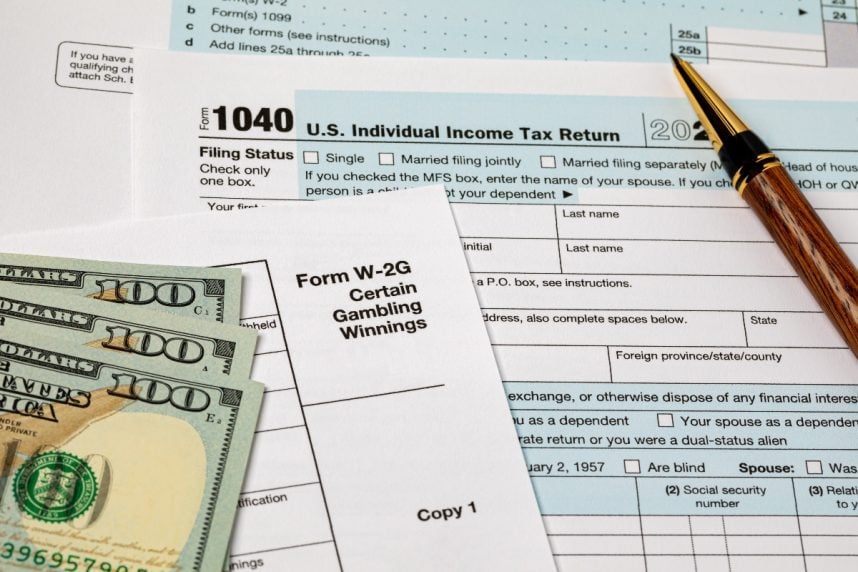
The Republicans and President Donald Trump’s One Big Beautiful Bill (OBBB) cut the amount of losses a gambler can deduct against winnings on their itemized federal return from 100% to 90%. The change means an itemized filer who wins $100,000 gambling during a tax year but also loses $100,000 would still need to pay federal taxes on $10,000.
Critics, including Nevada’s congressional delegation, say the tax change is unfair, forcing gamblers to pay federal tax on phantom income, or money they didn’t actually earn at the end of the year. Opponents to the OBBA also claim the tax change will lead to some professional and casual gamblers taking their business to offshore gaming platforms and operations, possibly leading to job cuts and reduced tax revenue.
An op-ed published in The Hill argues that the gambling deduction being trimmed from 100% to 90% is warranted.
Gambling Deduction Op-Ed
Mirit Eyal-Cohen, the Joseph D. Peeler Professor of Law at the University of Alabama School of Law, and Jay Soled, the distinguished professor of Taxation at Rutgers Business School, opine that the OBBB gambling deduction provision harmonizes the tax code by eliminating a tax benefit on personal consumption. Eyal-Cohen and Soled argue that gambling isn’t an occupation or business-related endeavor.
Because gambling is a form of entertainment, the tax code should eliminate gambling loss deductions in their entirety. More specifically, it is a form of personal consumption, not a productive economic activity,” their op-ed wrote.
The IRS largely forbids personal consumption expenditures from being deducted, unlike business and investment-related expenses, which are generally deductible.
Some may argue that if gambling winnings are taxed, fairness requires offsetting losses, as with stocks or other investments. But the tax code already denies deductions for income-producing activities if they are infused with personal consumption, such as taking a prospective client to a Broadway show. Consistency requires the denial of the gambling loss deduction,” the opinion piece continued.
Eyal-Cohen and Soled additionally argue that gambling deductions are inherently unfair to lower-income people.
“Equity is another important consideration. The way Congress has currently conceived the gambling loss deduction, the deck is deeply stacked against the majority of low- and moderate-income taxpayers while favoring high-income taxpayers. How so? Taxpayers must report their gambling winnings, but high rollers, who generally itemize their deductions for tax purposes, get to deduct most of their gambling losses, whereas low rollers, who generally take the standard deduction in lieu of itemizing their deductions, do not,” the piece claims.
Republican Leaders Blocking Gambling Tax Restoration
Rep. Dina Titus (D-NV) has garnered bipartisan support from Republicans, with 11 GOP representatives now cosponsoring her FAIR Bet Act. Sen. Catherine Cortez Masto (D-NV) has authored the FULL House Act, similar legislation to restore the gambling deduction to 100%, but it has attracted only four Republican cosigners.
Republican leaders in both the House and Senate have impeded the gambling deduction restoration measures. The FAIR Bet Act has sat in the House Ways and Means Committee since last July. The FULL House Act hasn’t moved from the Senate Finance Committee since being referred there last summer. Efforts to tack on the gambling deduction measures to spending and appropriations bills have also been removed by Republican leaders.
The OBBB tax change does not apply to 2025 returns due next month. It takes effect for the 2026 tax year, but the FAIR Bet and FULL House bills would be retroactive and restore the gambling deduction for this year.
No comments yet