
Deadwood Casinos Will Better Benefit Deadwood After Revenue Distribution Bill Becomes Law
Posted on: March 23, 2026, 08:17h.
Last updated on: March 23, 2026, 08:17h.

- A new law in South Dakota will keep more casino tax money in Deadwood
- Deadwood is the only place in South Dakota where commercial casinos are allowed
Deadwood casinos will soon generate more local revenue for the historic Gold Rush mining town in the Black Hills of South Dakota after Gov. Larry Rhoden (R) signed legislation that keeps more of the gaming money with the city.
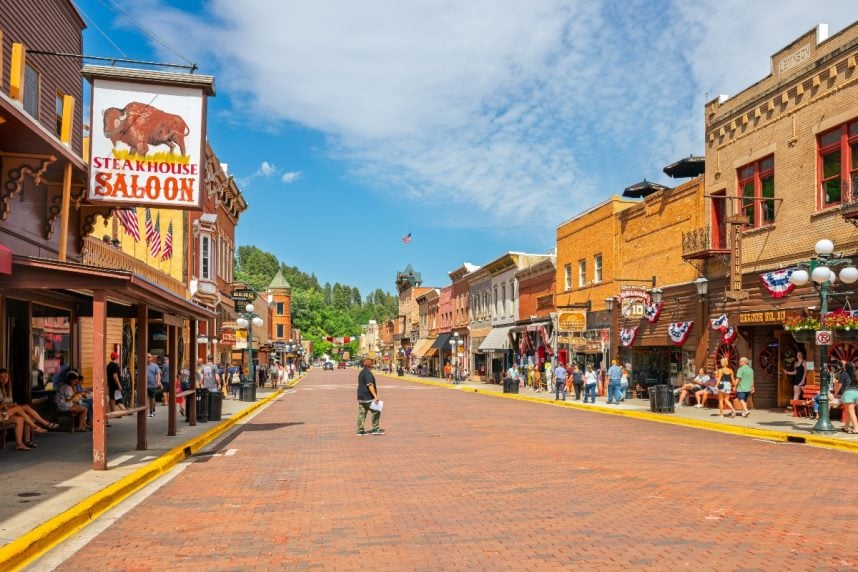
Senate Bill 102, passed by the Senate on Feb. 24 with a 31-2 vote and the House of Representatives on March 9 with a 64-5 tally, overhauls how the state uses its tax revenue from commercial casino gambling in Deadwood. In the only place where commercial casinos are permitted in South Dakota, the state has agreed to return a larger share of the 9% gaming tax to Deadwood.
I am committed to keeping our communities strong and South Dakota ‘Open for Opportunity,’ and that is exactly what these bills do,” Rhoden said in a news release. SB102 was one of three bills to provide more funding for cities by reducing the state’s take.
SB102, signed by Rhoden last week, removes a cap that has limited Deadwood to $6.8 million of the annual casino tax money. The new law, effective July 1, 2026, allocates 25% of the gaming tax to the state’s General Fund, 3.3% to Lawrence County, 0.7% to the Lead-Deadwood School District, and the remaining 71% to the City of Deadwood.
South Dakota Searchlight reports that, should the revenue allocation have been in place last year, Deadwood would have kept almost $7.3 million in gaming taxes.
Deadwood Alive and Well
Deadwood primarily uses its casino tax share for historic preservation. Through its Historic Restoration and Preservation Fund, the city has created numerous grant and loan programs to assist with Deadwood’s many National Historic Landmarks.
Maintaining these designations is critical to the economic success of the city and to the quality of life of its residents. The objective of the grant program is to stimulate quality restoration, protection, and interpretation of buildings, sites and properties that contribute to an understanding of the history of the City of Deadwood,” the city’s website explains.
Deadwood’s economy almost exclusively relies on tourism and gaming.
Today, Deadwood is home to 21 casinos, though “casino” has a far different definition than in Las Vegas. Deadwood casinos are mostly small bars and restaurants, with a smattering of gaming machines and a few table games.
Larger casinos, each with 200-400 slots, include the Silverado Franklin, Gold Dust, and Mineral Palace.
Gaming has been robust in recent years, as Deadwood’s gross gaming revenue (GGR) hit a record high of $151.9 million in 2024. Revenue cooled slightly last year, to over $150 million, but it remained 36% higher than in 2019, when casino win was $110 million.
Deadwood History
Established in 1876 during the Black Hills Gold Rush, Deadwood is among the most famed frontier settlements. The entire city is a National Historic Landmark, as designated by the National Park Service’s National Register of Historic Places.
For gamblers, the city is best known for being the site of the infamous “Dead Man’s Hand.” It was Aug. 2, 1876, when Wild Bill Hickok was murdered by Jack McCall while playing poker. Legend has it that Hickok was holding a hand of black aces and eights when he was gunned down. The fifth card went unknown.
No comments yet