
Quebec Fall Election Could Reshape Canadian Gaming Policies
Posted on: March 3, 2026, 11:56h.
Last updated on: March 5, 2026, 08:26h.

- Quebec provincial election set for October 5
- Parti Quebecois currently leading in the polls, incumbent CAQ sits in fourth, depending on poll
- Spokesperson from Quebec Online Gaming Commission said they’ve met with all the provincial parties about changes to Quebec igaming structure
The Quebec Online Gaming Commission (QOGC) is accelerating its efforts to push forward an agenda in favour of a regulated, competitive igaming market in the province, where Loto-Québec is currently the only legal igaming game in town.
Coalition Wants To Open the Market Up
There’s a provincial election coming up this October 5. Currently, according to polls, the Parti Quebecois is in the lead, ranging from 30% to 34%, followed by the Liberals ranging from 24 to 27%, the Conservative Party, ranging from 14% to 18%, followed by the incumbent CAQ, ranging from 11% to 17%.
QOGC sees an opportunity, according to spokesperson Ariane Gauthier in an interview with Casino.org, to make substantive progress in its efforts to see an Ontario-style (and soon, Alberta-style) situation where private operators are competing with the crown corporation.
QOGC is an organization of private operators comprised of Betway, Bet99, DraftKings, Entain, Flutter, Games Global, and Rush Street Interactive, partnering with Apricot Investments — committed to working with the Quebec government and local stakeholders to develop a new regulatory framework for the province.
$300 Million Potentially in Tax Revenue
Gauthier said the QOGC has now met with all the provincial parties, on several occasions, articulating its position.
“When you take the time to understand the narrative and to analyze what’s going on in Ontario, and soon in Alberta, you see that there’s no other way to go than to change the regulation, to create a framework that will allow for private online offerings,” she said. “So keeping a monopoly over online gaming with Loto-Québec is just not possible over the internet.
“We’re in an internet era, so we have to move on, and the sooner the Quebec government will do this, the better off we will all be,” she said. “That includes the players, who will be able to play in a safer environment, and also government and the economy, which will benefit from the economic activity. If Quebec was to regulate private online gaming, it will generate $300 million in taxation based on a 20% tax similar to what Ontario has.”
Loto-Québec Regulates Legal Online Gaming
Gauthier said the $300 million in taxable revenue will come through capturing the betting activity currently going on across the grey market, bringing a lot of it under the regulated tent. That number has nothing to do with increasing gaming activity in the process, she said.
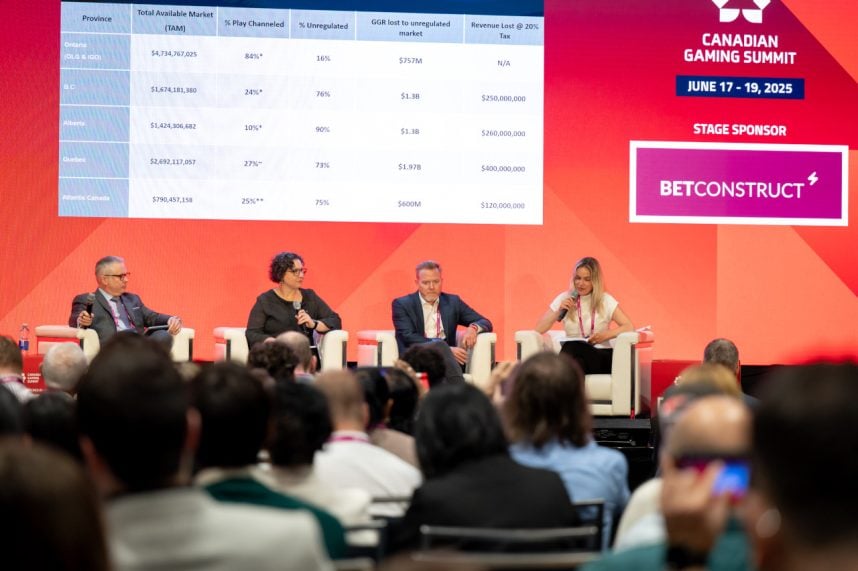
At the Canadian Gaming Summit in June, Gauthier was part of a panel discussion that touched on the gross gaming revenue provinces were losing to the grey market, with Quebec leading the charge at CAD $1.97 billion ($400 million in tax revenue lost if factoring in an Ontario-like 20% tax rate), followed by Alberta and B.C., at CAD $1.3 billion, Ontario, at CAD $757 million, and Atlantic Canada, at CAD $600 million.
Loto-Québec will lay out the argument differently. They say the majority of online players choose Loto-Québec’s platform, which offers a legal, secure, and responsible gaming environment. The coalition of private operators only benefits foreign companies, not players in Quebec, a spokesperson told us.
“Loto-Québec does not claim to be perfect, but 100% of its activities are legal,” said Renaud Dugas. “And, more importantly, 100% of what it generates remains in Québec. Last year, the corporation paid over $1.5 billion in dividends to the State, and that’s in addition to all its other contributions to Québec society.”
Call for Debate
Gauthier said all the provincial parties QOGC has met with are open to new regulation that includes private players. Alberta is about to go live with a new regulatory regime where the Alberta Gaming, Liquor and Cannabis Commission will act as regulator, responsible for licensing and compliance, while the Alberta iGaming Corporation will oversee the market, managing commercial relationships with licensed operators.
Political parties are trying to figure out their financials and how they will build their program, and they are well aware there’s an opportunity to bring in a safer environment and bring more money into the government,” she said. “There’s a huge deficit in Quebec, and $300 million is a lot of money to do a lot of things. CAQ has started to show interest, and the other political parties are well aware of the issue and are starting to show interest.”
Gauthier said she is more optimistic that the market will change in their favour compared to when she joined the QOGC in 2024.
“We wanted to bring a different perspective than what Loto-Québec was giving them,” she said. “For way too long, Loto-Québec had also a monopoly on communication and information for online gaming, and now with the Coalition, they cannot say all they want, because we will correct them, and challenge them. We need real facts and sound arguments to make good public policy decisions.”
Casino.org has reached out to the Parti Quebecois and Liberal Party for comment but we’ve yet to hear back.
No comments yet