

Vanderpump Hotel Chip Reveal Provides Excuse to Mansplain Everything About Casino Chips

The opening of the new Vanderpump Hotel, formerly the Cromwell, draws nigh.
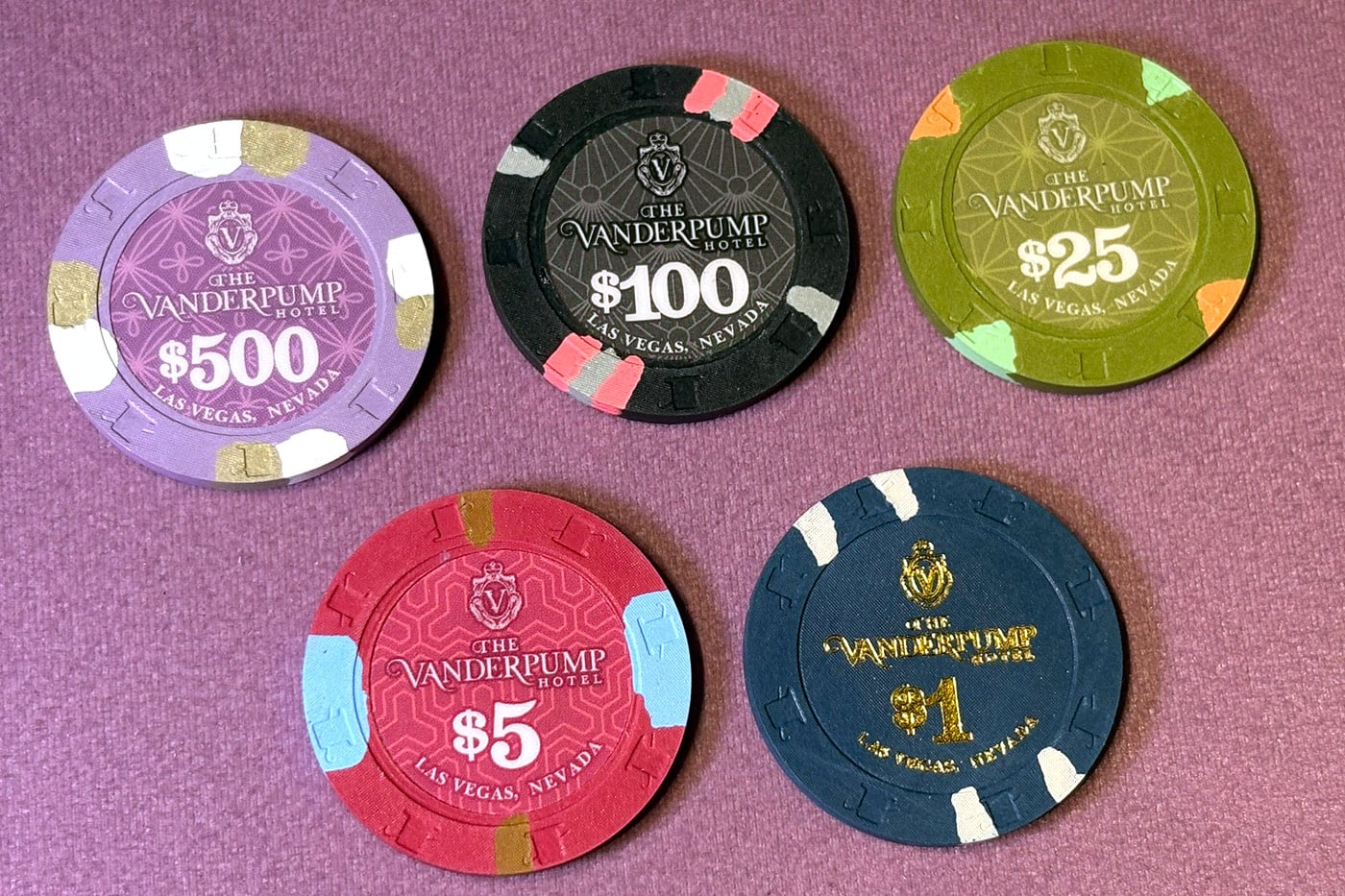
One of the most anticipated elements of a new hotel-casino is the time-honored tradition of unveiling new chips.
Vanderpump has done just that, and there’s been far too little fanfare, so we’re about to remedy that with not only the chip reveal, but also a metric ass-ton of mansplaining about casino chips! Lucky you.
Typically, when a casino rolls out new chips, they cancel (“discontinue”) the old ones, but we haven’t seen any notifications about that, so you’ll be able to wager or cash in your Cromwell chips at Vanderpump for the foreseeable future.
A recent example of a casino discontinuing chips is Plaza. In cases like this, the casino wants old chip series off the books because every outstanding chip represents potential redemption liability.
HEADS UP!
We’re retiring select Plaza casino chips. If you have any of the chips pictured here, please redeem them by 8/30/2026 at the Plaza Hotel & Casino Cage.Learn More: https://t.co/kaJAkFDg50 pic.twitter.com/vRINxns0xE
— Plaza Hotel Casino (@PlazaLasVegas) May 4, 2026
What casinos really want is for people to get chips and never cash them in. That’s known as “breakage.” Otherwise referred to as “pure profit.”
If you’re a chip collector, you missed out on the opportunity to get a Cromwell chip from Vanderpump. In chip collector circles, this is referred to as being “SOL.”
Chips are often discontinued when a casino closes. That’s not the case with Cromwell rebranding to Vanderpump, but it’s still a fascinating aspect of the casino industry, so we’re going to mansplain the hell out of it.
In Nevada, the relevant rule is NGC Regulation 12.070: “Redemption and disposal of discontinued chips and tokens.”
Basically, a casino that closes, sells, replaces chips or permanently removes chips from use must submit a written redemption plan to the Nevada Gaming Control Board Chair at least 30 days before the planned closure/removal/replacement.
The redemption window must generally be at least 120 days after the chips are removed/replaced or after operations cease.
Redemption of the chips doesn’t necessarily have to happen at the closed casino. Casinos often partner with neighbors. For example, Tropicana chips were redeemable at Oyo, even though the casinos weren’t affiliated, other than being neighbors.
When Oyo booted Mohegan, there was a similar redemption window.
Absolutely love this Jeff Koons-style addition to the @VirginHotelsLV lobby. New loyalty club desk has appeared near Lucia (replacing Pink Taco). If you have Mohegan chips, redeem them by July 3. Collectors will want to grab the new Virgin chips. pic.twitter.com/R7FzvPdG6K
— Vital Vegas (@VitalVegas) April 17, 2025
If you want to get really granular, and why would you, the notice requirement changed recently. Older Nevada rules required that the notice of cancelation of chips be published in at least two Nevada newspapers, at least twice weekly during the redemption period. Amendments made effective January 29, 2026 changed that to notice “sufficient to notify the public,” plus conspicuous posting at the casino or redemption location.
Ironically, our band in high school was named Conspicuous Posting.

The casino chip rabbit hole goes deep!
Casino chips are not technically “owned” by patrons. Nevada Regulation 12.060 says chips are “representatives of value evidencing a debt owed by the issuing licensee, and they remain the property of the issuing licensee.”
In most cases, the casino must redeem its own chips from players, but may refuse if it reasonably believes the presenter didn’t obtain them directly and lawfully. A casino may also refuse redemption if the person refuses to provide valid government photo ID when requested.
So, some of those crazy stories you hear about casinos refusing to cash out chips are true.
“Canceled” is the collector term people use for chips drilled, notched, stamped or otherwise marked so they can’t return to play. The regulatory phrase is more like “discontinued chips” and “destruction or other disposition.” The point is to end the casino’s outstanding chip liability after an approved redemption period.
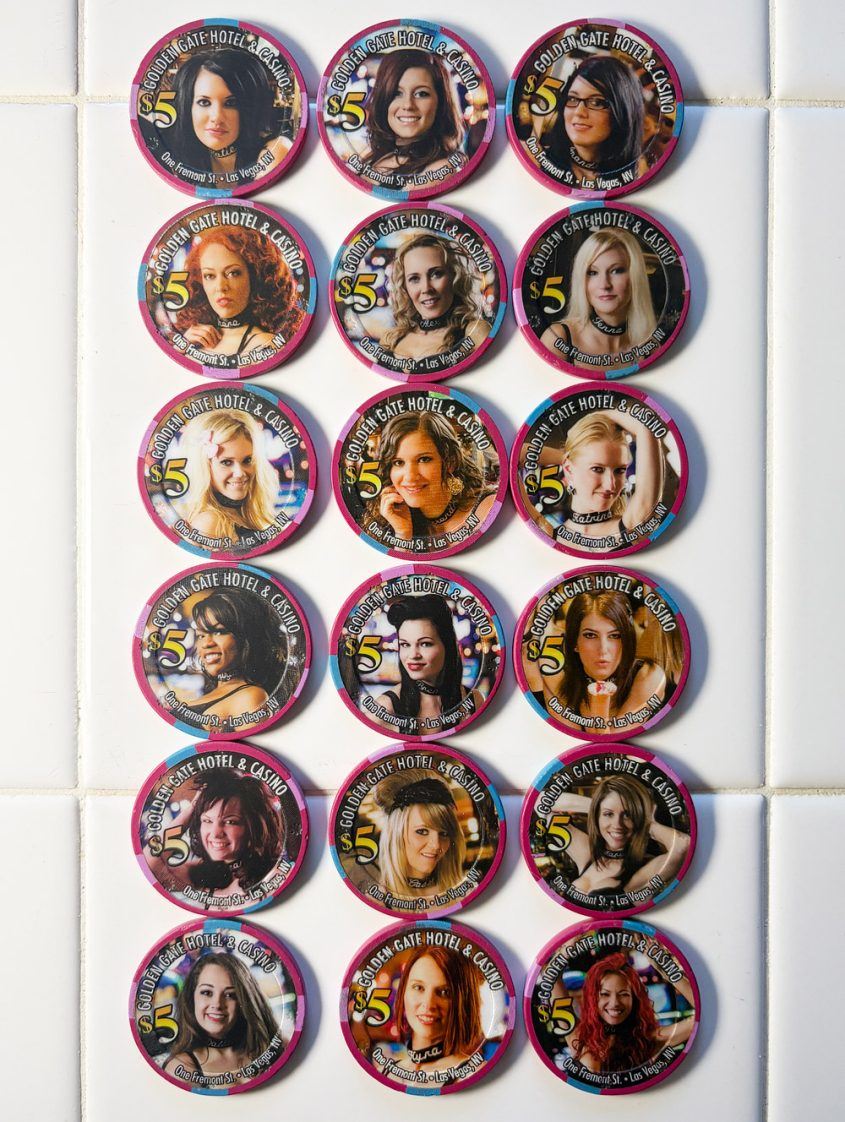
We haven’t even touched upon yet another scenario, when a casino removes its table games, like at Golden Gate, so no chips are issued, but they aren’t canceled or discontinued. That leaves the door open for use of the chips down the road.
Discontinued chips are just the tip of the chip iceberg!
There’s a whole realm of chip manufacturing and lore and collecting that most normal people never delve into.
We are speaking at the World’s Largest Collectibles Show, June 18-20, 2026 at South Point, so we are studying up on chips to become a noted chip expert by that time. Here’s more about our session (.pdf document). Learn more about the Casino Collectibles Association.
One of the more interesting aspects of chips is the jargon used to describe their designs and manufacturing quirks.
“Edge spots” and “inserts” are the contrasting colored shapes embedded into the edge of the chip. They help with security and quick denomination recognition from the side of a stack. Inserts have names like “rectangles,” “arrowheads” and “sawtooth.”
A chip’s “edge” is the outer circumference of the chip.
An “inlay” is the chip’s center graphic area with the logo and denomination. Traditionally, this was literally an inserted label under laminate. Modern chips may print directly onto the surface, but people still call it the inlay.
There’s also “hot stamping” and “foil stamping,” the chip’s metallic gold lettering and graphics. Vanderpump’s $1 chip uses a gold hot-stamped design, where metallic foil is pressed into the chip surface with heat. It’s much less expensive to produce than the fancier chips. Think about the U.S. penny. A chip can’t cost more to make than it’s worth.
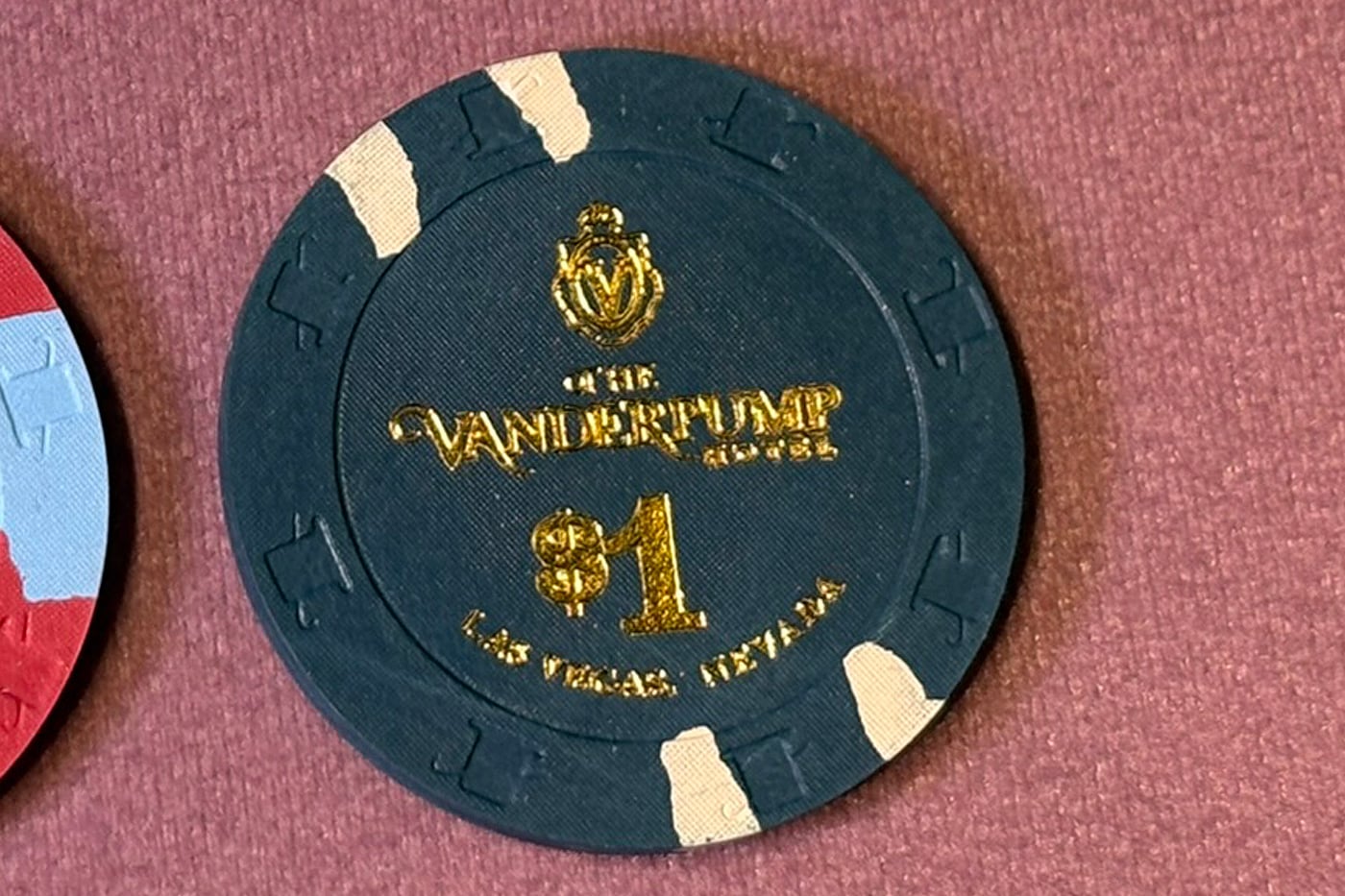
The “mold” or “molded pattern” is the embossed, repeating shape around the chip’s outer ring. Chip companies have signature molds that help identify authenticity and origin. Common molds are the hat and cane, Greek key and crosshatch. Now that you’re looking for them, they’ll jump out at you after having been invisible. You’re welcome.
A chip’s “base color” is the primary body color of the chip. Certain base colors are the default for certain denominations (the value of the chip). Red is almost universally $5, green is $25, black is $100. Vanderpump went with a nontraditional color for $1; it tends to be white.
In the casino industry, chips are called “cheques.”
A “rack” is 100 chips. A “barrel” is a stack of 20 chips.
Why do chips exist at all?
The answer is psychology.
Chips are easier to wager than cash. It’s that simple. It’s the same reason slot machines show “credits” as the default, as opposed to what those credits translate into in currency.
If players had to use cold, hard cash, every bet would feel more real, more painful and a lot harder to make.
Before chips, our ancestors used lots of alternatives. Early gamblers used random valuables like gold nuggets, coins, ivory, bone, wood and other improvised “chips.”
The making of chips is a rabbit hole within the rabbit hole!
Manufacturing casino chips is highly regulated and much more complicated than most players realize.
Nevada requires manufacturers to document security over artwork, hubs, plates, dies, molds, stamps, prototypes, samples, rejects, raw materials, work-in-process and finished inventory. It’s a whole thing.
Chips are made to exacting standards and sizes. A Vegas chip has to survive thousands of hands, sweaty fingers, dealer drops, sanitizer, chip riffles, pocket lint and the occasional dousing with beer.
Casino chips have a slew of security measures built in. Those might include UV markings, microtext, holograms, embedded RFID, special pigments, serial numbers, proprietary molds or other anti-counterfeiting features.
An RFID chip is a tiny electronic tag that uses radio waves to send stored information to a nearby reader, usually so an object can be identified or tracked without being scanned like a barcode. Simply, RFID chips help casinos monitor chip movements, much like a gastroenterologist monitors movements, but without the rubber gloves.
From Vanderpump’s chip designs, we assume they have RFID chips in all their denominations except $1.
Ellis Island even had a craps table with a felt layout specifically set up for RFID-enabled chips.
Ellis Island got RFID chips, which means its RFID-enabled craps table can now do what it was made to do. pic.twitter.com/P4owDmHRK2
— Vital Vegas (@VitalVegas) February 1, 2026
Random Vanderpump update below. The official opening of Vanderpump Hotel is June 11, 2026.
Sign’s up at new lounge at Vanderpump Hotel. Consensus among staff is Gigolo (or Gigolo’s) is the name. Gigolo (a/k/a "Giggy") was Lisa Vanderpump’s Pomeranian dog, shuffled off his mortal coil in 2020. https://t.co/q2qLPVSubJ pic.twitter.com/oqe6O90ctw
— Vital Vegas (@VitalVegas) May 23, 2026
Have we covered everything, chipwise?
Most chips for American casinos are made by a small group of specialized companies, especially GPI/Angel, whose brands include Paulson, Bud Jones and B&G; historically, many Paulson and Bud Jones chips were manufactured in Mexico, while B&G chips were made in France. Some chips are made domestically by companies such as Game On Chip Company/Chipco and Las Vegas-area custom chip makers.
Beyond being a noted chip expert, we have tried our hand at redesigning casino chips.

We are joking when we say we’re a chip expert, obviously, because there are people who are very, very serious about casino chips.
To collectors, chips are historical documents. A casino chip can preserve a logo long after the marquee is gone.
Back in the day, it was common for casinos to release custom, special edition chips with the specific intention of going home with collectors (breakage!). Casinos would create chips highlighting certain holidays, big events, shows and more.
Special edition chips are rare today. Every new chip design has costs, approvals, inventory controls, security concerns and redemption headaches. Breakage good, liability bad. Remember, chips are an IOU, and the casino never knows when it might be cashed.
We are personally a chip collecting hobbyist: We have a $1 chip from every Las Vegas casino that has, or ever had, table games.
The number of live table games in Las Vegas casinos is falling fast, mostly due to the high cost of labor. Fewer table games means fewer chips. Electronic table games use TITO (ticket-in, ticket-out) vouchers, just like slot machines.
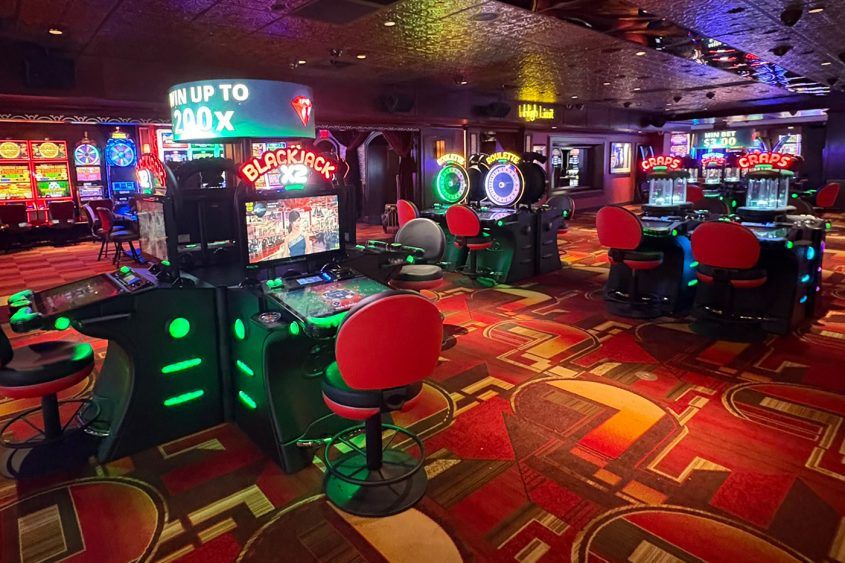
The feel and sound of chips simply can’t be replicated.
The chaos of chips at a hot craps table is one of the most magical things about the casino experience.
Poker players ruffling chips is mesmerizing. Splashing the pot, while irritating, was absolutely iconic in “Rounders.”
Carpet-bombing chips onto a roulette table is the ultimate expression of optimism and civil disobedience against logic and math.
We can’t wait to chat with all the chip fanatics at the World’s Largest Collectibles Show. They get it. They get what’s been lost. They get why we need to hold onto every vintage chip and swizzle stick and showgirl thong and cocktail napkin and matchbook we can consensually get our hands on.
Sometimes, the smallest souvenirs carry the biggest memories.
Nobody’s ever going to host a convention for people who collect QR codes.





Leave your thoughts on “Vanderpump Hotel Chip Reveal Provides Excuse to Mansplain Everything About Casino Chips”
10 Comments